

1. Why ThermoWood Rainscreen Systems Stand Out for Contemporary Design
Contemporary architecture in San Antonio demands materials that perform as thoughtfully as they design. Rainscreen systems using thermally modified wood deliver exactly that: weather resilience paired with the warm, expressive aesthetic that defines modern luxury homes. We’ve watched architects and builders struggle to find cladding that balances durability, fire compliance, and visual sophistication. ThermoWood solutions eliminate that compromise.
Thermally modified wood represents a fundamental shift in how we think about exterior cladding. Unlike standard lumber, which moves, shrinks, and weathers unpredictably, thermally modified wood siding undergoes a heat treatment process that alters its cellular structure. The result is wood that resists cupping, twisting, and dimensional change while maintaining the authentic grain and warmth that architects like Lake|Flato specify.
Rainscreen design amplifies these benefits. By creating a ventilated air gap behind the cladding, rainscreens manage moisture independently of the wall cavity, extending wood life and protecting the structural assembly. This separation is critical in San Antonio’s climate, where summer humidity and periodic rain can trap moisture behind traditional installations. When you pair a rainscreen cavity with thermally modified wood, you’re not simply protecting a wall. You’re future-proofing a design statement.
What sets us apart: We don’t just supply thermally modified wood. We provide guidance on system integration, fire ratings, and profile selection so your specification arrives site-ready and code-compliant.
2. Thermally Modified Ash: Durability Without Compromise
Thermally Modified Ash represents our top choice for architects seeking a material that performs like a hardwood while delivering the refined appearance of softwood. The heat treatment process transforms Ash’s grain into a consistent medium tone with subtle figure that photographs beautifully and ages gracefully.
The durability numbers matter here. Thermally Modified Ash achieves roughly the same decay resistance as naturally durable species like Cedar, but without the knots, checking, or color variation that can undermine a cohesive design. In rainscreen applications, this means consistent weathering patterns across the facade and predictable maintenance cycles. The wood resists checking even in San Antonio’s temperature swings, and the modified cell structure prevents the cupping that plagues untreated softwoods.
Specify Ash for commercial residential blends, luxury additions, or feature walls where visual continuity is non-negotiable. Use it in 5/4 or 6/4 thicknesses for cladding applications. Pair it with horizontal or vertical grain profiles depending on whether you’re emphasizing shadow lines or visual calm.
Your next step: Request samples in both smooth and hand-planed finishes to evaluate how Ash responds to your site’s light angles and surrounding materials.
3. Thermally Modified Pine: Cost-Effective Performance for Modern Homes
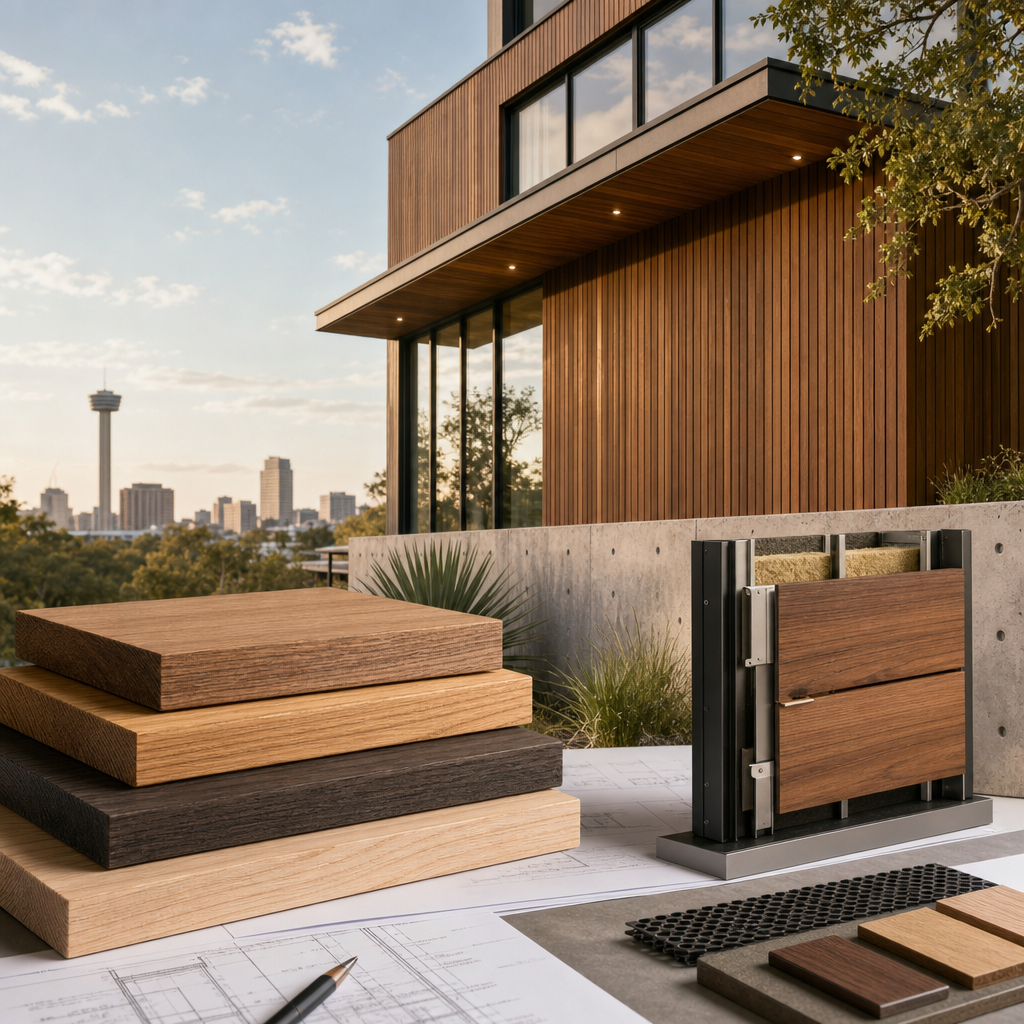
Where Ash serves the luxury market, Thermally Modified Pine delivers value-driven performance without aesthetic compromise. Pine’s rapid growth and lower density mean it planes and profiles beautifully, and the thermal modification process ensures the same stability as its pricier counterparts. For architects working with custom home builders on budget-conscious projects, Pine opens doors that standard lumber keeps closed.
The affordability advantage is meaningful. A 1000 linear foot rainscreen wall in Thermally Modified Pine costs roughly 30-40% less than Cedar equivalents while outperforming Cedar in dimensional stability. This price delta lets builders allocate budget toward other material expressions: more glass, better hardware, or additional detailing in stone or metal.
Pine’s grain pattern is fine and relatively uniform, so it accepts stain and finish systems predictably. We frequently specify it in natural finishes that gray naturally over five to seven years, creating the weathered aesthetic that San Antonio homeowners increasingly favor. Alternatively, specify finish-grade Pine with clear coat protection to maintain a warm honey tone indefinitely.
Action item: Compare Pine cost-per-linear-foot against Cedar and Hemlock in your preferred profile. The savings compound rapidly on larger projects.
4. Thermally Modified Poplar: Lightweight Solutions for Complex Geometries
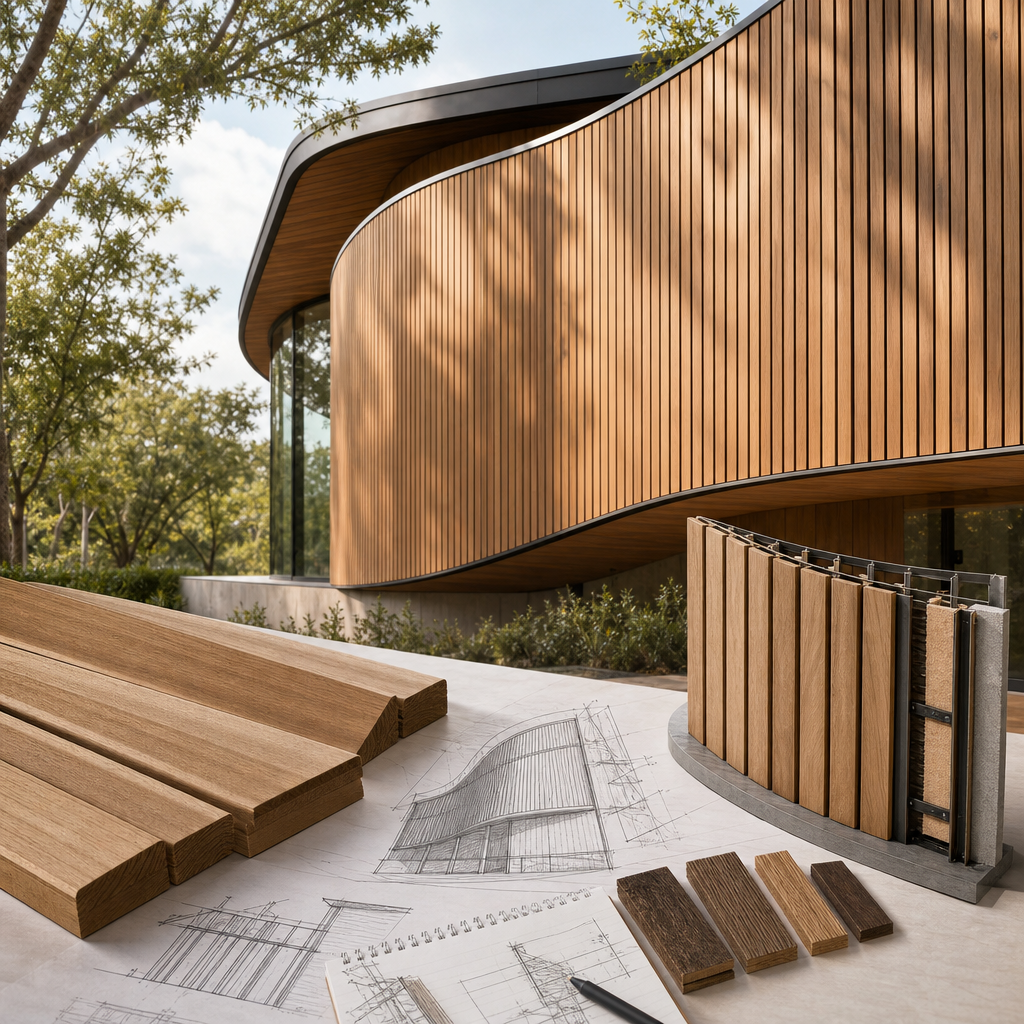
San Antonio’s contemporary architects frequently design curved cladding, angled rainscreens, and sculptural facades that demand material flexibility. Thermally Modified Poplar excels here. Poplar’s uniform, fine grain and lower density make it the easiest thermally modified wood to machine, bend, and profile into non-standard dimensions.
Poplar has earned undeserved skepticism in exterior applications, but thermally modified Poplar is categorically different from untreated stock. The heat treatment increases its janka hardness and decay resistance substantially. In rainscreen systems where airflow manages moisture, Poplar performs reliably even in humid conditions.
The real advantage emerges on complex projects. If your design incorporates curved soffit panels, angled cladding runs, or integrated timber screens, specify Poplar for machinability without sacrificing performance. Its pale, neutral tone also accepts custom stains exceptionally well, letting you match Poplar runs to adjacent Cedar or Ash elements seamlessly.
Practical consideration: Use Poplar for accent elements and curved details while anchoring the primary facade in Ash or Pine. This layered approach balances budget, performance, and design coherence.
5. Class A Fire-Rated ThermoWood Options for San Antonio Building Codes
San Antonio’s WUI (Wildland-Urban Interface) classifications and local fire codes increasingly mandate Class A fire ratings for exterior wood finishes. Many architects assume this requirement eliminates authentic wood cladding, forcing them toward composite materials. That’s simply false.
We supply thermally modified wood products pre-treated to achieve Class A fire ratings through specialized thermal and chemical processes. These products maintain the grain, finish quality, and weathering characteristics of standard ThermoWood while meeting ICC-ES certification and SAFETi testing standards. Thermally Modified Ash and Pine both qualify for Class A ratings when specified correctly.
The distinction matters: Class A fire-rated ThermoWood isn’t treated wood in the traditional sense. It’s not pressure-treated lumber or chemically soaked material. The thermal modification process itself creates the fire resistance. This means you avoid the green tones, surface degradation, and maintenance concerns associated with fire-retardant coatings.
For any project within San Antonio’s fire-prone corridors or hill country properties, specify Class A ThermoWood from the start. It eliminates redesign cycles and ensures compliance without aesthetic compromise.
Verification step: Always confirm your local AHJ’s acceptance of thermally modified Class A products before finalizing specifications. San Antonio-area jurisdictions typically embrace these materials, but documentation streamlines permitting.
6. Ventilation and Moisture Management in Rainscreen Installations
Rainscreen performance depends entirely on installation discipline. We see architect-specified systems fail not because the material was wrong, but because ventilation assumptions went unverified in the field.
A properly functioning rainscreen maintains a minimum 1-inch air cavity behind cladding, with clear pathways for air movement. Specify battens or furring strips at standard intervals (typically 16 or 24 inches on center) and ensure that air can flow horizontally along the sheathing. Vertical drainage planes should direct water downward without pooling. Weep holes at the base, screened inlets at the bottom, and clear exits near the roofline complete the system.
The cavity width matters more than most builders realize. A 1-inch gap provides adequate ventilation for most ThermoWood applications. Thicker gaps (2 inches or more) don’t improve performance proportionally and waste material. Thinner gaps restrict airflow and defeat the system’s moisture-management purpose.
Pair rainscreen design with quality house wrap or intelligent moisture barriers. We recommend specifying Class A fire-rated barriers in San Antonio applications to ensure the entire assembly meets code requirements.
Installation verification: Require your builder to submit a rainscreen detail drawing to your team for approval before framing begins. Catch ventilation oversights during design review, not in the field.
7. Specifying the Right Finish Profile for Your Architectural Vision
Profile selection transforms how light interacts with your facade and influences installation labor, cost, and long-term maintenance. This decision belongs in your hands, not the lumberyard’s.
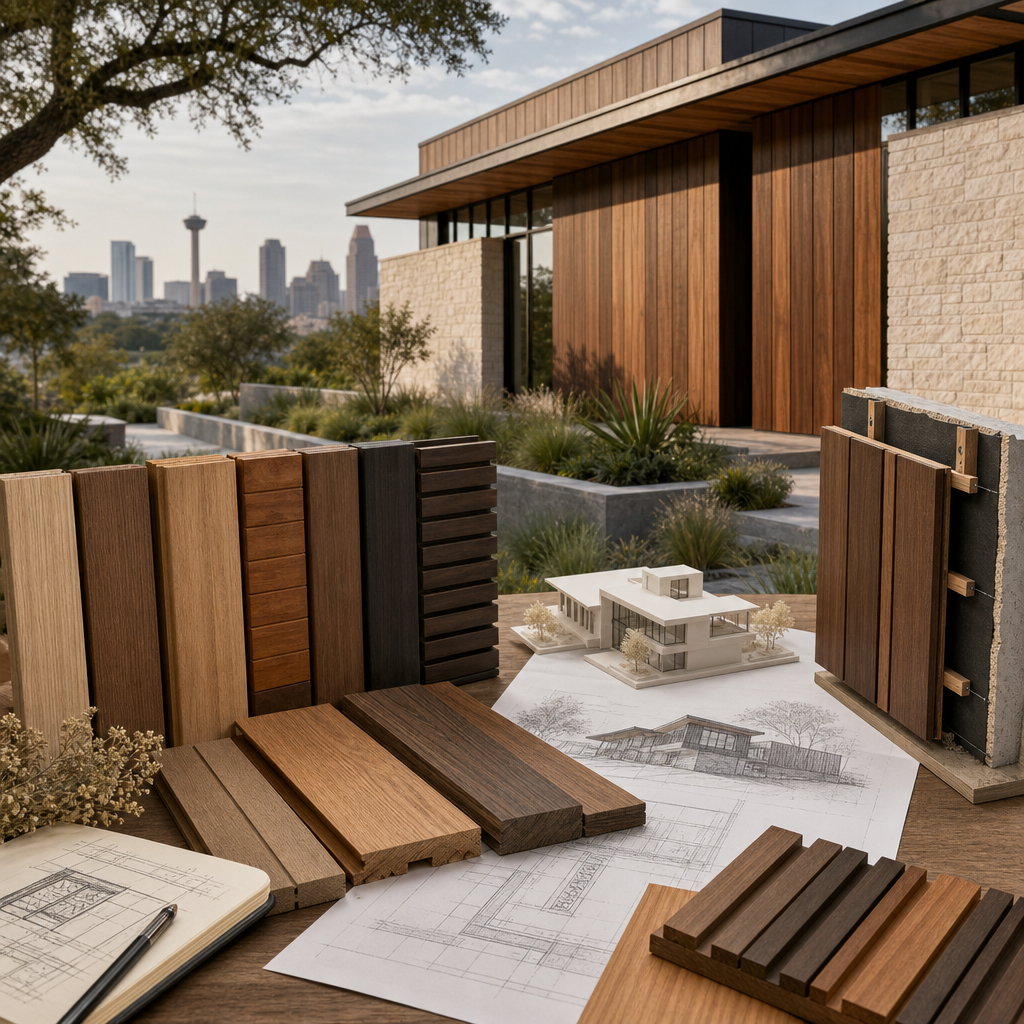
Smooth-surface profiles emphasize grain figure and deliver a refined, contemporary aesthetic. They’re ideal for designs with strong geometric forms or minimal additional detailing. Hand-planed or wire-brushed profiles introduce texture and visual depth, making facades feel more tactile and forgiving of weathering variation. Fluted or comb profiles introduce dramatic shadow lines that evolve with sun angle throughout the day.
We stock Arborwood cladding and custom profiles in all thermally modified wood species. Our in-house milling capability means you’re not limited to standard profiles. If your design calls for a specific dimension, thickness, or surface treatment, we engineer and produce it.
Thickness selection carries weight too. Thicker material (6/4 or 8/4) delivers visual presence and reduced maintenance. Thinner stock (5/4 or 4/4) reduces cost and simplifies installation while still performing reliably in rainscreen systems. Your budget, scale, and architectural intent should guide the choice.
Final specification decision: Submit your profile, species, grade, and finish requirements to us for sample production and mockup evaluation. Seeing your chosen wood in actual light and adjacent materials transforms abstract selections into confident architectural decisions.
To place orders, order samples, or talk with a live person.
Frequently Asked Questions (FAQ)
What thermally modified wood options do we stock for San Antonio rainscreen projects?
We supply Thermally Modified Ash, Pine, Poplar, and Ayous in profiles designed specifically for rainscreen applications. Each material offers distinct advantages: our Ash provides superior durability and color stability, Pine delivers cost efficiency without sacrificing performance, and Poplar works exceptionally well for architects pursuing complex geometric wall designs. All our thermally modified inventory meets the moisture and dimensional stability requirements that rainscreen systems demand in the San Antonio climate.
Do we carry Class A fire-rated wood products that comply with San Antonio building codes?
Yes, we stock a complete line of WUI Class A fire-rated wood products for siding, cladding, decking, and fencing. Our fire-rated options work seamlessly within rainscreen assemblies and meet the specific code requirements for San Antonio and surrounding Texas jurisdictions. We can help you specify the right fire-rated material that maintains the architectural expression your design requires.
How do we support proper ventilation and moisture management in your rainscreen installation?
We provide materials engineered for rainscreen performance, but our role is supplying the wood components that work within properly designed ventilation cavities. We recommend collaborating with your building science consultant or contractor to ensure your rainscreen assembly includes appropriate air gaps and drainage planes. Our team can discuss how our specific products integrate into ventilated wall systems and answer technical questions about material compatibility with common rainscreen details.


