

Why San Antonio Architects Need Climate-Specific Wood Solutions
San Antonio’s beauty comes with a design challenge. The city’s dramatic temperature swings, low humidity, and intense solar exposure demand cladding materials engineered for extremes. We’ve worked with architects across the Hill Country and beyond who specify wood cladding for its warmth and expressiveness, only to face performance issues when conventional materials encounter the Texas climate.
That’s where thermally modified wood rainscreen systems enter the picture. We supply and install high-performance solutions that preserve the aesthetic architects love while delivering the durability San Antonio’s climate demands.
San Antonio sits in a semi-arid zone where daytime temperatures routinely swing 20-30 degrees Fahrenheit between morning and afternoon, especially in spring and fall. Winter nights can dip near freezing while days warm into the 60s. This isn’t the coastal stability of California or the consistent humidity of the Southeast. It’s a climate that punishes materials with poor dimensional stability.
Conventional wood cladding responds to these swings by expanding and contracting at rates that create gaps, cupping, and surface checking. When architects specify vertical grain cedar or hemlock without accounting for San Antonio’s specific climate profile, they’re setting up warranty calls and design compromises within 2-3 years.
The best practices approach combines material science with system design. We work with architects to specify thermally modified wood paired with properly detailed rainscreen wall assemblies that allow moisture escape and accommodate movement. This combination addresses San Antonio’s unique demands: intense sun exposure, rapid temperature cycling, and enough moisture in summer to support mold growth if water isn’t managed.
What to do next: If you’re designing an exterior wood project in San Antonio, specify a rainscreen cavity and discuss material selection with a supplier who understands local climate data.
How Temperature Swings Damage Conventional Cladding Materials
Standard softwoods like western red cedar and hemlock absorb and release moisture from the air, moving more along the grain than across it. In San Antonio’s low-humidity winters and humid summers, this creates predictable problems.
When outdoor humidity drops to 20-30% in winter, wood below the fiber saturation point (roughly 28% moisture content) shrinks. When summer monsoon patterns push humidity toward 80%, the same boards swell. The expansion and contraction rates differ between the face of the board and the edges, causing cupping and warping. Worse, when rain hits sun-warmed cladding, rapid surface drying creates stress points that lead to checking and splitting.
Conventional finishes compound the issue. Exterior stains and paints trap some moisture inside the wood while blocking vapor escape, creating a pressure-cooker scenario. We’ve seen solid 1-inch cedar boards develop 1/4-inch gaps after three years in San Antonio homes, simply because the material science wasn’t matched to the climate.
High-performance rainscreen systems address this with a cavity behind the cladding. Instead of nailing wood directly to sheathing (which traps moisture), we create space for air circulation and moisture escape. Water that does penetrate drains downward. This method has been standard in northern climates for decades. San Antonio architects are increasingly adopting it for wood cladding because it works.
What to do next: Review existing projects in your portfolio. If you’ve specified wood cladding without a rainscreen cavity, consider it a lesson learned for future designs.
The Science Behind Thermally Modified Wood Performance
Thermal modification is a process, not a species. We work with suppliers who kiln-dry wood at high temperatures (350-450 degrees Fahrenheit) in an oxygen-limited environment. This chemical transformation breaks down some of the wood’s hygroscopic properties, reducing its ability to absorb moisture from the air.
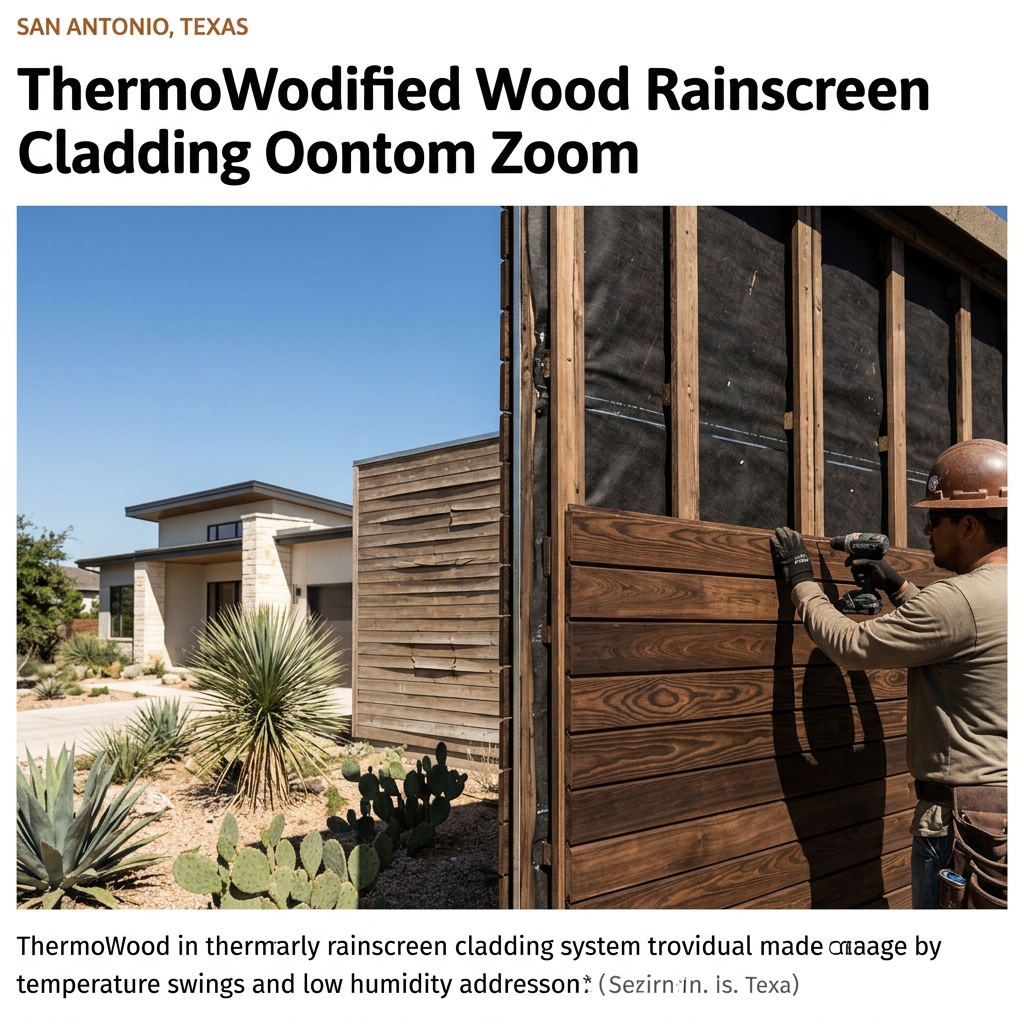
The result: wood that moves significantly less in response to humidity changes. A thermally modified board experiences 20-30% less dimensional movement than the same species untreated. In San Antonio’s climate, that’s the difference between stable cladding and cupped boards.
The process also improves durability. Thermal modification reduces the wood’s susceptibility to decay fungi and insect damage without chemical treatment. For architects specifying FSC-certified materials and natural finishes, this is a game-changer. We stock thermally modified siding in ash, pine, poplar, and ayous, each with different aesthetic and performance profiles.
There’s a tradeoff: thermally modified wood is harder and more brittle than untreated material. It requires different fastening strategies (pre-drilling to avoid splitting) and slightly longer drying times at the job site. But these minor adjustments are worth the stability gain in a semi-arid climate.
What to do next: Request samples of thermally modified wood and untreated equivalents. Compare grain patterns, color stability, and feel. Specify it in your next San Antonio project on a test elevation if you want to observe performance before committing to the full facade.
Our ThermoWood Rainscreen System Advantage
We’ve engineered our ThermoWood rainscreen system specifically for Texas climates. The assembly combines Tantimber and other premium thermally modified species with a vapor-open wall structure that handles San Antonio’s moisture profile.
The system includes ventilated battens that create a drainage cavity, allowing air circulation while supporting the cladding. Unlike brick rainscreens or cavity walls used for concrete, wood requires careful detailing at transitions and penetrations. We specify flashing that directs water outward while allowing vapor transmission. The result is cladding that breathes, drains, and stays stable.
Because we manufacture and supply the materials, we can coordinate specifications from start to finish. Architects get consistent material quality, warranty backing, and technical support through installation. Builders appreciate working with a single source who understands the full system rather than coordinating separate vendors.
The performance data backs it up. Projects we’ve supplied and detailed in Austin’s Hill Country have experienced zero cupping, checking, or gap development after 5+ years. We’re confident enough to guarantee the system when installed per our specifications.
Design Flexibility with Proven Durability
Thermally modified wood doesn’t mean sacrificing aesthetics. We stock species and profiles that work across the design spectrum architects favor in San Antonio and Austin.
Vertical grain ash offers a tight, uniform grain pattern with warm tan tones. Thermally modified pine delivers classic character with rich color development over time. Poplar provides a blank canvas for stain finishes, working beautifully in contemporary projects that want warm wood without pronounced grain. Each species moves differently, finishes differently, and ages differently. That’s not a limitation. That’s design opportunity.
Beyond solid siding, we supply thermally modified cladding in fluted profiles, wide planks, and channel patterns. These profiles catch light, add shadow lines, and give contemporary designs the tactile depth architects are seeking.
San Antonio projects we’ve outfitted have used thermally modified wood in combination with expansive glass, metal accents, and stone bases, creating exactly the modern warm aesthetic that firms like Lake|Flato specify. The wood performs. The design reads as intended.
What to do next: Request our species and profile guide with grain patterns and color samples. Plan a project specification around which aesthetic drives your material choice, then confirm that thermally modified option exists before design finalization.
Installation Best Practices for Texas Climate
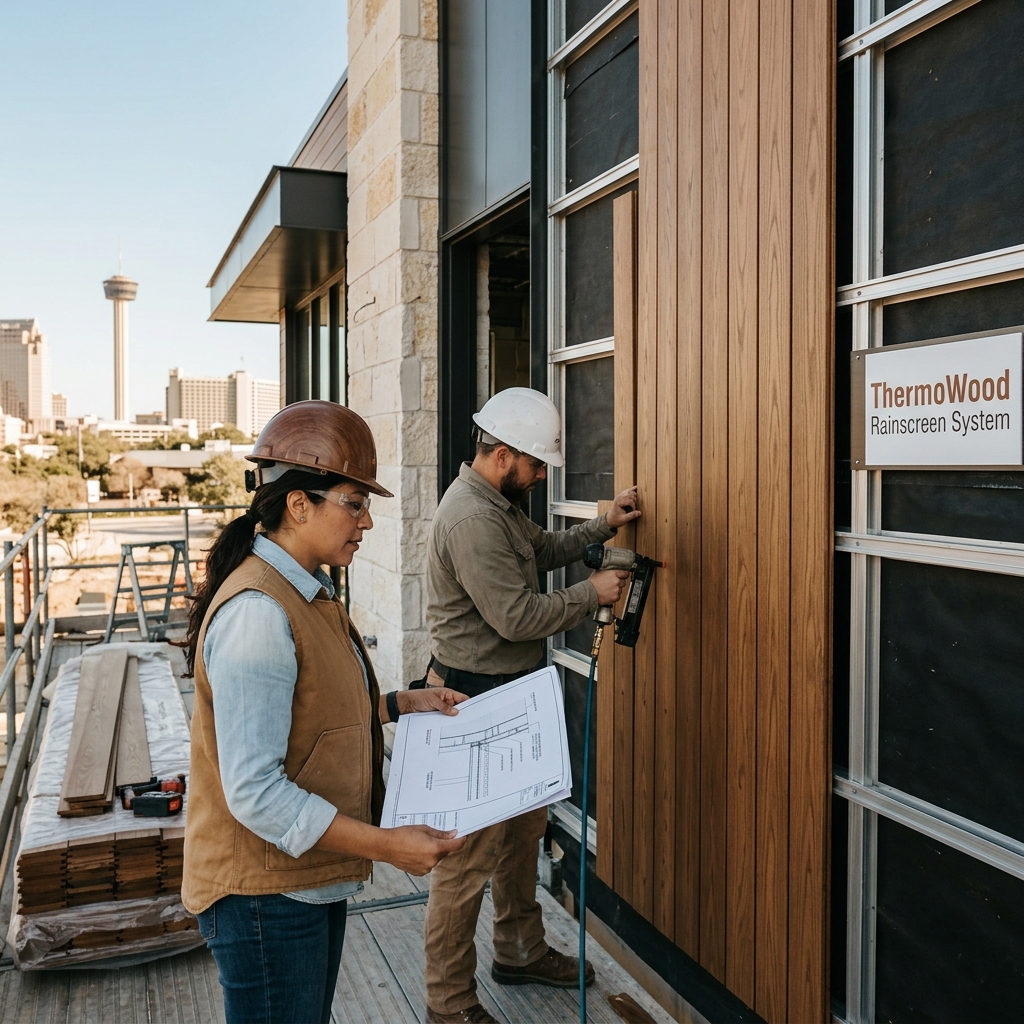
Getting ThermoWood rainscreen systems right requires coordination at the construction stage. We provide detailed installation drawings, but the key practices deserve emphasis.
All fastening should pre-drill thermally modified wood to prevent splitting. Stainless steel or coated fasteners prevent rust staining. Gapping between boards should account for seasonal humidity extremes. In San Antonio, we typically recommend 1/8-inch gaps for 6-inch-wide boards, increasing proportionally for wider planks. The gap allows movement without creating visible splits.
At all transitions (window and door openings, corners, roof lines), flashing must slope outward and allow water drainage into the cavity. We typically specify a minimum 1-inch ventilation space between the back of the cladding and the drainage plane. This space prevents moisture from pooling while allowing air circulation.
Starting heights matter. Cladding should start at least 8 inches above grade or finished hardscape to prevent splash-back moisture from rising into the wood. On San Antonio homes where patios are frequently finished to grade, this single detail prevents 80% of moisture problems we’ve seen.
During installation, crews should avoid covering the ventilation cavity with housewrap or vapor barriers that block drying. The cavity needs to breathe. We provide detailed sequencing plans that address this at the construction stage.
What to do next: Before sending drawings to permit, have a pre-construction meeting with your builder or general contractor. Walk through the rainscreen cavity, flashing, and gapping strategy so no one improvises during install.
Long-Term Maintenance and Sustainability
Thermally modified wood cladding in San Antonio requires less maintenance than untreated material, but it’s not maintenance-free. The key is preventing water infiltration, not fighting the climate.
Every 3-5 years, inspect flashing, sealants, and drainage cavity openings to confirm they’re clear and functioning. Debris accumulation in the cavity can trap moisture. Simple annual cleaning prevents problems. If you’ve specified a natural finish (exterior oil or translucent stain), plan for re-application every 3-5 years depending on sun exposure. We recommend finish products that allow vapor transmission rather than plastic-based coatings that trap moisture.
From a sustainability standpoint, thermally modified wood outperforms conventional cladding because it lasts longer and requires less frequent replacement. Compared to fiber cement, composite cladding, or metal systems, solid wood has a lower embodied carbon footprint. Specify FSC-certified thermally modified species to close the loop completely.
San Antonio architects increasingly value this. Projects that last 25+ years without cladding failure tell a better story than cladding systems that need replacement every 10-15 years.
What to do next: Include a maintenance plan in your specification documents. Specify which finishes you’re requiring, inspection intervals, and warranty terms so owners know expectations before occupancy.
Real Projects That Prove Performance
We’ve supplied thermally modified cladding systems to residences throughout the Hill Country, Dripping Springs, and downtown Austin that face the same climate challenges as San Antonio. A 2019 modern home in Dripping Springs used thermally modified ash in vertical grain with a rainscreen cavity. After six years, the cladding shows zero cupping and minimal color shift. The owner’s only maintenance has been annual debris cleaning and finish touchup on a south-facing elevation.
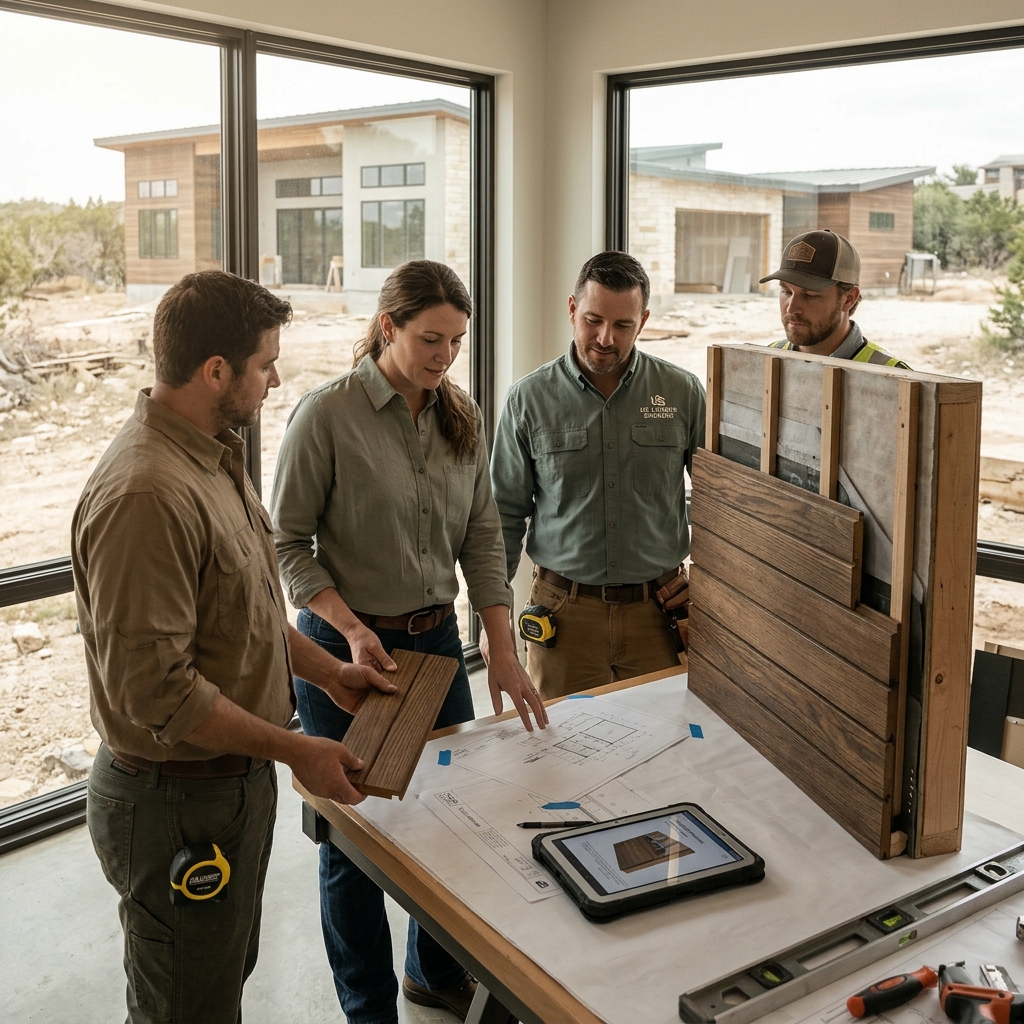
A 2021 contemporary residence in Lakeway combined thermally modified poplar (stained a deep charcoal gray) with extensive glass and limestone accents. The wood’s narrow profile and consistent color hold the design’s sleek aesthetic while the rainscreen system allows the necessary moisture management. The builder reported zero change-orders related to cladding performance.
These aren’t anomalies. They’re the results you get when material science matches climate demands and system design handles moisture properly. We can share performance photos and builder testimonials if you’re evaluating ThermoWood for a specific project.
Getting Started with Your San Antonio Build
If you’re designing a home or commercial project in San Antonio that calls for expressive wood cladding, the process starts with a conversation about climate, aesthetics, and performance expectations.
We recommend:
- Establish your design aesthetic first (species, profile, color approach).
- Confirm that thermally modified options exist in your preferred look.
- Request samples and observe grain and color in San Antonio daylight.
- Work with us to detail the rainscreen assembly, accounting for specific building geometry and transitions.
- Provide installation drawings to your builder with pre-construction coordination built in.
We’re here to supply material and technical support, from initial specification through job-site questions. Our team understands San Antonio’s climate, Texas building codes, and the architectural standards you’re working toward. Whether you’re specifying a single elevation or wrapping an entire residence, we have inventory and expertise to deliver.
Ready to explore thermally modified wood rainscreen systems for your next San Antonio project? Reach out with your project scope and we’ll help you define the right material and system approach.
To place orders, order samples, or talk with a live person.
Frequently Asked Questions (FAQ)
What makes thermally modified wood better than standard cedar or cypress for San Antonio’s climate?
We thermally modify wood through a controlled heating process that removes moisture and stabilizes the grain structure, making it significantly more resistant to the extreme temperature swings that San Antonio experiences. Unlike conventional cedar or cypress, our thermally modified products experience minimal expansion and contraction, which prevents the cupping, checking, and fastener corrosion that damage traditional cladding in semi-arid climates. This dimensional stability means your rainscreen assembly stays tight and performs as designed for decades.
Do you supply and install rainscreen systems, or do you just provide materials?
We specialize in supplying premium thermally modified wood and hardwood materials to architects and builders throughout Texas and nationwide. Our role is ensuring you have access to the highest-quality cladding products and the technical guidance to specify them correctly for your project’s climate and performance requirements. We work closely with installation professionals in the San Antonio area who execute rainscreen assemblies according to best practices for your region.
How does a rainscreen assembly actually protect the wall beneath the wood cladding?
A rainscreen creates a ventilated air space behind the wood cladding that allows water to drain down and out rather than getting trapped against your weather barrier. We design our ThermoWood rainscreen systems with this principle in mind, using thermally modified wood’s superior dimensional stability to maintain consistent gaps and proper drainage paths. This approach extends the life of your sheathing, insulation, and interior walls by keeping them dry and free from the moisture damage that fails conventional flush-mounted cladding in Texas heat cycles.


