

The Challenge of Finding Consistent Poplar Trim for High-End Projects
When you’re designing a contemporary home that demands clean lines, warm wood tones, and flawless finishes, poplar trim becomes essential. Yet sourcing consistent, high-grade poplar paint-grade material across an entire project is harder than it should be. Most standard lumber suppliers treat trim as commodity inventory, stocking what moves quickly rather than what meets architectural specifications.
The real problem isn’t availability—it’s consistency. Poplar varies significantly in grain structure, color, and dimensional stability depending on origin and processing. A trim order split between two suppliers often arrives with noticeable differences in finish quality, stain acceptance, and movement characteristics. For architects accustomed to specifying materials with precision, this unpredictability creates costly delays and compromise on vision.
We’ve built our business around solving exactly this problem. Our relationships with premium poplar mills give us access to material graded specifically for paint applications, with tighter tolerances and more reliable performance than general-purpose stock.
Action step: Before your next trim specification, request samples from potential suppliers. Compare grain consistency, surface finish quality, and how different stains absorb across samples from the same supplier lot.
Why Poplar Paint-Grade Trim Matters for Contemporary Architecture
Poplar occupies a unique position in architectural woodwork. It’s dimensionally stable, machines beautifully for complex moulding profiles, and accepts paint and stain with exceptional evenness. Unlike harder species that can show grain variation or resist finish coats unevenly, poplar provides the neutral canvas contemporary design requires.
For the contemporary aesthetic your projects embody, poplar serves a specific purpose. It supports clean architectural lines without competing for visual attention through dramatic grain patterns. When paired with expansive glazing and minimalist interiors, subtle wood trim grounds the space without overwhelming it. The wood presence remains warm and human-scaled without dominating the composition.
Paint-grade poplar also performs better than paint-grade softwoods in stable interior environments. Its lower density means fewer dents from installation and handling, and its cell structure accepts filler and primer more uniformly, resulting in smoother final surfaces. This translates to fewer callbacks and punch-list items.
Action step: Specify paint-grade poplar in your interior trim schedules, noting finish requirements (primer-ready versus pre-primed). This clarity prevents last-minute material substitutions.
Sourcing Challenges Architects Face with Standard Lumber Suppliers
Generic lumber yards don’t invest in the infrastructure required for specialty trim sourcing. Their suppliers operate on high-volume, low-margin models where custom orders or tight grading specifications don’t fit the business model. You either accept their available stock or wait months for special orders, often at premium pricing.
The sourcing friction shows in real projects: trim arrives with surface defects requiring sanding and refinishing on-site (adding labor), grain variation forces contractors to adjust stain schedules mid-project, or dimensional inconsistencies require shimming that undermines finish quality. Each issue multiplies costs and delays.
Beyond material challenges, generic suppliers rarely understand architectural intent. When you specify “paint-grade poplar mouldings with continuous grain matching,” most suppliers interpret this as generic trim and deliver whatever similar-looking profile happens to be in stock. The disconnect between specification and delivery creates unnecessary back-and-forth.
We work differently. Our team includes specialists who understand architectural drawings, specification language, and the material science behind finish performance. When you contact us with your trim requirements, you’re speaking with people who grasp why your specifications matter.
Action step: Establish a pre-project conversation with your material supplier. Walk them through your finish schedule, site conditions, and installation timeline before finalizing orders.
How We Supply Matched Mouldings That Meet Architect Specifications
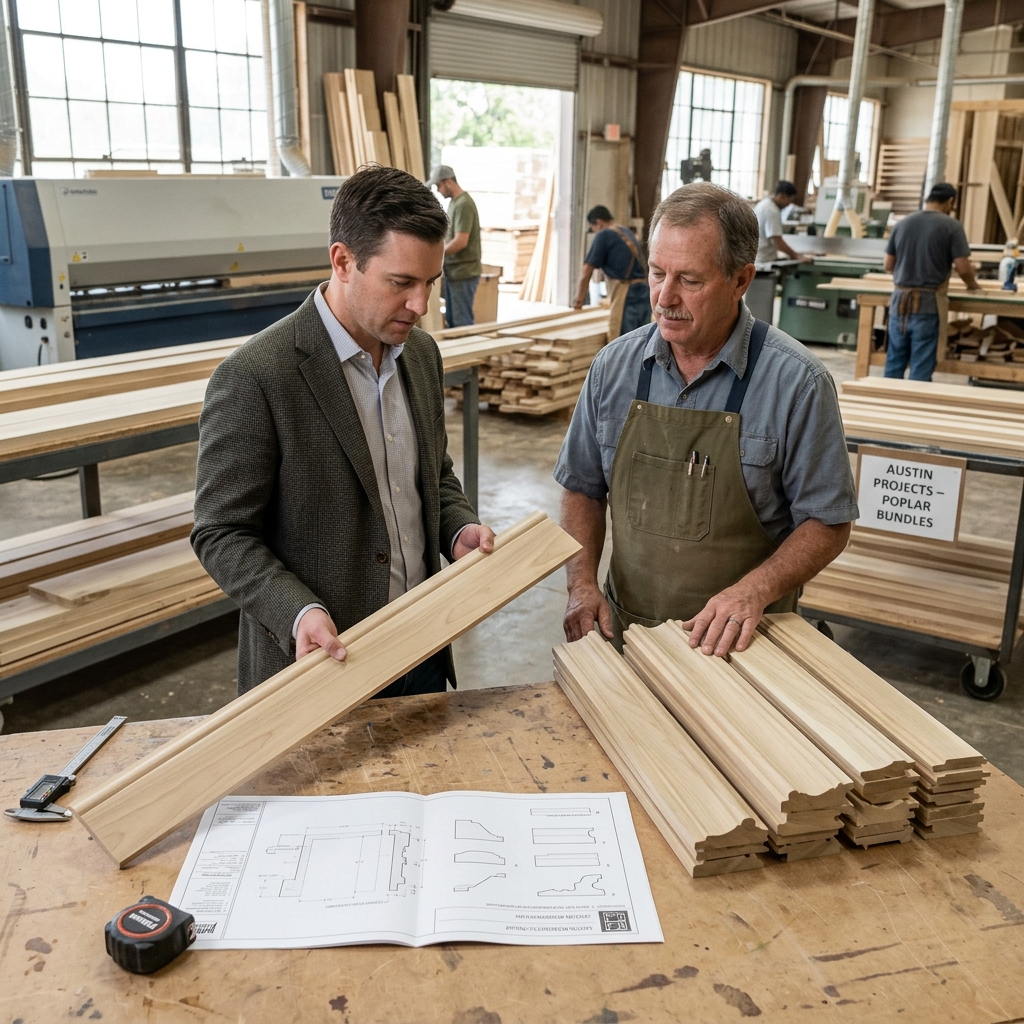
Our sourcing process starts with understanding your complete project requirements. We review your architectural specifications, finish schedules, and design intent before recommending material. This isn’t about selling what’s convenient—it’s about delivering what serves your design.
For matched moulding sets, we coordinate with mills that can supply coordinated profiles from the same production run. This ensures consistent color, grain structure, and finish characteristics across all trim elements. Rather than hoping multiple shipments happen to match, we guarantee it.
We maintain relationships with mills producing premium paint-grade poplar in the specific profiles architects most commonly specify: colonial mouldings, contemporary flat-panel trims, and custom profiles for distinctive architectural moments. When a profile doesn’t exist in our current inventory, we access mill resources to produce it, typically within 2-3 weeks for standard runs.
Our role extends beyond order fulfillment. We flag potential issues before they reach your job site. If a finish schedule seems incompatible with site conditions (high humidity, extreme temperature swings), we recommend adjustments that preserve your design intent while ensuring performance. If we identify a specification that might create challenges during installation, we communicate early so plans can adjust.
Action step: Request a material sample pack from our team before finalizing specification. This allows finish verification and installation validation with your general contractor.
Our Poplar Inventory and Customization Capabilities
We stock paint-grade poplar in the profiles most commonly requested by Texas architects: standard 5/4 trim stock, 1×12 boards for continuous wall applications, and coordinated moulding sets. Our current inventory includes over 40 different profile configurations, with quick turnaround on additional profiles through our mill network.
Beyond standard widths and profiles, we support custom applications. If your design requires poplar with specific moisture content, pre-priming, or custom surfacing (wire-brushed, sand-blasted, or hand-distressed), we coordinate directly with mills to deliver exactly what your project needs.
Thickness tolerance is another dimension we control carefully. Standard lumber yards accept industry-standard thickness variation (plus-or-minus 1/16″). For applications where your trim mounts to precise backing or requires consistent reveals, we source material graded to tighter tolerances, ensuring smooth installation and professional finished appearance.
We also maintain inventory of complementary materials—hardwood fillers that match poplar grain, high-quality primer formulated for poplar applications, and finishing products that ensure your specified paint or stain performs as designed. This integrated approach means you’re not cobbling together materials from multiple suppliers.
Action step: If your project requires custom profiles or dimensions, contact us 4-6 weeks before your material delivery deadline. This timeline allows mill coordination and prevents compressed schedules.
Quality Standards We Maintain for Paint-Grade Applications
Our quality standards reflect our understanding that trim is architectural detail, not commodity. We grade every shipment against paint-grade standards that exceed industry minimums: tight knot specifications, minimal surface defects, consistent grain structure, and verified moisture content.
Surface finish quality matters particularly for paint applications. We inspect for surface planing irregularities, raised grain, and fuzzy grain that would require additional sanding. Material arrives ready for finishing, not requiring on-site remedial work.
We also verify dimensional stability. Poplar with high interior stress (residual tension from manufacturing) can warp after installation. Through our mill relationships, we source material from mills using kiln practices that minimize residual stress, ensuring your trim remains flat and stable once installed.

Documentation accompanies every order. We provide material certifications confirming grade, moisture content, and milling standards. This documentation supports your specification compliance and provides contractors with clear reference points during installation.
Action step: Include material certification requirements in your specifications. This ensures suppliers maintain documented quality standards rather than relying on verbal assurances.
Regional Availability Across Texas for Your Projects
We serve projects throughout Texas and all 50 states, with particular depth across the Texas regions where contemporary residential architecture thrives: Austin, Dallas, Houston, San Antonio, the Hill Country, and surrounding communities. Our logistics infrastructure ensures consistent, predictable delivery regardless of project location.
For Austin-area projects, we offer local pickup and can often coordinate same-week delivery for in-stock items. For projects across Texas or nationally, we work with vetted freight partners who handle specialty lumber with appropriate care, delivering trim in condition ready for immediate installation.
Our regional familiarity includes understanding local climate conditions. Texas humidity and temperature variation create specific finish challenges. We recommend material specifications and finishing products optimized for your project’s geographic context, preventing the movement and performance issues that arise when materials are specified without site-climate consideration.
Action step: Contact us early with your project timeline and location. We’ll confirm material availability and delivery logistics before you finalize your design specifications.
Sustainability and FSC Certification in Our Poplar Selection
Contemporary architecture increasingly incorporates sustainability as a design principle, not an afterthought. Our sustainability practices reflect this commitment. We supply FSC-certified poplar products, ensuring your trim sourcing supports responsible forest management.
FSC certification provides third-party verification that material originates from forests managed to rigorous environmental, social, and economic standards. For architects seeking to align material choices with design values, FSC certification offers documented accountability.
Poplar itself supports sustainability objectives. It grows faster than many hardwoods, requires fewer resources to process into finished trim, and machines efficiently (minimal waste during moulding production). Paired with responsible sourcing practices, poplar represents a material choice aligned with contemporary values.
We track chain-of-custody documentation for certified materials, ensuring your specifications can be verified and your project documentation supports any sustainability certifications you’re pursuing (LEED, Passive House, or internal firm standards).
Action step: If your project requires certified material, specify FSC certification in your trim schedule. This ensures suppliers source accordingly rather than treating it as a last-minute request.
Working with Us: The Sourcing Process for Architects
Our process is straightforward: initial conversation, material sampling, specification coordination, and delivery. The early conversation is crucial. We discuss your design intent, finish schedule, site conditions, and installation timeline. This context informs every subsequent recommendation.
Once we understand your project, we provide material samples and specification language refined through years of successful project delivery. You review samples in your space under your anticipated lighting conditions, confirming performance and finish characteristics match your vision.

We then formalize specifications with your design team and coordinate directly with your general contractor regarding delivery logistics, unloading requirements, and site-specific considerations. Our role continues through installation, with our team available to address any on-site questions from your contractor.
Throughout the process, communication remains transparent. If we identify potential issues, we raise them early. If delivery timelines shift, we notify you immediately rather than allowing surprises at critical project moments.
Action step: Schedule a 20-minute call with our sourcing specialists. They’ll walk through your current project specifications and identify opportunities to improve material performance and specification clarity.
Why US Lumber Brokers is Your Trusted Local Partner
We’ve built our business on serving architects like you: design-driven professionals who view material selection as integral to architectural vision, not a secondary logistical concern. Our team includes specialists with both supply-chain expertise and design understanding. We speak your language because we’ve worked alongside architectural teams for years.
Our inventory depth—from standard paint-grade poplar to thermally modified woods, hardwoods, and composite alternatives—means you can explore material innovation without fragmenting your supply relationships. One conversation accesses our entire resource network.
Texas roots matter. We understand your regional market, your competitive landscape, and the specific architectural traditions that characterize Texas contemporary design. We’ve worked on projects across Austin, Dallas, the Hill Country, and beyond, delivering material that supports your design excellence while maintaining project budgets and timelines.
When you choose us as your trim supplier, you’re accessing a partner invested in your project success. We’re not managing high-volume commodity orders; we’re supporting architects in bringing distinctive designs to life.
Next step: Contact our sourcing team with your current project specifications or material questions. We’ll provide samples, refine recommendations, and coordinate delivery that supports your timeline and vision.
To place orders, order samples, or talk with a live person.
Frequently Asked Questions (FAQ)
What wood species do we stock for paint-grade trim applications?
We maintain robust inventory of premium poplar specifically selected for paint-grade trim and mouldings, which is our primary offering for architectural applications. We also carry complementary species like thermally modified pine and poplar when projects call for alternative paint-grade options. Our poplar sourcing focuses on clear, consistent grading that meets the exacting standards your designs require for seamless trim installations.
How do we ensure matched mouldings across large architectural projects?
We work directly with architects to document specific moulding profiles, dimensions, and grain characteristics needed for each project phase. Our manufacturing capabilities allow us to produce consistent runs of custom or standard profiles, and we maintain detailed records so subsequent orders match exactly. Since we both supply and manufacture, we control the entire process rather than relying on third-party mills, which eliminates the matching inconsistencies you typically encounter with standard lumber suppliers.
Can we source poplar trim for projects across Texas and beyond?
We ship premium poplar paint-grade trim and mouldings throughout Texas and all 50 states, with established relationships supporting projects in Austin, Dallas, Houston, San Antonio, and the Hill Country. Our Texas-based operations mean we understand local climate considerations that affect wood movement and finishing, and we coordinate delivery schedules to align with your project timelines.


