

Why Architects Choose Fluted Paneling for Contemporary Design
Modern Texas architecture demands materials that balance visual warmth with structural integrity. Fluted wall slat paneling has emerged as the preferred choice for architects designing contemporary homes across Austin, Dallas, Houston, and beyond. This expressive wood finish creates the rhythmic depth that defines today’s most admired residential projects while meeting rigorous performance standards for our climate.
We’ve worked with Texas architects for years to specify and deliver fluted paneling systems that transform exteriors and interiors alike. The material choices, installation methods, and durability considerations require expert guidance to ensure your design intent survives weathering, fire codes, and daily use.
Fluted wall slat paneling delivers the warm, tactile aesthetic that contemporary design demands without relying on solid mass. The rhythmic shadow lines created by the flutes add depth and movement to what might otherwise read as a flat surface, making the facade visually dynamic while remaining architecturally restrained.
Your design intent matters here. Unlike conventional siding that disappears into the background, fluted paneling becomes an intentional design element. It frames and emphasizes the building form, particularly when light rakes across the surface at dawn or dusk. This quality aligns perfectly with the Lake Flato and Page design philosophy: creating warm, naturally lit spaces where materials speak clearly.
From a practical standpoint, fluted paneling also offers specification flexibility. You can orient the flutes horizontally for a contemporary lineal expression, or arrange them vertically for a more traditional reading. Architects often use this variation strategically across a single elevation to delineate zones, emphasize entries, or create visual rhythm between living and service areas.
The material also performs well in mixed-material compositions. Pairing fluted cedar paneling with extensive glazing, metal frames, and stone creates the textural contrast that modern residential design requires. We’ve seen projects where fluted wall slat systems become the primary cladding, with glass and masonry playing secondary roles.
Next step: Sketch your primary facade elevation with fluted paneling in your preferred orientation. Determine whether you need consistent flute direction across all elevations or strategic variation to reinforce your design zones.
The Visual Impact of Vertical Grain Slat Systems
Vertical grain lumber creates a visual hierarchy within the flute system itself. Unlike flat-sawn material, vertical grain exhibits tight, parallel growth rings that emphasize linearity and motion along the board length. When combined with fluted profiles, this grain pattern intensifies the directional quality your design is seeking.
The flute geometry matters equally. Deeper flutes cast more pronounced shadows, creating a bolder expression from a distance. Shallower flutes read more subtly and suit projects where you want the grain character to dominate over shadow play. Most contemporary projects use flutes in the 0.5 to 1.5-inch depth range to maintain visual interest without creating maintenance pockets.
Cedar and hemlock both exhibit naturally tight vertical grain when properly milled. The difference lies in color stability and grain visibility. Clear grain vertical cedar shows less color variation over time, reading as a cohesive warm surface that ages gracefully. Hemlock grain is more uniform initially but develops richer character as weathering occurs.
We specify vertical grain systems for projects where the wood itself, not just shadow, should convey warmth and movement. This distinction matters when selecting between different milling standards. Standard vertical grain cuts one face at roughly 45 degrees to the growth rings; clear vertical grain cuts at steeper angles, maximizing the linear grain expression on the exposed surface.
Your architect’s rendering software should account for this vertical grain visibility at your project’s typical viewing distances. Grain that reads beautifully at 10 feet may disappear at 50 feet, changing the visual impact significantly.
Next step: Request full-size samples of your chosen wood species and flute profile milled to vertical grain standards. View them under your project’s typical lighting conditions.
Material Selection: Cedar, Hemlock, and Douglas Fir Options
Clear grain western red cedar remains the most specified option for high-visibility contemporary projects. It delivers warm honey and amber tones that deepen predictably over time, creating the patina that architects love. Cedar’s natural decay resistance means less maintenance, and it works beautifully in Austin’s variable humidity and the Hill Country’s intense UV exposure.
Hemlock offers a cooler, more refined aesthetic. Its pale initial color and tight grain create a sophisticated baseline that pairs exceptionally well with modern metal detailing and glass. Hemlock requires annual sealing in our climate to prevent weathering that can compromise the flute definition, but architects choosing hemlock often view this maintenance schedule as part of the material’s intended expression.
Douglas fir splits the visual difference. Its warm amber undertone matches cedar’s character, but the grain pattern reads more prominently, offering greater visual interest in deeper flute systems. Douglas fir holds paint or stain exceptionally well if your design calls for color, and its structural properties make it suitable for load-bearing applications in hybrid frame systems.
Our inventory includes comb siding specifications across all three species, allowing direct visual comparison. We also stock thermally modified options in ash, pine, and poplar for projects seeking enhanced stability or distinctive color palettes.
Tropical hardwoods like Ipe and Cumaru perform exceptionally well in high-moisture zones, though their dense grain and cost point them toward accent applications rather than full elevation coverage on most residential projects.
Next step: Specify material by species, grade (clear vs. select), and grain orientation. Request samples milled to match your final flute profile and board width.
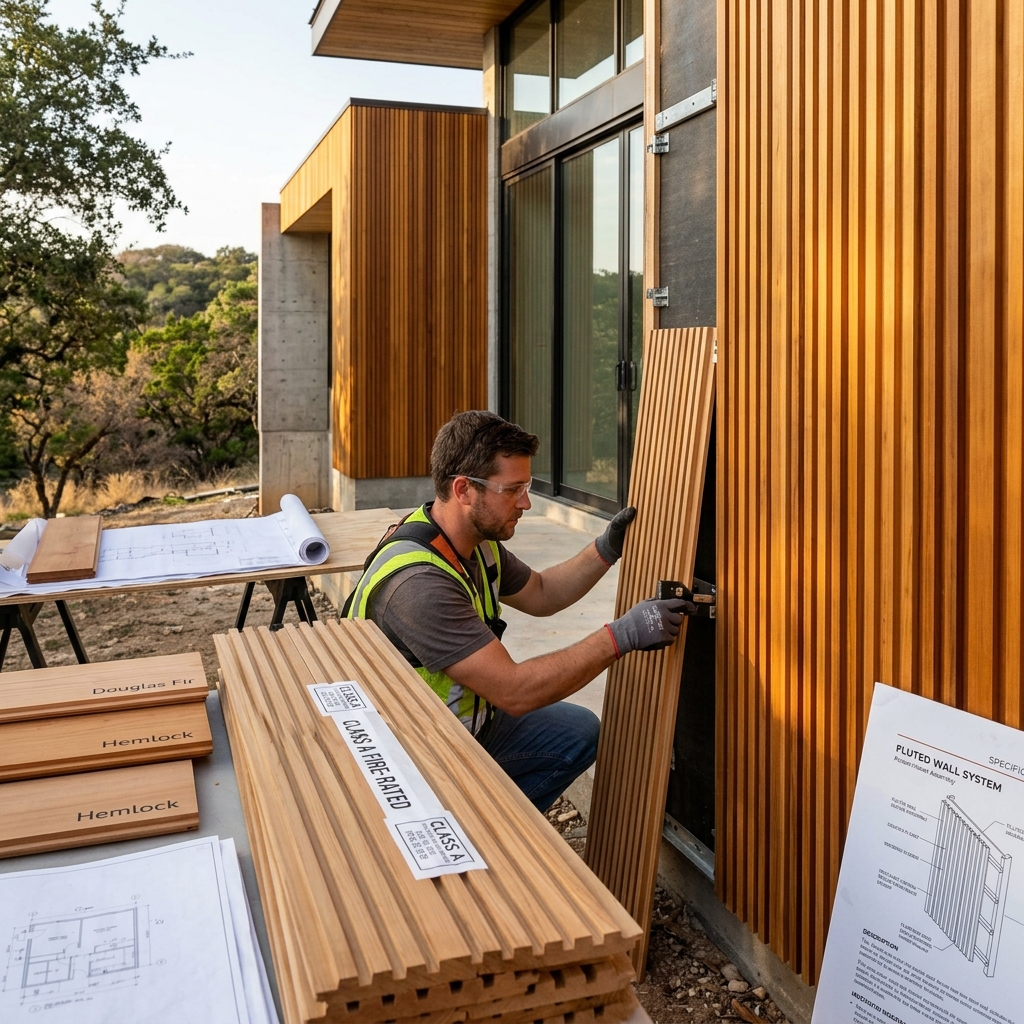
Durability and Weather Performance in Texas Climate
Texas climate poses specific material challenges: intense UV radiation that fades unprotected wood, variable humidity that drives seasonal movement, and occasional moisture exposure in transition zones. Fluted paneling amplifies these challenges because the flute geometry creates moisture traps at the valley and exposure zones at the ridges.
Cedar and hemlock move seasonally across their grain width by roughly 0.5 to 1 percent as humidity fluctuates. In a 6-inch-wide fluted board, this translates to measurable cupping or crowning that can damage flute definition over time. Vertical grain orientation reduces this movement significantly compared to flat-sawn material, which justifies the premium cost.
Thermally modified wood addresses seasonal movement directly. Our thermally modified ash, pine, and poplar products reduce moisture absorption and dimensional movement by 40 to 50 percent compared to standard material. The heat-treatment process darkens the wood naturally, creating rich chocolate and caramel tones that read as intentional contemporary finishes.
Clear western red cedar weathers naturally to silver-gray unless sealed. This aging is beautiful and predictable but requires acceptance that your warm honey tones will shift within 18 to 24 months in full sun. Hemlock and Douglas fir benefit from topcoat protection every 3 to 5 years to maintain original appearance.
We recommend annual inspection of fluted systems, particularly in areas where water pools or debris accumulates. Wind-driven rain exposure on the weather-facing side demands proper flashing and drainage detailing behind the paneling system. Your architect and contractor should verify that the air gap behind fluted panels allows water drainage and permits drying.
Next step: Specify maintenance expectations and finish details in your construction documents. Clarify whether natural weathering or sustained appearance is your design intent.
Fire-Rated Solutions for WUI Class A Requirements
Wildfire-urban interface designation (WUI) zones throughout central Texas demand Class A fire-rated cladding. Austin, Dripping Springs, Spicewood, Driftwood, and the Hill Country properties all benefit from communities adopting stronger fire resistance standards.
Fire-rating for wood paneling typically requires one of two approaches: inherently fire-resistant material or protective finish systems. We supply Class A approved thermally modified woods and specialty treatments that allow fluted paneling specifications without compromising your design intent.
Thermally modified products offer Class A ratings without sacrificing the wood aesthetic. The heat-treatment process fundamentally alters the wood’s combustibility. Our thermally modified ash delivers warm, contemporary tones that read identically to untreated hardwoods while meeting WUI requirements.
Finish-based Class A ratings involve intumescent coatings that protect underlying wood by forming a protective char layer when exposed to fire. These coatings can be tinted to natural wood tones but require periodic reapplication every 10 to 15 years and affect the wood’s tactile quality slightly.
We work with architects to align fire-rating requirements with design vision. Most projects in our service areas choose material-based fire resistance over coatings because the performance is passive and the aesthetic integrity remains unchanged.
Verify your specific property’s fire rating requirements with local building departments in Austin, Dallas, San Antonio, or wherever your project is located. Designations vary, and some areas require Class B rather than Class A depending on proximity to wildland interfaces.
Next step: Contact your local fire marshal or building official to confirm exact fire-rating requirements. We can specify suitable Class A materials once those requirements are clear.
Installation Best Practices for Fluted Wall Systems
Fluted paneling installation success depends on proper substrate preparation, fastening strategy, and ventilation. The wood’s seasonal movement must be anticipated and accommodated, not constrained.
Fastening should allow lateral movement across the board width. We recommend stainless steel fasteners rated for exterior use, placed at the flute ridge (never in the valley) where they won’t trap water or show under raking light. Fastener spacing typically follows manufacturer guidance: 16 inches on center for most applications, less if boards are wider than 8 inches.
Ventilation is critical. Fluted panels installed directly over solid sheathing trap moisture behind the panel, promoting rot and finish failure. Provide a minimum 3/4-inch air gap using battens or furring strips that permit water drainage and air circulation. This air space also reduces seasonal cupping by allowing moisture to equalize on both panel surfaces.
Flashing at transitions, windows, and roof lines must be detailed to prevent water from entering the air space behind the fluted system. We’ve seen too many projects compromise finish durability because the flashing strategy didn’t account for the panel thickness and air gap.
Board orientation matters. Sloping bottom edges slightly encourage water runoff rather than pooling. If you’re running flutes horizontally, slope each board 1/8 inch per foot to the downhill end.
Most contemporary projects use seamless joints between fluted panels, requiring butt joints or carefully detailed splices. Gaps expand and contract seasonally, so specify fastener patterns that permit movement without separation.
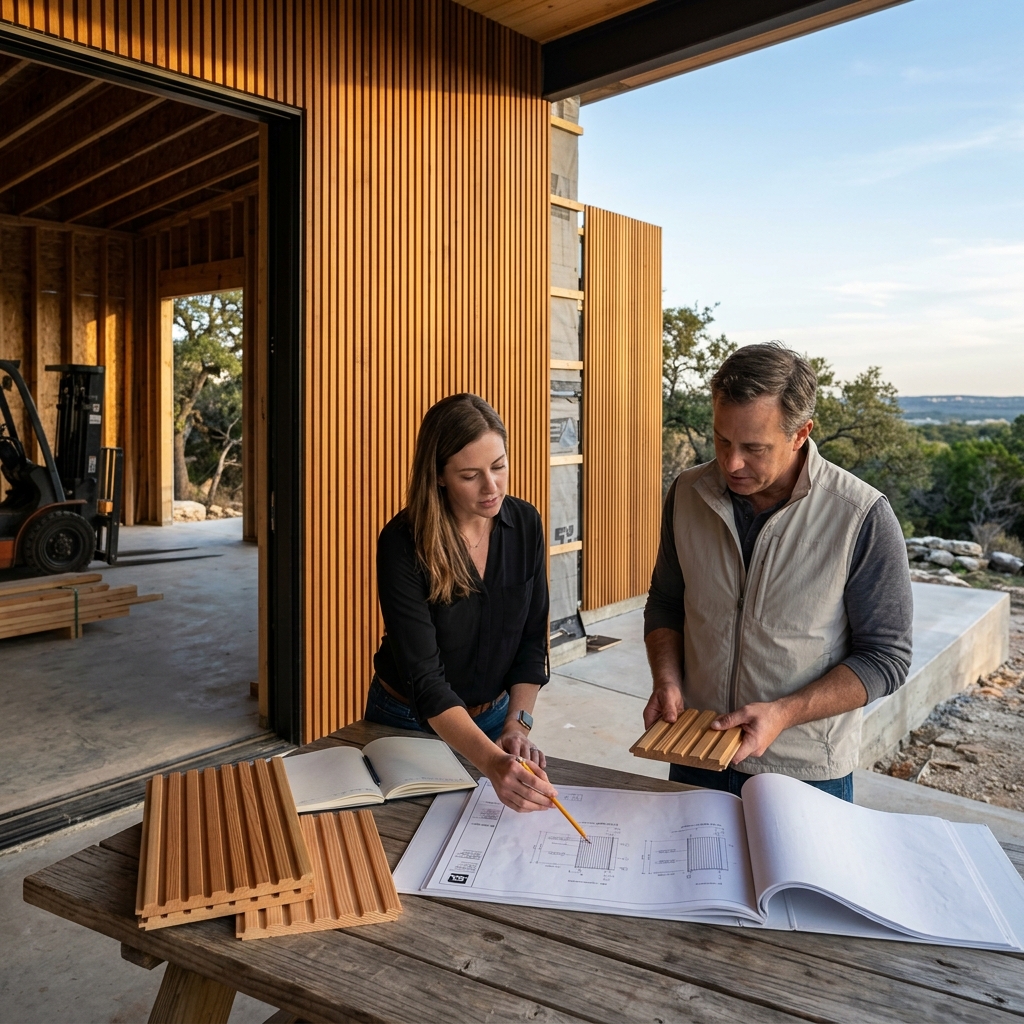
Next step: Have your contractor provide a detailed installation mockup on a low-visibility elevation before full deployment. This reveals fastener visibility, flute definition, and drainage performance early.
Sustainable Sourcing and FSC Certification Standards
We supply FSC-certified western red cedar, hemlock, and Douglas fir for architects prioritizing responsible forestry. FSC certification guarantees that material was harvested from well-managed forests where ecosystem integrity and worker welfare meet rigorous third-party standards.
FSC certification is particularly important for projects in environmentally conscious communities like Austin, Hill Country regions, and suburban Dallas markets where homeowners expect sustainability accountability. Specifying FSC material demonstrates your commitment to responsible practice without sacrificing aesthetic or performance qualities.
Our thermally modified wood products are sourced from sustainably managed forests in Europe, where thermal modification technology originated. This material offers both certification credibility and superior performance characteristics for contemporary design.
Tropical hardwoods like Ipe and Cumaru come with higher sustainability scrutiny. We source these materials from certified suppliers only, but we recommend reserving them for accent applications where small material volumes reduce forest impact. Thermally modified pine, ash, and poplar offer comparable durability at significantly lower environmental cost for primary cladding.
Chain-of-custody documentation follows your material from forest to mill to installation. We can provide complete sourcing documentation for LEED projects or other green building certifications requiring material transparency.
Next step: Specify FSC certification requirements in your construction documents. Request that all material be accompanied by chain-of-custody documentation verifying certification status.
Our Complete Specification Support for Your Project
We provide more than material supply. Our team includes specification support designed specifically for Texas architects working with fluted wall slat paneling.
We maintain full inventory across all species, grades, and profiles we’ve mentioned. We can deliver samples milled to your exact flute dimensions and board width, enabling accurate visual assessment before commitment. For projects in Austin, the Hill Country, Dallas, Houston, and San Antonio, we offer in-person consultation to discuss material selection relative to your specific site conditions and design intent.
Our mill capabilities allow custom profile milling if your design calls for flute geometries beyond standard offerings. We’ve executed bespoke paneling for Lake Flato-inspired projects throughout central Texas, and we understand the material precision that contemporary architecture demands.
Fire-rating guidance comes directly from our team’s experience with WUI requirements across Texas. We know which Class A materials perform best in different aesthetic contexts, and we maintain documentation supporting code compliance discussions with building officials.
For projects requiring thermally modified materials, we distribute leading brands and maintain current pricing and availability. Your specification gets delivered on schedule without the supply chain uncertainty that plagues national distributors.
Whether your project is a residential addition in Austin, a contemporary home in Dripping Springs, or a custom build in Horseshoe Bay, we’re equipped to support the full specification and material delivery process.
Your next step: Reach out with your project scope, preferred species, and design intent. We’ll provide samples, pricing, availability, and specification language ready for your construction documents.
To place orders, order samples, or talk with a live person.
Frequently Asked Questions (FAQ)
What wood species do we recommend for fluted wall slat paneling in Texas homes?
We typically specify Clear or Vertical Grain Western Red Cedar, Hemlock, or Douglas Fir for fluted paneling projects across Texas. Each species offers distinct aesthetic qualities: cedar provides warm tones and natural weather resistance, hemlock delivers refined grain patterns ideal for contemporary designs, and Douglas Fir offers strength with prominent grain character. We can source all three in the vertical grain profiles that showcase the expressive wood aesthetic your designs require.
Can we supply fluted paneling that meets WUI Class A fire-rating requirements?
Yes, we stock and manufacture fire-rated wood products specifically approved for Class A applications in high-risk areas. Our WUI-compliant fluted wall systems meet all current Austin and statewide building codes without compromising the visual impact you’re designing for. We handle the specification documentation and compliance details so your projects move forward smoothly.
How do we support architects through the specification process for fluted wall systems?
We provide complete specification support, including detailed installation guidelines, material samples, and performance data tailored to your project requirements. Our team works directly with your office to ensure material selections align with your design intent while meeting durability and code requirements for Texas climate conditions. We also coordinate with your builders to confirm proper installation of our products.


