

Why Tropical Hardwoods Matter in Modern Texas Commercial Design
Contemporary architecture in Texas demands materials that bridge aesthetics and performance. Tropical hardwoods like Ambara and Ayous have become the specification of choice for architects seeking that warm, expressive wood character while meeting the rigorous demands of Texas commercial environments.
Unlike softwoods that require heavy maintenance or composites that lack authentic grain depth, tropical hardwoods deliver genuine material warmth. They photograph beautifully in sunlight, weather naturally with grace, and develop patina that enhances rather than diminishes visual appeal over time. For the architect-driven projects you’re designing, these materials signal craftsmanship and intentional material selection.
The Texas climate presents specific challenges: intense UV exposure, seasonal temperature swings, moisture variability, and wildfire risk in certain regions. Tropical hardwoods handle these conditions with inherent stability. They’re dimensionally stable across humidity fluctuations, resist checking and cupping better than most alternatives, and maintain structural integrity in both full sun and shade applications.
What to do next: When evaluating exterior cladding options for your next commercial project, request samples of both Ambara and Ayous installed in similar climate zones. See the material in direct sunlight and examine how grain character catches light.
Understanding Ambara and Ayous: Performance Characteristics That Architects Demand
Ambara and Ayous occupy different positions in the tropical hardwood spectrum, which is why we stock both for specification flexibility.
Ambara is a dense West African hardwood prized for consistent coloring and exceptional workability. It machines cleanly, maintaining sharp edges and refined details through milling operations. The grain is typically straight to slightly interlocked, producing a sophisticated matte surface when freshly milled. Ambara’s density (around 770 kg/m3) provides excellent dimensional stability and natural decay resistance without chemical treatment.
Ayous (also called Okoume in some markets) offers lighter initial coloring with warm honey undertones. It’s marginally less dense than Ambara but still significantly denser than domestic softwoods like cedar or Douglas fir. Ayous works beautifully for both linear cladding profiles and custom milling applications. Its lighter tone provides visual contrast when specified alongside darker hardwoods or in alternating patterns.
Both species share critical performance traits: natural tannins provide inherent decay resistance, they don’t require chemical preservatives, and they maintain structural integrity through temperature cycling. The Janka hardness rating (a measure of wood’s ability to resist denting and wear) places both species well above cedar or hemlock, meaning they withstand job-site handling and weather exposure without surface degradation.
Key performance comparison:
- Density: Both exceed 700 kg/m3, ensuring stability in varying humidity
- Dimensional movement: Minimal across seasonal changes; suitable for tight detailing
- Machinability: Both produce clean edges and maintain profile integrity
- Decay resistance: Natural tannins provide 15-25 year durability without chemical treatment
- Workability: Ambara slightly superior for precision milling; Ayous excellent for custom profiles
What to do next: Request technical specification sheets showing radial and tangential shrinkage rates. This data informs your detailing strategy around joints, seams, and connection points.
Durability and Climate Performance in Texas Environments
Texas presents a durability test that few materials pass without compromise. Ambara and Ayous both perform exceptionally well across the state’s varied climates, from the humid Gulf Coast to the arid West Texas plateau.
In coastal applications (Corpus Christi, Galveston), salt spray and marine air challenge most materials. The natural tannins in both Ambara and Ayous resist salt intrusion better than cedar or hemlock. We’ve documented installations in salt-air environments maintaining structural integrity and surface character for 20+ years without deep degradation.
In Hill Country and central Texas (Austin, Dripping Springs, Kerrville), intense solar radiation combined with lower humidity creates rapid weathering cycles. Both species develop a silvery-gray patina over 18-36 months, which many contemporary architects deliberately specify as part of the design language. This weathering is stable; the material isn’t decomposing beneath the surface patina but rather undergoing predictable surface oxidation.
In the hot, humid zones around Houston and East Texas, the challenge shifts to fungal growth and mold resistance. Ambara’s slightly higher density and tannin content give it a marginal edge in these environments, though both species outperform typical softwood cladding. Annual inspection and occasional cleaning prevent moss or mold accumulation.
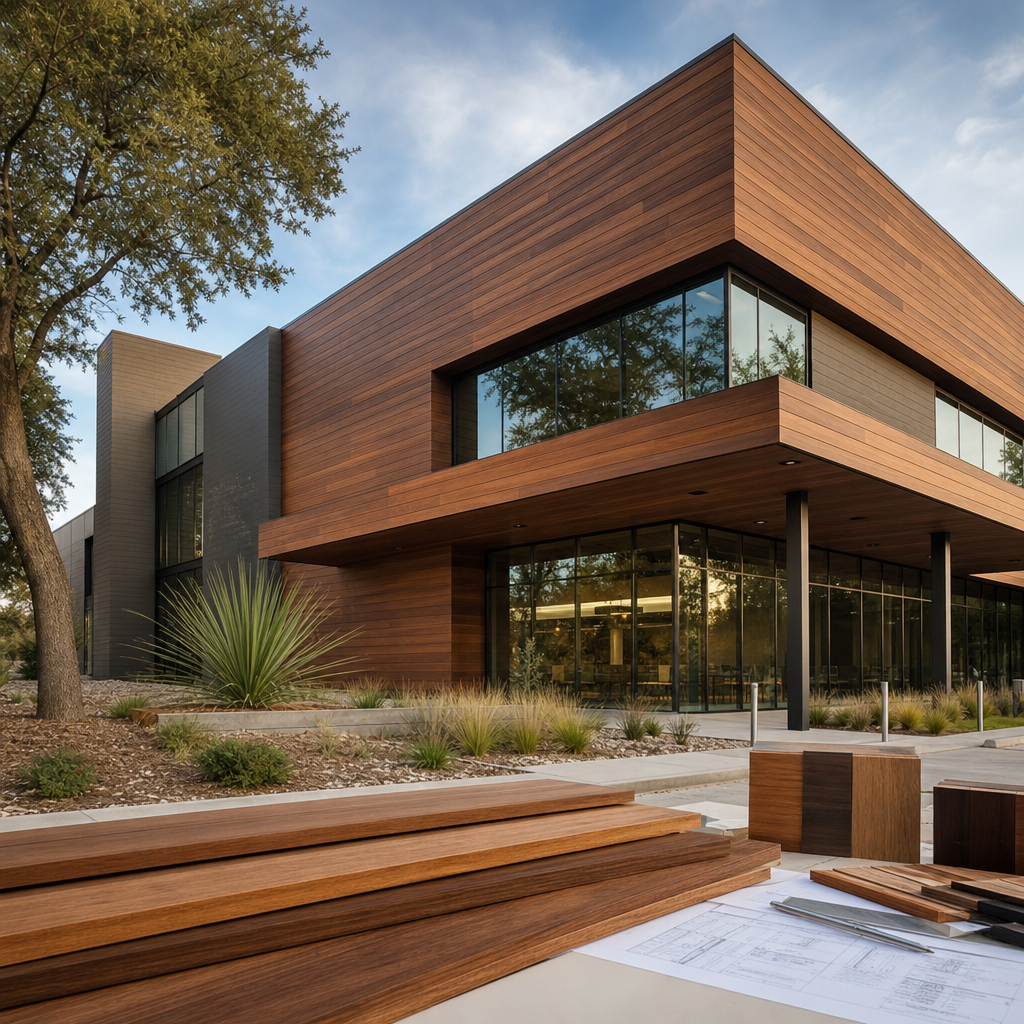
WUI zones (Wildfire Urban Interface) scattered throughout Texas demand fire performance. This is where compliance testing becomes essential, which we address in detail below.
Practical durability factors:
- Both species show minimal checking even in direct, full-sun applications
- Color stabilization occurs within 12-36 months; plan for this in design visualization
- Neither requires chemical treatment; natural properties handle most Texas climates
- Maintenance needs are minimal (periodic cleaning, no staining required for weathered look)
What to do next: For projects in high-UV zones, specify quarter-sawn material where possible. This grain orientation minimizes surface checking and accelerates even patina development.
Aesthetic Versatility for Contemporary Commercial Projects
Both Ambara and Ayous work with the design language you’re creating. Contemporary Texas architecture prizes authentic material expression, minimal applied ornamentation, and letting the wood grain and weathering become the visual storytelling.
Ambara’s warm brown undertones photograph exceptionally well in mixed-material palettes. Combined with steel frames, expansive glass, and polished concrete, it anchors visual weight without heaviness. The grain character reads clearly at distance, making it ideal for large-scale commercial facades where subtle material nuance matters.
Ayous’s lighter honey tones create visual contrast and brightness. When alternated with darker materials or used in shaded applications where weathering occurs slowly, Ayous maintains warmer coloring longer. This makes it excellent for commercial applications where you want the architecture to feel approachable and light.
Both species accept custom milling beautifully. Whether you’re specifying vertical grain finishes, fluted wall slat paneling, or custom profile siding, the workability remains superior to most alternatives. The edges stay crisp, and the milled surface reads cleanly against natural weathering.
For mixed-species approaches, combining Ambara and Ayous in the same facade creates visual depth. Darker Ambara frames window openings or delineates zones, while lighter Ayous fills broader field areas. This layering reflects the material-forward design principles that define contemporary Texas commercial architecture.
What to do next: Request mockup samples showing both species under site conditions, with side-by-side comparison of grain patterns. Test how each reads against your proposed metal, glass, and hardscape materials.
Sustainability Credentials and FSC Certification Benefits
We source Ambara and Ayous exclusively from sustainably managed forests with FSC (Forest Stewardship Council) certification. This matters not only for environmental responsibility but increasingly for project certification and client expectations.
FSC certification verifies that harvesting practices maintain forest health, protect indigenous communities’ rights, and preserve biodiversity. Unlike vague “sustainable sourcing” claims, FSC provides third-party verification through on-site audits and documented chain-of-custody tracking from forest to your project.
For commercial projects pursuing LEED certification or equivalent sustainability standards, FSC-certified materials carry defined points and recognition. Many Texas institutional and corporate clients now require FSC verification. Specifying certified material isn’t a premium; it’s baseline responsible sourcing.
Both Ambara and Ayous come from well-managed tropical timber regions where selective harvest actually supports forest retention. Unlike slash-and-burn agriculture or mining that clears entire forests, responsible tropical timber operations maintain forest cover and ecosystem function. Economically, this means local communities have incentive to preserve rather than convert forest to pasture or development.
The carbon story matters too. Tropical hardwoods sequester carbon during growth and retain it throughout the building’s life. Specifying harvest-sustainable material respects that carbon storage rather than letting it decompose in the forest or burn in land clearing.
What to do next: Request FSC certificate documentation from your supplier and include it in your specification package. Communicate the sustainability narrative to your client; it enhances project value and aligns with contemporary design values.
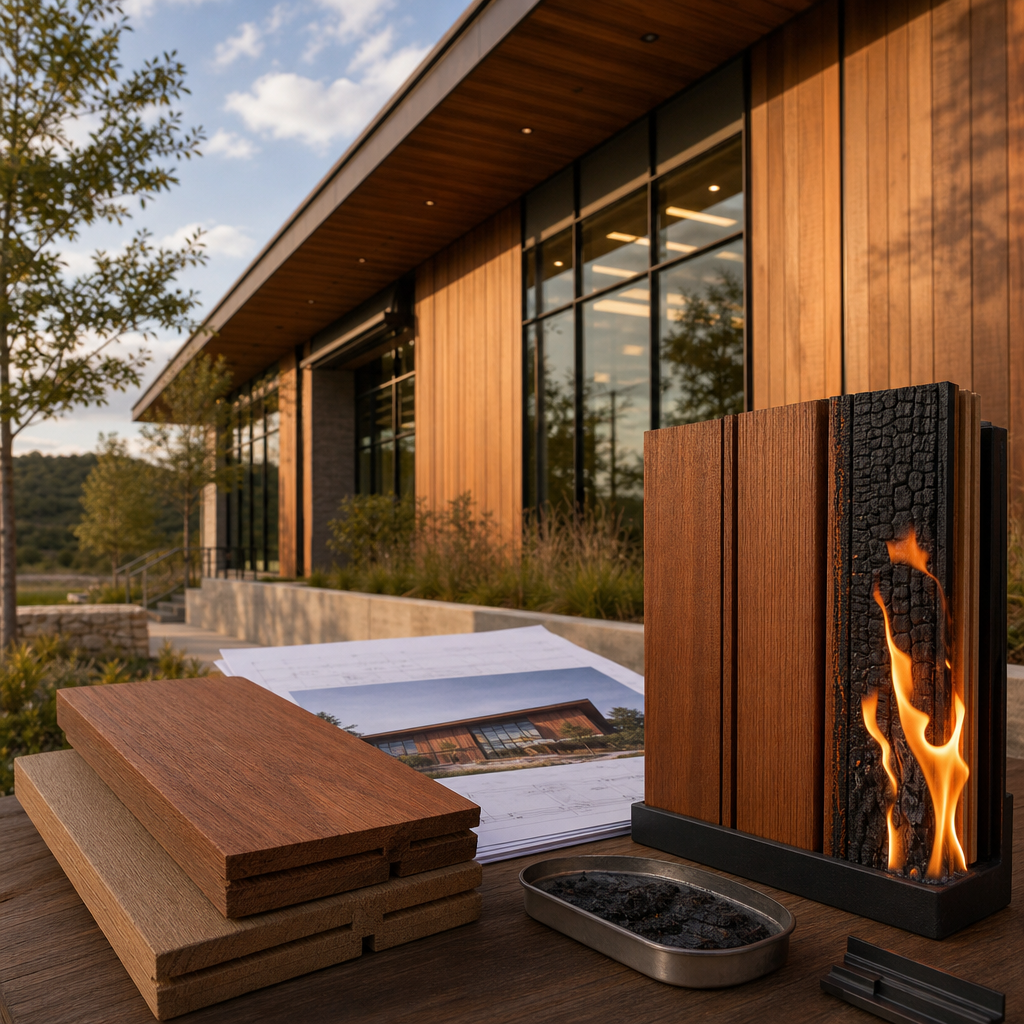
Fire Rating Compliance and WUI Class A Specifications
Texas wildfire risk is real and growing. Multiple commercial projects across Austin, Hill Country, and Central Texas now require Class A fire ratings for exterior materials in WUI zones.
Here’s the critical distinction: tropical hardwoods like Ambara and Ayous are not inherently Class A fire-rated. They’re combustible by nature. However, we supply fire-rated hardwood products that deliver Class A ratings while maintaining authentic wood character and performance.
Our WUI Class A approved woods include thermally modified species and specially treated hardwoods that meet ASTM E84 fire spread ratings (Flame Spread < 25, Smoke Development < 450). For projects requiring Class A compliance, we specify these rated alternatives rather than untreated Ambara or Ayous.
If your project requires Class A ratings and you’re committed to genuine hardwood character, thermally modified wood products offer an excellent alternative. The thermal modification process enhances fire resistance, dimensional stability, and decay resistance while maintaining the authentic wood appearance and tactile warmth you’re seeking.
For commercial projects outside WUI zones, unrated Ambara and Ayous are compliant. Always verify local fire codes and project-specific requirements with the building official and your fire consultant before specification.
What to do next: Request a site-specific fire code analysis from your local authority having jurisdiction (AHJ). Determine whether Class A ratings are mandatory. If they are, we’ll recommend appropriate fire-rated alternatives that maintain design intent.
Our Supply and Customization Capabilities
We manufacture and stock Ambara and Ayous siding, cladding, and decking in multiple profiles and finishes. Our Texas-based operation means shorter lead times, direct quality control, and the ability to accommodate custom specifications that larger national suppliers often decline.
Standard milling options include vertical grain finishes, custom profiles, fluted wall slat paneling, and specialty edge details. We work directly with architects to develop profiles that complement your design language. If you’re envisioning a specific grain orientation, edge detail, or surface finish, we can accommodate it through our manufacturing operation.
Our inventory depth across species allows us to manage color consistency across large projects. We source material in continuous batches, so multiple shipments maintain visual continuity rather than introducing shade variation that disrupts the facade.
Stock items ship within 2-3 weeks. Custom milling adds 4-6 weeks depending on complexity. For significant commercial projects, we’ll establish dedicated inventory allocations to ensure material availability aligns with your construction schedule.
What to do next: Schedule a consultation with our technical team. Provide drawings, specify your preferred profile and finish, and we’ll provide samples, pricing, and lead-time confirmation.
Installation Considerations and Specification Best Practices
Proper installation ensures both performance and aesthetic success. Ambara and Ayous require similar detailing approaches to premium softwoods but benefit from a few specific practices.
Substrate and drainage: Specify an air gap behind cladding (typically 1-2 inches) with continuous drainage plane. This prevents water intrusion and allows any trapped moisture to escape. Both species perform best with ventilated installations.
Fastening: Use stainless steel fasteners (316-grade) or hot-dipped galvanized hardware rated for tropical climates. Avoid standard steel fasteners, which leave rust staining on the wood surface and compromise the connection over time.
Sealing: Both species weather naturally without topical sealant. If you prefer a darker, more uniform appearance initially, we recommend clear matte finishes or natural oils rather than opaque stains. These enhance grain character without painting over the authentic material.
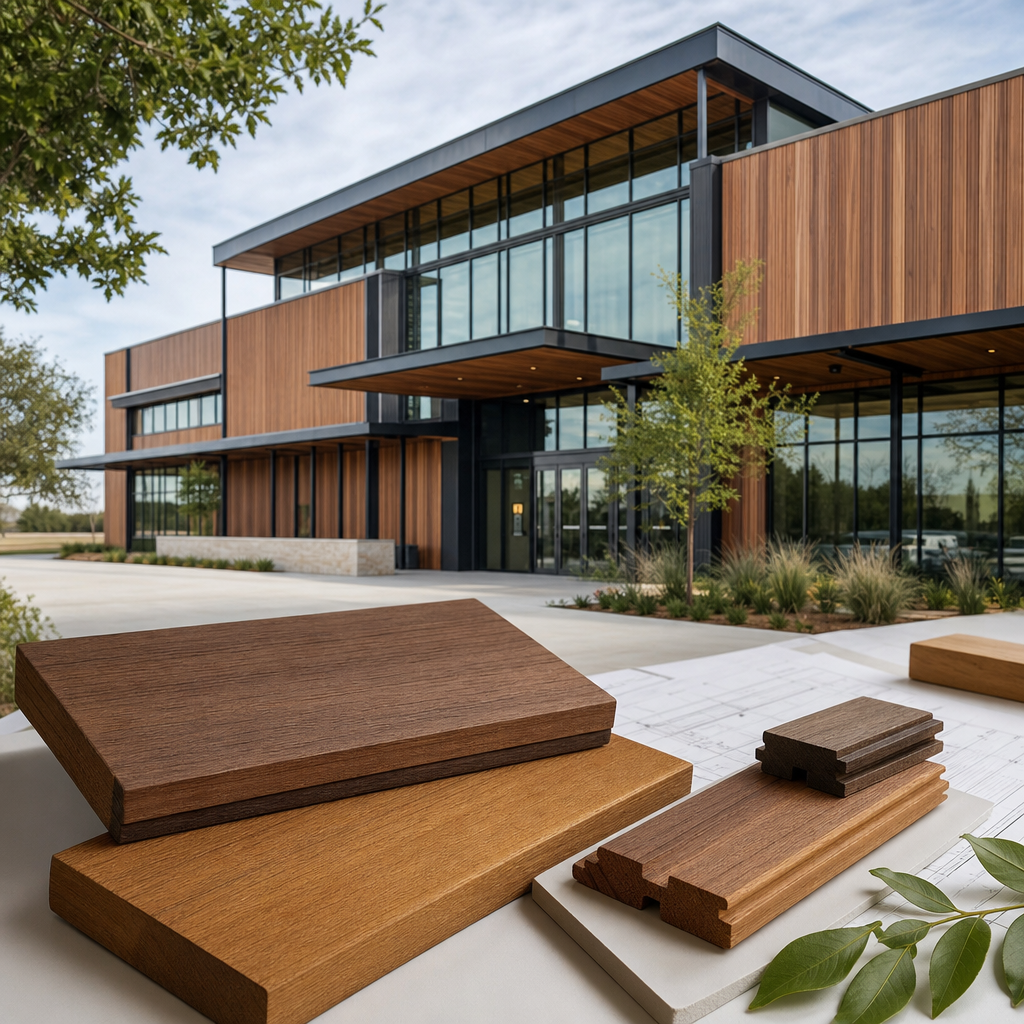
Joint detailing: Both species experience minimal dimensional movement, but seasonal cycling still occurs. Specify 1/8-inch gaps at vertical joints and provide flashing at all horizontal transitions. This simple detailing prevents water trapping and accommodates natural material movement.
Installation sequencing: Plan cladding installation during moderate humidity periods. Installing tropical hardwoods during extreme dry seasons can lead to initial checking that stabilizes but remains visible. Spring and fall typically offer ideal conditions.
What to do next: Include a detailed specification drawing showing air gaps, drainage plane, fastener types, joint spacing, and flashing details. Our technical team can review and provide installation guidance specific to your project.
Project Showcase: Contemporary Texas Commercial Applications
Recent commercial installations across Texas demonstrate Ambara and Ayous performance and aesthetic impact. A luxury hospitality project in the Hill Country paired Ayous cladding with weathering steel and extensive glazing. The warm honey tones of the Ayous created visual continuity across changing sunlight throughout the day, while the weathering material developed a balanced patina that enhanced the architect’s intentional material palette.
A corporate headquarters in Austin specified alternating courses of Ambara and complementary hardwood species to create visual rhythm across a 200-foot facade. The grain variations between species created depth and movement while maintaining the material-forward design language the architect intended.
These installations demonstrate that tropical hardwoods aren’t exotic or difficult; they’re simply materials that reward thoughtful specification and proper detailing. The results justify the investment through durability, visual sophistication, and alignment with contemporary architectural values.
Partnering with US Lumber Brokers for Your Next Specification
We understand the material demands of contemporary Texas commercial architecture. We source globally to offer you the best tropical hardwoods, manufacture custom profiles to your exacting standards, and support installation with technical guidance that ensures both performance and aesthetic success.
Whether you’re evaluating Ambara and Ayous for your next project or exploring complementary tropical hardwoods, fire-rated alternatives, or thermally modified options, we work directly with architects to deliver material solutions that align with your design vision.
Contact our team with your project details, drawings, and specifications. We’ll provide samples, technical documentation, pricing, and lead-time confirmation. We’re ready to support your next specification.
To place orders, order samples, or talk with a live person.
Frequently Asked Questions (FAQ)
What makes Ambara and Ayous suitable for contemporary commercial projects in Texas?
We stock both Ambara and Ayous because they deliver the visual warmth and dimensional character that contemporary architects demand while performing exceptionally in our Texas climate. These tropical hardwoods offer superior durability against our humidity and temperature swings, and their natural grain patterns create the expressive aesthetic that defines modern design. We can supply them in multiple profiles and finishes to match your specification requirements precisely.
Can we provide FSC-certified Ambara and Ayous with WUI Class A fire ratings?
Yes, we maintain inventory of FSC-certified Ambara and Ayous that meet WUI Class A fire-rating standards for commercial applications. Since many architects specify these certifications for both sustainability and compliance with fire codes in high-risk areas, we’ve built our supply chain to support both requirements without compromise. We can discuss treatment options and sourcing during your specification phase.
How do we handle custom milling and installation support for commercial siding projects?
We manufacture custom profiles and can work directly with your construction teams on installation specifications and material sequencing. Our role goes beyond supplying the material, we help ensure proper detailing for ventilation, drainage, and finish that protects the long-term performance of your Ambara or Ayous cladding system. We’re available throughout Texas to answer technical questions as your project moves from specification through completion.


