

Why Moisture Management Matters for Texas Cladding Projects
Texas humidity is relentless. From the coastal moisture near Houston to the seasonal swings in Austin, your cladding system must breathe or fail. Moisture trapped behind wood siding drives rot, mold, and structural decay that compromises both aesthetics and building integrity.
Architects designing modern homes with bold wood exteriors understand this challenge intimately. When you specify natural wood cladding, you’re committing to a system that actively manages water and vapor. Open joint cladding isn’t optional in Texas; it’s foundational.
We’ve worked with Texas-based architects for years, and the pattern is clear: projects that prioritize moisture management from the specification stage avoid costly callbacks and maintain their warm, authentic wood character for decades. The alternative is watching carefully selected vertical grain cedar or Ipe degrade prematurely.
Actionable takeaway: Before selecting any cladding material, map your project’s exposure (wind-driven rain, sun orientation, HVAC discharge locations) and verify your system includes ventilation pathways behind the wood face.
The Problem: Moisture Failure in Traditional Cladding
Closed joint or flush-butt cladding systems look clean on drawings. In practice, they trap moisture like a poorly sealed envelope. Water infiltrates through micro-gaps or imperfect sealing, runs down the back of the boards, and sits against house wraps or sheathing. Vapor condenses in the cavity. Within 3-5 years, you see soft spots, surface checking, and mold that spreads to framing.
The culprit isn’t always heavy rain. In Texas, humidity alone drives condensation when warm interior air meets cool exterior walls. Traditional systems with no drainage path have nowhere for that moisture to escape except deeper into the wall assembly.
We’ve documented failures where architects specified premium materials like Clear grain Western Red Cedar, but the installation method lacked proper ventilation. The material quality didn’t matter once moisture had nowhere to go. That’s a specification failure, not a material failure.
What to do next: Audit your current project details or specifications. If your cladding plan mentions “sealed joints,” “caulk all butt joints,” or relies solely on house wrap for moisture control, that’s your red flag.
Our Open Joint Cladding Advantage
Open joint systems create intentional air gaps between cladding boards. Water that penetrates the face drains quickly behind the wood layer, and continuous air movement through the cavity evaporates residual moisture before it reaches the sheathing.
We specify and supply open joint systems as the standard for Texas projects because the physics work. A 6-12mm gap between vertical boards, combined with a properly installed rainscreen substrate, creates a pressure-equalized cavity that outperforms traditional methods by an order of magnitude.
For architects designing contemporary homes with dramatic wood siding, open joint systems don’t compromise aesthetics. The shadow line between boards becomes a design feature, emphasizing the rhythm and texture of the material. Modern projects at Lake|Flato and similar firms routinely use open joint details not just for performance, but as an intentional aesthetic choice.
We provide guidance on gap sizing, substrate selection, and trim detailing so your open joint design achieves both durability and the precise visual expression your project demands.
US Lumber Brokers Material Selection for Moisture Resilience
Not all wood performs equally in ventilated assemblies. We stock materials specifically chosen for open joint applications in Texas climates.
Clear and Vertical Grain Western Red Cedar resists checking and cupping in exposed conditions, maintaining tight joints over time. Cypress offers natural rot resistance and dimensional stability. Douglas Fir delivers strength and workability. For high-performance projects, Thermally modified wood eliminates the hygroscopic movement that causes joints to open and close seasonally.
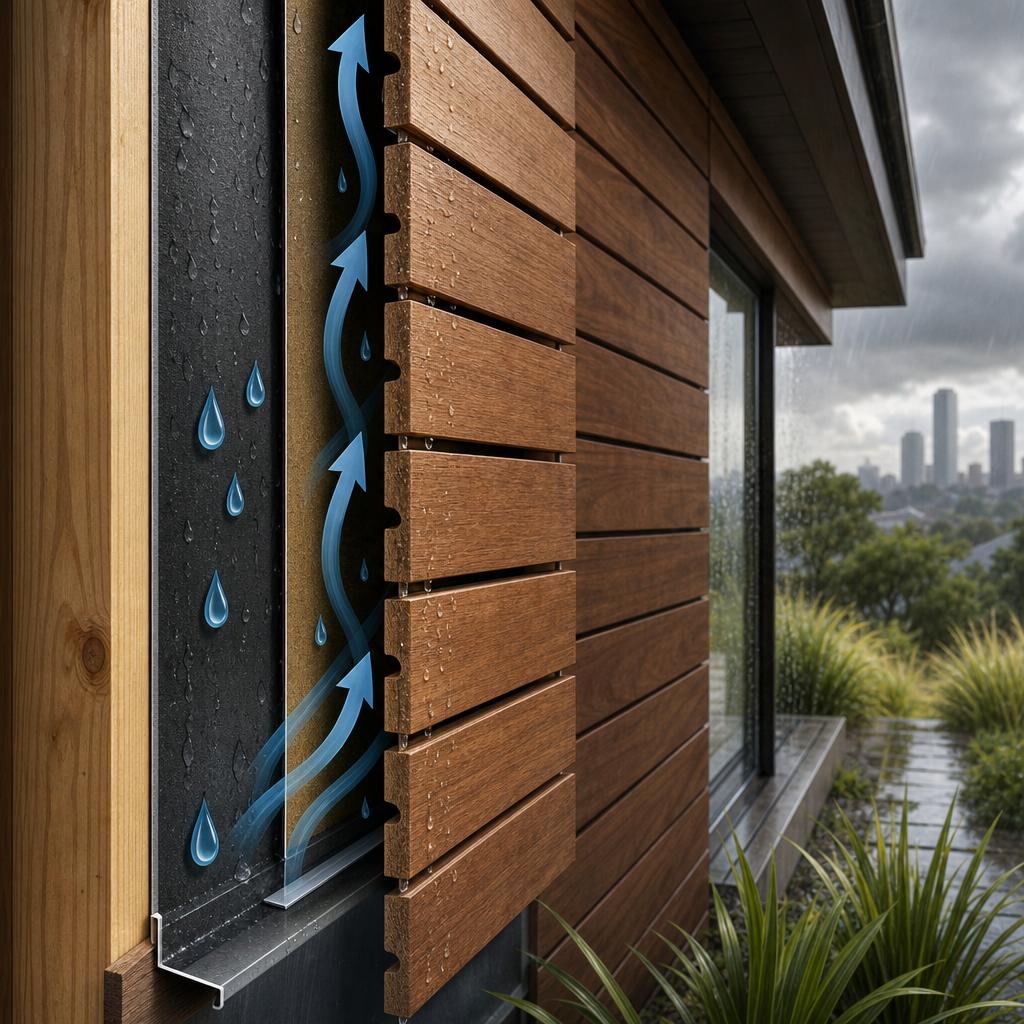
Hardwoods like Ipe, Cumaru, and Garapa bring unmatched durability and require no chemical treatment. In open joint systems, these dense materials perform exceptionally well because the ventilation path prevents the trapped moisture that accelerates decay in softer species.
We also distribute Arborwood Cladding, a thermally modified product engineered for consistency and minimal movement. For architects specifying regionally sourced materials, our Southern Yellow Pine and FSC-certified options deliver both performance and sustainability credentials.
Next step: Share your project’s water exposure profile and desired aesthetic with us. We’ll recommend the specific grade, species, and finish that performs best under your climate conditions.
Installation Best Practices for Texas Climate
Installation technique determines whether your material choice succeeds or fails. Open joint cladding requires meticulous execution.
First, the substrate must be a true rainscreen: rigid foam, battens, or ventilated substrate that creates the air gap. Never install cladding directly against house wrap without an air space. Second, horizontal flashing must channel water out and down, never inward. Every horizontal joint, window, and penetration needs a drip edge that extends beyond the face plane.
Fasteners matter too. Stainless steel or hot-dipped galvanized fasteners prevent rust staining, especially critical for light-colored woods like Cedar and Ash. Drive fasteners through the center of the board thickness to minimize cupping and joint opening. In Texas heat, boards expand and contract daily; centered fastening accommodates this movement.
We recommend engaging installers experienced with open joint systems on residential projects in your region. The difference between a six-year lifespan and a thirty-year lifespan often comes down to how competently the substrate is built and flashed.
Thermally Modified Wood: Superior Performance Standard
Thermally modified wood undergoes controlled heating that removes the cell structure driving moisture absorption and movement. The result is a material that barely swells or shrinks, even in Texas humidity cycles.
For open joint cladding, this matters immensely. Your joints remain tight. Finish doesn’t check or peel as readily. The wood performs almost like a composite material, but it’s 100% natural wood with zero chemical treatment. FSC-certified thermally modified options exist for architects prioritizing sustainability without compromising durability.
The cost premium is real, but it’s recovered in labor savings during installation (fewer fit-and-finish adjustments), extended finish life, and eliminated callbacks. We’ve specified thermally modified ash and pine on high-end residential projects where the architect’s vision demands pristine wood surfaces year after year.
Thermally modified wood excels specifically in open joint systems because the ventilation path eliminates the one scenario where the material struggles: total saturation. The cavity stays dry, the boards stay stable, and the system delivers decade-spanning performance.
WUI Class A Fire-Rated Options with Drainage
Texas building codes increasingly require Class A fire-rated materials for structures in wildfire-prone areas. Many architects assume this means sacrificing natural wood or compromising moisture management.
We supply WUI Class A fire-rated products that maintain open joint performance. Some are pressure-treated softwoods with fire retardants that don’t significantly impair drainage. Others are thermally modified or naturally dense hardwoods that achieve Class A ratings through inherent properties, not chemical treatment.
The key detail: not all Class A products work in ventilated cavities. Some rely on char formation, which works only if the material is exposed. We help specify products where the fire rating is compatible with rainscreen installation and the material’s dimensional properties support consistent joinery over time.
For projects in the Texas Hill Country, Horseshoe Bay, or other WUI zones, this integration of fire performance and moisture management isn’t a trade-off; it’s a requirement. We ensure both are met.
Comparing Open Joint vs. Closed Joint Systems
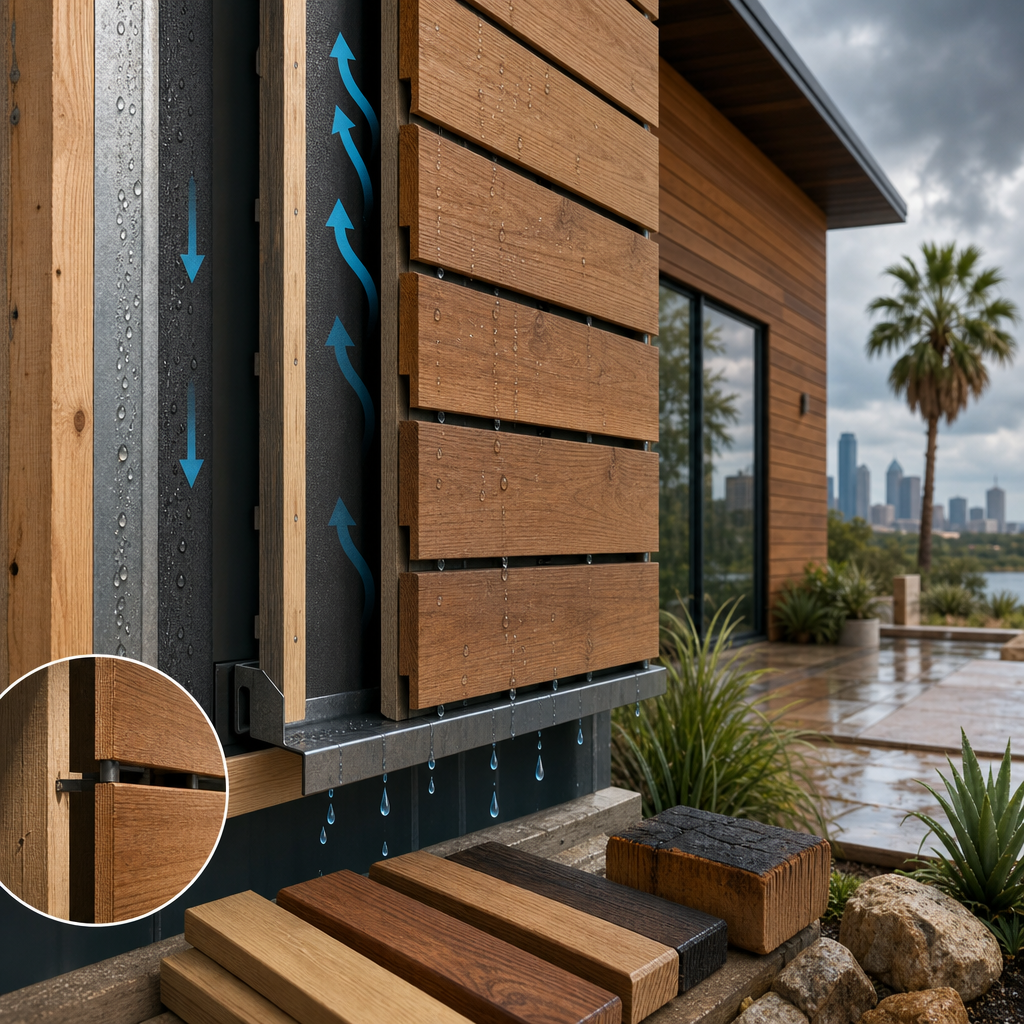
Closed joint systems appear on projects because they’re simpler to specify and familiar to traditional contractors. Here’s the honest comparison:
Closed Joint: Relies on exterior sealant and house wrap for water management. Cheaper upfront. Faster installation. However, sealants degrade in 5-7 years, joints open, and water finds its way in. No drainage path. High failure risk in high-moisture climates.
Open Joint: Higher material and design cost. Requires experienced installation. Intentional gaps create a maintenance-free drainage system. Water passes through instantly. Cavities dry quickly. 30+ year lifespan with proper material selection.
In Texas, the decision is straightforward. Closed joint systems inevitably leak. Open joint systems, when properly detailed, simply don’t. Architects designing homes intended to last are choosing open joint every time.
The aesthetic argument often favors open joint, too. Continuous shadow lines are more contemporary and visually expressive than flush-butt siding.
Why Vertical Grain Cedar and Cypress Excel
Vertical grain (VG) milling aligns growth rings so they run perpendicular to the board face. This grain orientation resists cupping and checking far better than flat-sawn material. In an open joint system, this stability becomes critical.
As boards expand and contract with humidity, VG cedar and cypress maintain tight joints. Finish lasts longer because the wood isn’t flexing and opening micro-cracks. The wood also sheds water more efficiently when water hits vertical grain surfaces.
Cypress adds natural durability. Its chemical composition resists rot and insect damage with zero chemical treatment. For architects specifying regionally authentic materials with genuine performance, VG cypress is unmatched in the Southeast and Central Texas.
We stock clear VG Western Red Cedar and premium VG Cypress specifically for open joint cladding. The investment is justified when you’ve designed a home that will anchor its landscape for thirty years.
Long-Term Durability: What Architects Should Expect
Properly specified and installed open joint cladding delivers 25-40+ years of service in Texas climates. The variance depends on material choice, finish quality, and exposure.
Clear VG Cedar in a sheltered location with good paint coverage lasts 25-30 years. Thermally modified ash or pine performs at 30+ years. Ipe or other tropical hardwoods, 40+ years. These are real timelines we’ve observed on projects across Texas.
What you don’t see are failures. No callbacks for rot, no mold, no structural damage. The initial investment in open joint design and premium materials pays constant dividends.
Finish maintenance does matter. High-quality exterior stains and sealers require recoating every 5-7 years, but this is cosmetic upkeep, not a structural fix. You’re maintaining wood that’s fundamentally sound.
Set realistic expectations with your client: An open joint system with quality material and finish is a 30-year facade that looks fresh for a decade, then develops honest weathering character that many architects find desirable. Plan maintenance accordingly.
How to Specify Open Joint Cladding for Your Project
Start with the rainscreen detail. Partner with your contractor or building science consultant to design the substrate: whether you’re using rigid foam, battens on wrap, or a manufactured rainscreen product. This detail is non-negotiable.
Next, specify the material by species, grade, and finish. We recommend written specifications that include moisture content at installation (12-15% for most softwoods), fastener type, and gapping tolerances. Don’t just say “vertical grain cedar;” say “VG Western Red Cedar, clear grade, 6mm open joints, installed with 304 stainless fasteners.”
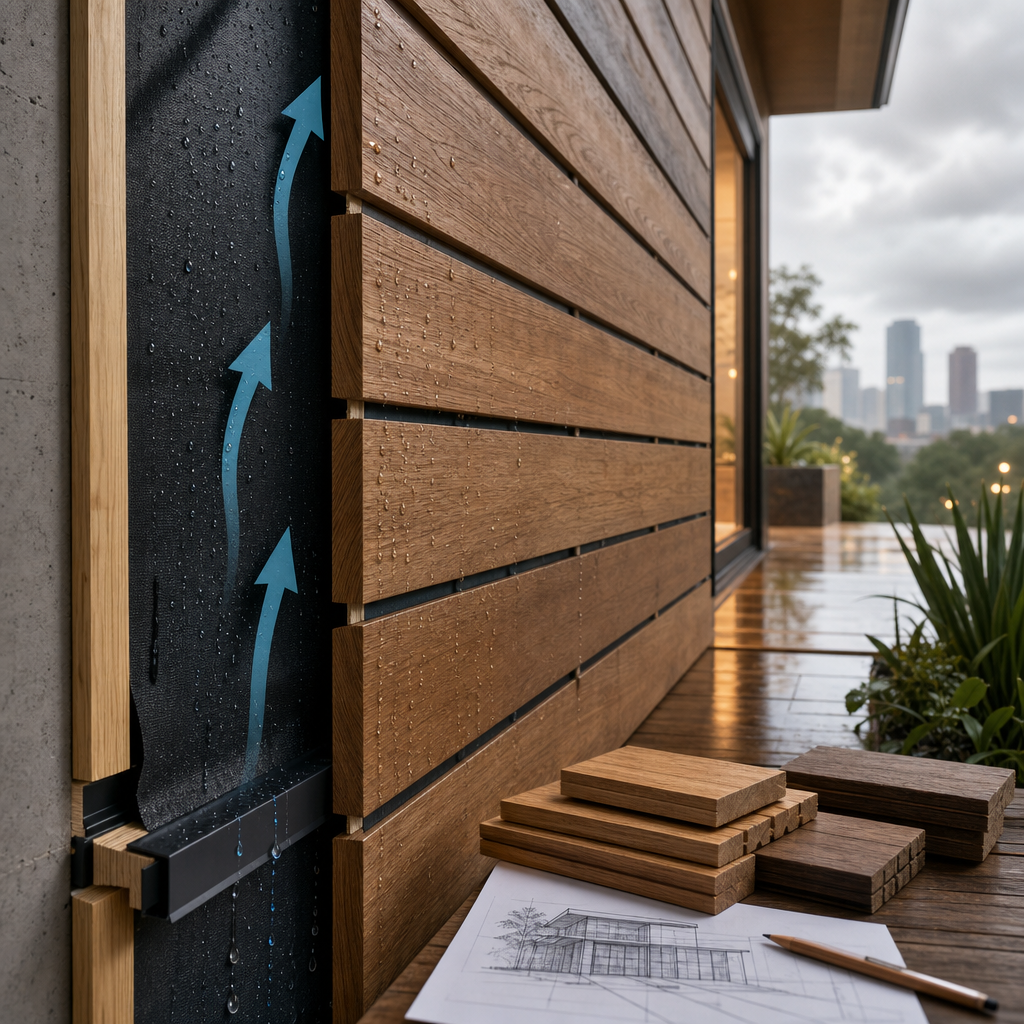
Detail every horizontal transition: windowsills, caps, base flashing, and transitions to other materials. Each requires a drip edge and a clear drainage path. This is where failures happen.
Specify the finish system explicitly: “Two-coat exterior stain system, [brand and color], applied by certified applicator following manufacturer’s cure times.” Vague finish specs lead to shortcuts.
Finally, include a mock-up requirement. Build 4×8 feet of the actual assembly with your specified material and substrate on site. Inspect it, photograph it, and use it as the installation standard for the entire project.
We can review specifications at any stage and flag details that won’t perform in Texas climates. Catching these issues on paper costs nothing; fixing them on-site costs everything.
Why US Lumber Brokers Is Your Definitive Partner
We’ve spent years building relationships with Texas architects who design with intention and material authenticity. We understand that when you specify wood, you’re not just choosing a surface; you’re defining how the building performs, ages, and ultimately succeeds.
Our inventory includes every material category necessary for open joint systems: premium softwoods, hardwoods, thermally modified options, Class A fire-rated products, and engineered boards from manufacturers like Arbor Wood and Tantimber. We carry enough depth in each category that you’re not forced into compromise choices.
Beyond inventory, we provide technical support. We’ve consulted on moisture-related failures, reviewed installation photos, and helped troubleshoot detailing challenges. When an architect from Austin to Houston faces a spec question at 2 PM, we respond with material knowledge and real-world project experience.
We’re also positioned as both supplier and manufacturer. This means we control quality on products we make and can source competitively on products we distribute. Your budget goes further without cutting performance.
Most importantly, we share your commitment to craftsmanship. The architects and builders we work with are creating homes designed to last generations. Open joint cladding systems that we’ve specified and supplied are performing flawlessly across Texas twenty years later. That track record, built project by project, is why we’re the definitive partner for your next specification.
Ready to begin: Contact us with your project details. We’ll recommend the optimal material, review your moisture management strategy, and ensure your cladding system delivers both the aesthetic vision and the durability your architecture deserves.
To place orders, order samples, or talk with a live person.
Frequently Asked Questions (FAQ)
What makes open joint cladding systems better for Texas moisture control than traditional closed joint approaches?
We’ve found that open joint systems allow air circulation behind the cladding layer, which is critical for Texas humidity management. This ventilation pathway lets moisture that penetrates the outer surface escape quickly rather than accumulating behind the boards, preventing rot and decay. We typically recommend open joint installation for any architect-driven project in our service areas, particularly in Hill Country and lake communities where moisture exposure is constant.
Which wood species from our inventory perform best in open joint cladding installations across Texas climates?
We supply Vertical Grain Western Red Cedar and Cypress specifically because their tight grain structure resists moisture infiltration while still allowing the drainage benefits of ventilated systems. These species, along with our thermally modified wood options like Thermally Modified Ash and Pine, have proven durability in Texas’s variable humidity and temperature swings. For architects seeking maximum performance, we also stock hardwoods like Cumaru and Garapa, which naturally resist moisture without requiring as much maintenance as softer woods.
How does your thermally modified wood inventory address moisture challenges that standard lumber cannot?
Our thermally modified products undergo a heat-treatment process that fundamentally alters the wood’s cell structure, making it significantly more resistant to moisture absorption and swelling than untreated alternatives. This means less dimensional movement in your open joint system, which keeps drainage gaps consistent and prevents the gaps from closing up during wet seasons. We’ve seen architects specify our Thermally Modified Ash and Ayous for projects where long-term performance and minimal maintenance are priorities.


