

Why Carbon Footprint Matters for Architect-Designed Homes
Your clients are asking harder questions about environmental impact. They’re drawn to natural materials, but they also want to know what their design choices mean for the planet. This tension between aesthetic vision and ecological responsibility is no longer theoretical—it’s become a core project requirement.
For Texas architects committed to sustainability, material selection has moved beyond aesthetics. A deck or exterior cladding that lasts 15 years versus 40 years carries vastly different carbon consequences. The materials we specify today shape both the environmental footprint and the long-term maintenance narrative of a home.
We’ve watched this evolution closely. Architects working with firms like Lake|Flato understand that specifying materials is really specifying stewardship. When you choose between bamboo and thermally modified wood, you’re making decisions that ripple through manufacturing, transportation, installation, replacement cycles, and disposal. Getting this right matters for your project’s story and your client’s values.
Understanding Lifecycle Assessment in Building Materials
Lifecycle assessment (LCA) measures the total environmental impact of a material from extraction through end-of-life. This includes raw material sourcing, manufacturing processes, transportation, installation, use, and eventual disposal or recycling. It’s the only honest way to compare materials.
Here’s what often gets missed: a product’s upfront carbon footprint tells only part of the story. A material that costs less to produce but requires replacement twice as often may carry double the total carbon burden. LCA forces us to look at the full timeline, not just the manufacturing phase.
When evaluating decking or cladding materials, focus on these key metrics:
- Embodied carbon: emissions locked into the product before it reaches the site
- Transportation footprint: weight, distance, and shipping method matter
- In-service durability: how many years before replacement becomes necessary
- End-of-life pathways: recyclability, biodegradability, or landfill impact
- Processing energy: the fuel intensity required for material transformation
Many manufacturers publish Environmental Product Declarations (EPDs) that provide verified LCA data. We recommend requesting these when evaluating options for your projects. They allow apples-to-apples comparison rather than marketing claims.
Moso Bamboo Decking: Growth Cycle and Carbon Claims
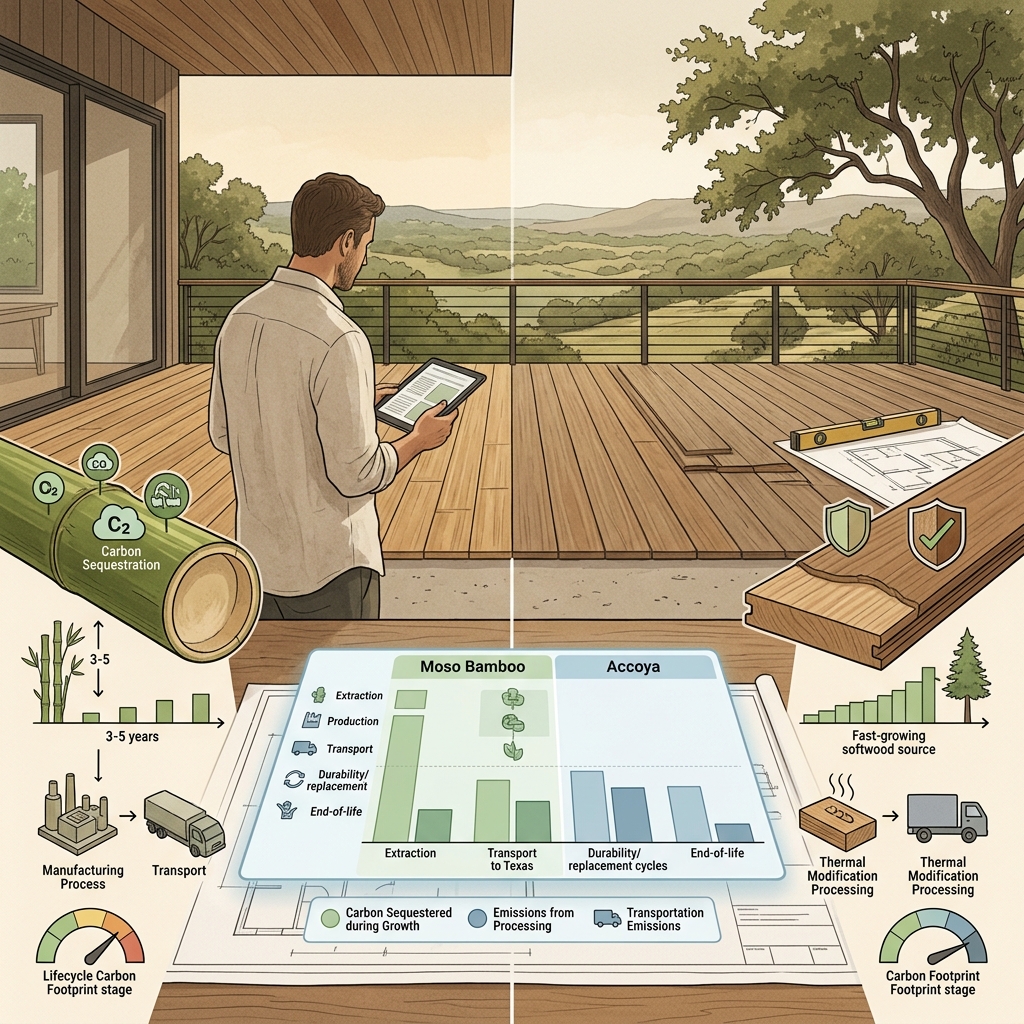
Moso bamboo grows faster than almost any wood species on earth. A culm (individual shoot) can reach full size in just 3-5 years, compared to 20-40 years for most timber trees. This rapid renewal cycle sits at the center of bamboo’s environmental marketing, and there’s real substance to it.
The carbon sequestration math is straightforward: fast growth means rapid photosynthesis and carbon absorption from the atmosphere. Bamboo stands regenerate quickly from their root systems after harvest, requiring minimal replanting. For pure carbon capture during growth, bamboo is genuinely efficient.
But here’s where the full LCA complicates the narrative. Moso bamboo production concentrates in Asia, primarily China, where most of the world’s commercial supply originates. This creates substantial transportation footprint—typically 8,000 to 12,000 ocean freight miles to North America. Processing also requires chemical adhesives and kiln drying that add embodied carbon.
In Texas’s climate, bamboo decking presents another challenge: durability. Bamboo is softer than many hardwoods and naturally less rot-resistant than species like Ipe or thermally modified wood. Outdoor exposure in our humid summers and temperature swings demands protective finishes and more frequent maintenance. Many bamboo decks require refinishing every 3-5 years, where higher-durability alternatives might go 10-15 years between treatments.
The replacement cycle is where bamboo’s carbon advantage can erode. If you’re specifying a material that will need complete replacement or significant restoration in 15 years, you’re adding embodied carbon from that new installation to your total lifecycle impact. A more durable option that goes 30 years with minimal intervention can win the LCA comparison despite higher upfront carbon.
Accoya Thermally Modified Wood: Processing and Carbon Impact
Accoya represents a different philosophical approach: take a sustainable fast-growing softwood and thermally modify it to achieve hardwood-level durability. The process heats wood to high temperatures (around 200 degrees Celsius) in an oxygen-free environment, fundamentally altering the cellular structure.
This thermal modification dramatically improves rot resistance, dimensional stability, and hardness. An Accoya deck resists decay comparable to tropical hardwoods, but it starts with European sustainably harvested softwood, primarily radiata pine and other plantation species. Accoya decking from certified sources carries lower transportation emissions than Asian bamboo imports and FSC certification backing.
The processing energy is real. Thermal modification is fuel-intensive, and the heating process does add embodied carbon. However, independent LCAs consistently show that Accoya’s dramatically extended service life (25-40 years for exterior decking) offsets the processing energy within the first decade of use. You’re amortizing manufacturing impact across significantly more years of performance.
We stock Accoya decking specifically because the durability math aligns with sustainability goals. In our experience, architects specifying for long-term performance find that Accoya’s lifecycle carbon calculus favors durability-first thinking.
Consider transportation benefits too. Because Accoya achieves hardwood performance from softwood feedstock, it requires less material to meet the same structural and aesthetic requirements. A 3/4-inch Accoya deck performs like material that might otherwise need to be 1.5 inches thick in softwood species.
Durability and Replacement Cycles: The Hidden Carbon Cost
This is where we see the biggest misconception. Architects sometimes assume that specifying the lowest-embodied-carbon material available is the most sustainable choice. But a low-carbon product that needs replacement is actually a carbon liability.
Let’s ground this with a Texas example. Two 500-square-foot deck scenarios over 30 years:
Scenario A: Bamboo decking with replacement at year 15
- Initial installation: X units of embodied carbon
- Maintenance refinishing: years 3, 7, 12 (additional chemicals, labor, fuel)
- Complete replacement at year 15: X units of embodied carbon again
- Total 30-year impact: 2X plus maintenance interventions
Scenario B: Accoya decking with no replacement
- Initial installation: 1.3X units of embodied carbon (higher upfront due to processing)
- Maintenance: light sealing at year 8, year 20 (minimal chemical input)
- No replacement needed
- Total 30-year impact: 1.3X plus light maintenance
The replacement cycle compounds fast. Every decade you avoid replacement saves the full embodied carbon of that new installation plus the transportation, labor, and waste handling of the old material’s removal and disposal.
In hot, humid Texas climates, this matters acutely. Moisture drives decay, splitting, and cupping. Durability isn’t a luxury—it’s the foundation of sustainable design. We consistently recommend asking suppliers for real-world service life data in climate conditions matching your project location, not generic best-case scenarios.
Fire Performance and Climate Resilience Considerations
Texas wildfire exposure varies dramatically by region. The Hill Country, western suburbs of Austin, and areas near San Antonio face genuine WUI (wildland-urban interface) fire risk. Your material selection carries safety implications that also intersect with carbon calculations.
Class A fire-rated wood products exist within both bamboo and modified wood categories, but the testing and ratings differ. Accoya, when treated with approved fire-retardant finishes, achieves Class A ratings for exterior applications. Bamboo typically requires chemical fire treatment because its natural resistance is limited.
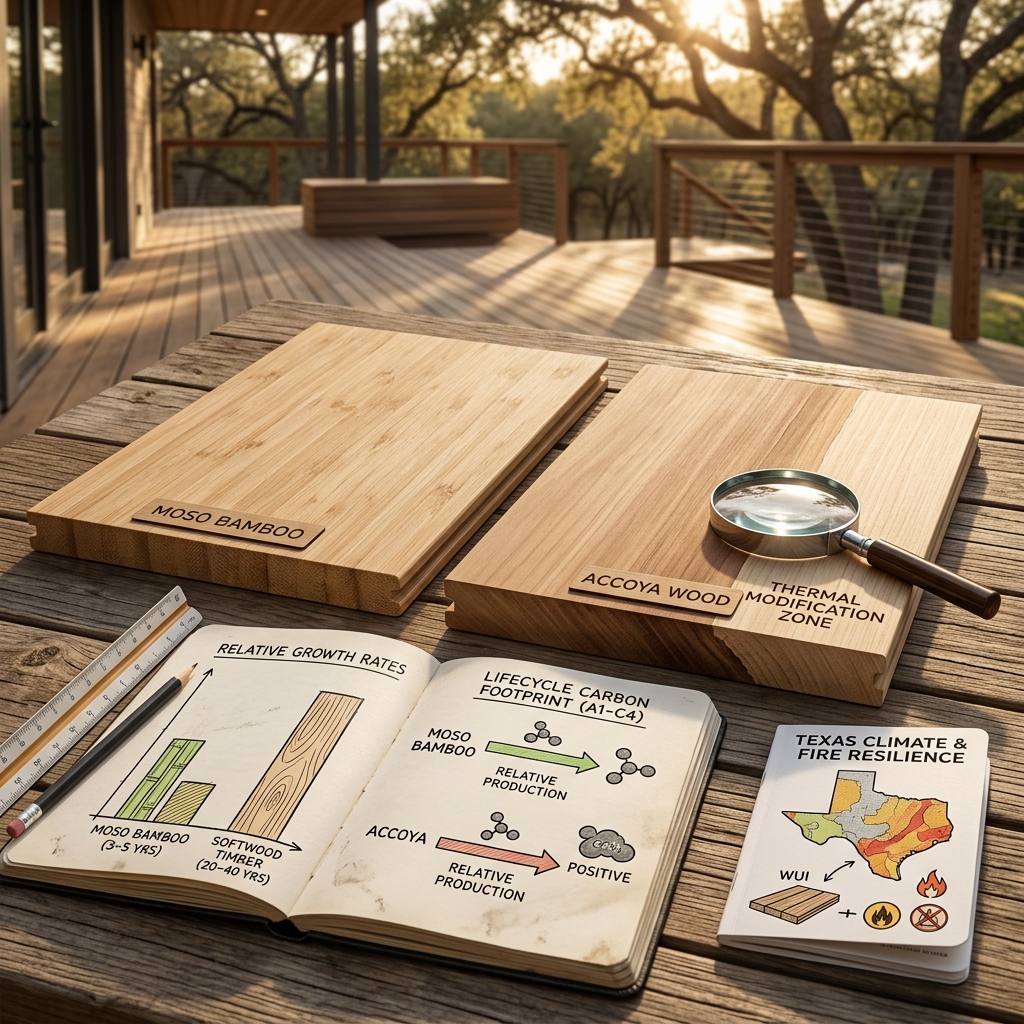
Fire-retardant treatments add embodied carbon and can affect long-term durability. A thermally modified wood that achieves fire performance through material properties rather than chemical treatment represents a cleaner sustainability path. It also tends to maintain its fire rating longer without reapplication.
Climate resilience extends beyond fire. Dimensional stability matters in Texas. Our temperature swings and seasonal humidity fluctuations stress materials that move too much. Thermally modified wood’s improved dimensional stability reduces cupping, splitting, and fastener corrosion compared to untreated softwoods or bamboo. Less stress on materials means less maintenance, longer service life, and lower lifecycle carbon.
Our Expertise in Sustainable Material Selection
We work with Texas architects specifically because material knowledge in this market requires hands-on experience. We source and manufacture with direct knowledge of how these products perform through hot, humid summers and occasional hard freezes.
Our commitment goes beyond stocking shelves. We maintain relationships with mills producing thermally modified wood products—including Accoya, Thermally Modified Ash, Pine, and Poplar—ensuring you have access to materials backed by robust sustainability certifications and real service-life data.
We also stock leading brands including TimberTech, Trex, and Fiberon for architects who specify composite alternatives. Sometimes a low-maintenance composite makes the strongest lifecycle carbon case, particularly when aesthetics demand stain or color consistency that wood can’t reliably deliver.
The point is this: sustainable material selection requires knowing your options deeply. We’re here to help you evaluate real LCA data, not marketing promises, and to specify materials that align both with your design vision and your client’s environmental values.
Specifying Low-Carbon Decking for Contemporary Design
Modern contemporary architecture, as Lake|Flato and Page Architects demonstrate, celebrates the honest expression of natural materials. This aesthetic aligns beautifully with durability-first material selection. Warm wood tones, expressive grain, and visible aging actually benefit from materials chosen for longevity.
When specifying for low lifecycle carbon, start with these principles:
- Prioritize durability over upfront environmental metrics. A 40-year material beats a 15-year material even if the latter has lower embodied carbon.
- Request Environmental Product Declarations (EPDs) and third-party lifecycle assessment data. Marketing claims aren’t equivalent to verified science.
- Account for local climate. Coastal humidity, Texas heat and moisture, and fire exposure all affect real-world service life.
- Design with maintenance in mind. Specify finishes, details, and material combinations that support the long-term durability you’re banking on.
- Consider locally available materials when they perform well. Shorter supply chains mean lower transportation carbon.
Thermally modified wood fits naturally into contemporary design. It ages gracefully, deepening in color over time while maintaining structural integrity. Unlike bamboo, it doesn’t require regular refinishing to maintain performance. Unlike pressure-treated lumber, it doesn’t carry the environmental baggage of chemical preservation.
The visual warmth and authenticity of real wood—not composite products trying to mimic wood—remains unmatched for architect-designed homes. The trick is specifying species and products engineered to last.
Real-World Performance in Texas Climates
Austin, San Antonio, Hill Country, and the surrounding regions present distinct performance demands. Hot summers with humidity spikes, occasional freezes, intense sun exposure, and seasonal rain patterns stress materials differently than milder climates.
Ipe, Cumaru, Garapa, and other tropical hardwoods naturally handle these conditions well, but they carry significant transportation and sourcing concerns. That’s why thermally modified alternatives have gained architect adoption—they deliver comparable performance from European plantation softwoods with cleaner sustainability profiles.
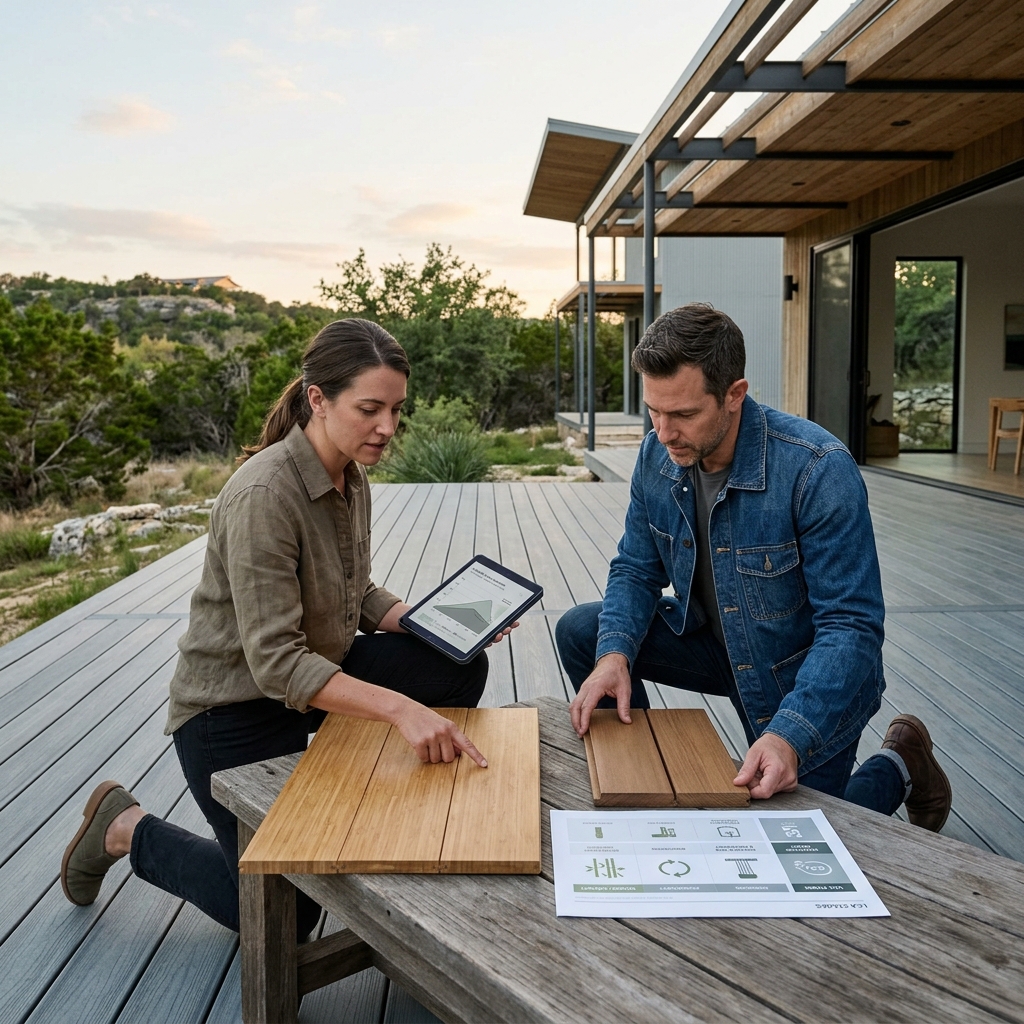
We’ve observed that Accoya and similar thermally modified products maintain dimensional stability and color consistency better than untreated softwoods through Texas seasonal swings. Bamboo, while beautiful initially, often develops cupping and requires intervention within 5-8 years in our climate. That’s not a criticism of bamboo as a material—it’s simply that bamboo wasn’t evolved for this environment, and the lifecycle carbon cost of managing that mismatch is real.
When you specify Accoya for a Hill Country home or an East Austin renovation, you’re choosing a material that was literally engineered to handle European weather stress that mirrors Texas humidity and temperature swings. The performance data backs that choice.
Making the Right Choice for Your Project
The lifecycle carbon comparison between bamboo and Accoya isn’t simple, and honestly, pretending there’s one right answer would be disrespectful to the complexity of your projects.
Bamboo makes sense when you’re designing a coastal contemporary home with shorter-term ownership plans and maintenance budgets to match, or when specific aesthetic qualities (very light color, visible grain variety) are non-negotiable. It’s a real material with real environmental benefits during growth.
Accoya and similar thermally modified woods make sense when you’re designing for permanence. When you’re creating a home meant to endure, to age authentically, and to minimize environmental intervention over decades. When your client values the integrity of real wood without the ecological baggage of tropical imports or the maintenance burden of untreated softwoods.
We recommend this process: request LCA data from both suppliers, plug in the expected service life for your specific climate and design, calculate total 30-year impact, and then check that math against performance guarantees and real-world references. We’re happy to help evaluate options and connect you with case studies of how these materials actually perform in Texas conditions.
Sustainable design isn’t about choosing the material with the lowest upfront carbon number. It’s about choosing the material that, over the lifetime of the structure, requires the least total environmental intervention. That’s how you design homes that your clients can feel genuinely good about.
To place orders, order samples, or talk with a live person.
Frequently Asked Questions (FAQ)
What’s the actual carbon difference between Moso bamboo and Accoya decking over their lifespan?
We’ve found that while Moso bamboo grows faster and sequesters carbon quickly, Accoya’s superior durability often results in a lower lifecycle carbon footprint because it requires replacement far less frequently. A typical Moso deck may need replacement every 10-15 years in Texas’s heat and humidity, whereas Accoya decking performs reliably for 25-30 years or longer. When you factor in the embedded carbon from manufacturing, transportation, and installation of replacement materials, Accoya’s longer service life typically wins out on total carbon impact, even accounting for its thermal modification process.
How do we help architects specify the most sustainable decking option for their projects?
We work directly with your design team to evaluate both material performance data and lifecycle considerations specific to Texas climates. We supply both options and provide real specifications, durability expectations, and honest carbon accounting so you can make decisions based on your project’s actual performance requirements rather than marketing claims. Our role is giving you the technical foundation to specify with confidence, whether that’s Accoya, bamboo, or another material that fits your design intent and sustainability goals.
Why does durability matter more than you might think when choosing between these materials?
Every time a decking material fails prematurely and requires replacement, you’re essentially doubling or tripling its total carbon footprint because you’re starting the manufacturing and installation cycle over. We’ve seen projects where choosing a material based on initial carbon claims alone ended up less sustainable overall because the material couldn’t stand up to Texas sun, moisture cycles, and temperature swings. That’s why we emphasize proven performance data and real-world lifespan estimates alongside carbon calculations.


