

Why Architects Are Choosing Thermowood Over Standard Wood
Contemporary architecture thrives on authentic materials that age beautifully. When architects like those at Lake|Flato design homes that celebrate natural wood, they’re not just choosing aesthetics, they’re making a performance decision. Standard wood siding tells one story: gorgeous initially, then vulnerable to weathering, rot, and the intense Texas climate. Thermowood tells another: the same warm, expressive grain you want, plus engineered durability that survives decades without compromise.
We work with Texas architects daily who face this exact tension. They envision homes with raw wood character, but they also specify materials that hold up. That’s where thermowood changes the equation entirely.
Thermowood (thermally modified wood) transforms standard lumber through controlled heat treatment, removing moisture and creating wood that simply performs differently. No chemical additives, no synthetic coatings masking the grain. Just wood that’s been refined to handle harsh conditions while maintaining its authentic appeal.
Architects in Austin and throughout Texas are specifying thermowood for one clear reason: it delivers the material honesty they’re after without asking clients to choose between beauty and durability. When you design a glass-and-wood contemporary home where that cladding is a dominant visual element, you need material that won’t checker, cup, or fade unevenly within five years.
The thermal modification process removes the cellular moisture that attracts insects and fungi. This means thermowood resists decay naturally, without relying on pressure treatments or preservatives. For architects committed to clean material stories, this distinction matters enormously. Your specification becomes genuinely sustainable, not just treated for longevity.
What to do next: Review the projects on your drawing board where standard cedar was your default choice. Consider which ones sit in direct sun or high-moisture zones. Those are your best candidates for thermowood’s superior performance profile.
Durability and Longevity: The Performance Advantage
Standard wood siding in Texas faces relentless challenges. Summer heat cycles moisture in and out of the grain. Winter brings fluctuating humidity. Air pollution in urban areas accelerates surface weathering. Within seven to ten years, clients are looking at graying, checking, and significant maintenance costs.
Thermowood handles this without flinching. The thermal modification process creates a material with dimensional stability that’s nearly twice as stable as untreated wood. This means less movement, less stress on fasteners, and no surprise callbacks about seasonal gaps appearing in your carefully detailed wood planes.
We’ve supplied thermowood to luxury residential projects across the Hill Country, from Kerrville to Spicewood, where the extreme seasonal temperature swings would destroy standard cedar within a decade. Homeowners in these areas specify thermowood because they understand the cost of re-siding. Once thermowood goes up, it’s there for 20, 25, even 30 years with only routine maintenance.
The longevity advantage also means lower lifetime costs. Yes, thermowood costs more upfront than standard cedar or hemlock. But when you calculate material plus labor across the lifespan of the home, thermowood becomes the economical choice. A siding replacement is expensive; avoiding it entirely is invaluable.
Your action item: Request durability data from suppliers. Ask for long-term case studies from similar climates. Don’t accept “it lasts longer” without specific numbers on dimensional movement and decay resistance.
Fire Rating and Safety: Meeting WUI Class A Standards
Austin’s wildland-urban interface (WUI) expansion means fire-rated materials aren’t optional for increasingly more projects. Class A fire ratings require materials to resist ignition and limit flame spread, and thermowood can meet these standards without losing its material integrity.
We supply WUI Class A approved thermowood products specifically treated to meet fire safety codes while preserving the authentic wood character architects demand. Unlike some fire-rated alternatives that rely on chemical coatings or veneers, our thermowood maintains its honest wood expression while delivering the safety performance required for homes in fire-prone zones.
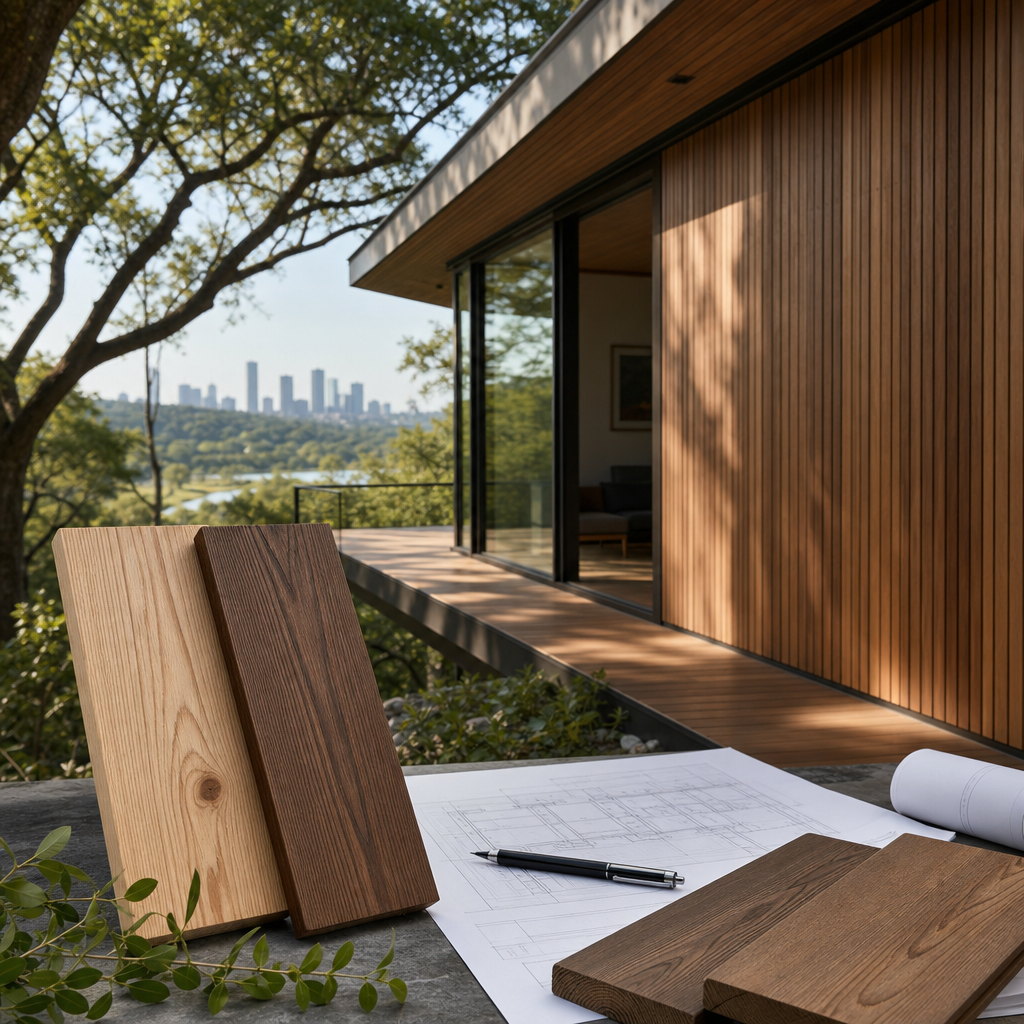
This matters from both a specification standpoint and a liability standpoint. When you’re working on properties in areas like Dripping Springs, Bee Cave, or the Hill Country where WUI restrictions apply, thermowood offers a straightforward solution that passes code without forcing compromises on design intent.
The thermal modification process itself doesn’t diminish fire performance. The Class A rating comes through additional treatment protocols we’ve implemented across our inventory, ensuring your wood cladding meets safety standards while retaining the warmth and character your designs rely on.
Next step: Confirm fire ratings with your supplier before finalizing specifications. Not all thermowood products carry Class A ratings, so verify this early in your design process.
Aesthetic Superiority: Natural Beauty That Lasts
This is where thermowood wins in ways that standard wood simply cannot match. Contemporary architecture thrives on the interplay between raw materials and refined design. Wood cladding becomes a primary aesthetic vehicle, expressing warmth and authenticity against minimalist forms and expansive glazing.
Standard wood looks magnificent on day one. It also begins its transformation immediately. Weathering creates an unpredictable patina, with some surfaces graying faster than others depending on sun exposure and rain patterns. Within a few years, what was a unified wood expression becomes visually fragmented.
Our thermowood selections including Thermally Modified Ash, Pine, and Poplar offer architects richer color options than traditional choices. The thermal modification process can enhance the natural grain character, making the wood more visually engaging without any staining or finishing. And critically, this aesthetic stability. The color deepens gradually and uniformly, creating the aged-wood character architects often pursue, but on your timeline and in your control.
For luxury custom projects where the wood itself is the design statement, thermowood’s consistency is non-negotiable. You specify it once, and it ages exactly as designed rather than becoming a maintenance headache that undermines your aesthetic intent.
What to consider: Visit completed projects where thermowood has been in place for three to five years. See how it’s aged. This real-world reference will inform your color and species selection far better than any sample.
Sustainability Credentials: FSC Certified Excellence
Austin architects increasingly work with clients who demand sustainability credentials alongside design excellence. Thermowood addresses both priorities simultaneously.
We source FSC-certified thermowood products, ensuring your material specifications support responsible forestry practices. The thermal modification process itself is environmentally sound: it uses heat rather than chemicals, producing a material that’s fully recyclable and free of synthetic treatments.
This becomes particularly important when you’re designing high-end custom homes where environmental consciousness and visual quality are both non-negotiable. Clients understand that their architect-designed home reflects their values. Specifying certified sustainable materials reinforces that alignment.
Our thermally modified wood selection spans species and applications, all sourced with sustainability front and center. When you specify Thermally Modified Wood Solutions, you’re not making a compromise between performance and ethics. You’re choosing material that delivers both.
Our Complete Thermowood Selection and Capabilities
We maintain one of Texas’s most comprehensive thermowood inventories specifically curated for architect-driven projects. Our selection includes:
- Thermally Modified Ash and Pine (lighter tones, premium grain)
- Thermally Modified Poplar (refined character, excellent finishing properties)
- Thermally Modified Ayous (coastal applications, superior stability)
- Ipe and hardwood alternatives with thermal modification for decking and heavy-duty applications
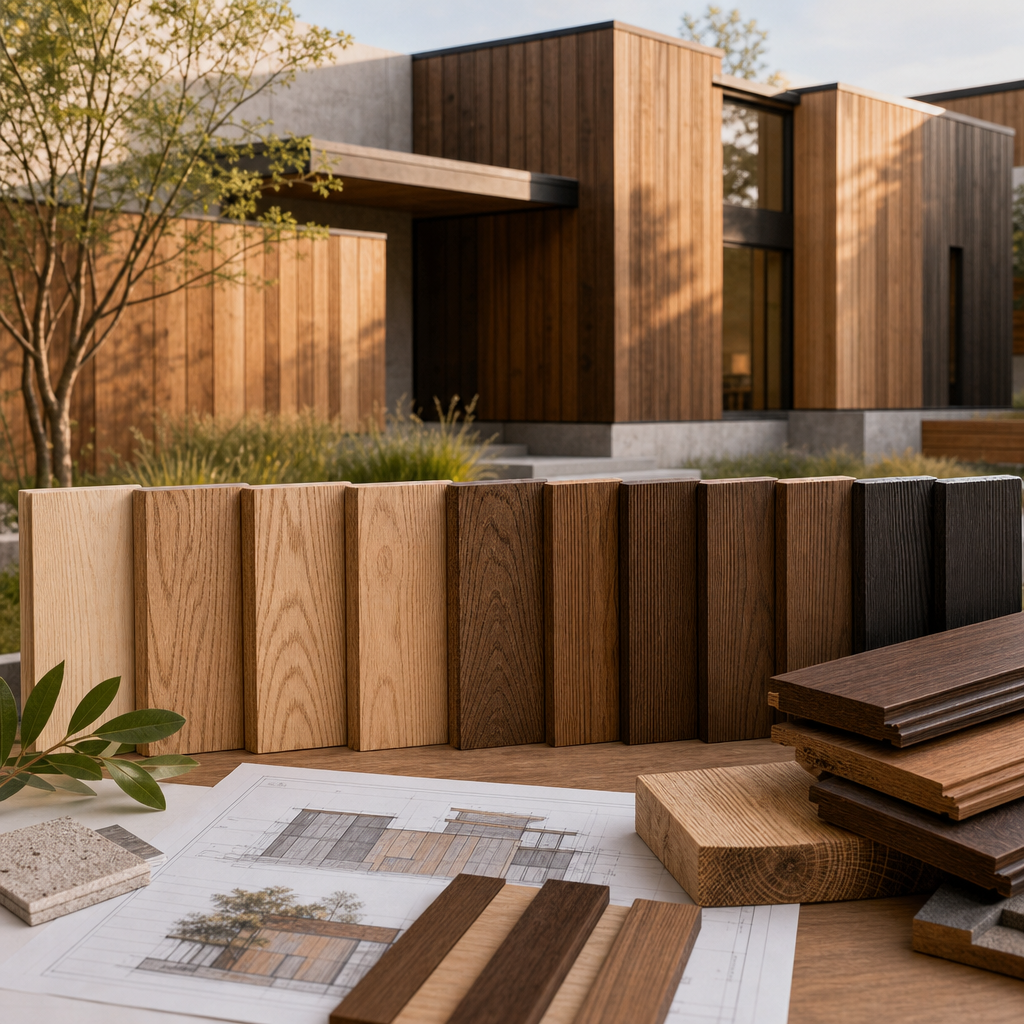
Beyond thermowood, we stock premium vertical grain softwoods including Clear and Vertical Grain Western Red Cedar, Yellow Cedar, Hemlock, Douglas Fir, Cypress, and Southern Yellow Pine. For luxury custom work, our hardwood inventory spans Ipe, Cumaru, Garapa, Massaranduba, and Tigerwood.
We also carry leading composite and engineered brands including Arbor Wood, Tantimber, TimberTech, Trex, and Fiberon, giving you options across the performance and aesthetic spectrum.
What distinguishes our operation is depth. We don’t simply stock inventory. We understand architect specifications, custom milling requirements, and the technical nuances of material selection for demanding contemporary design. We can source exactly what your project requires, whether that’s 20,000 board feet of clear thermowood siding or custom mill work on specialized profiles.
Your next move: Share your project specifications with us. Even before finalizing material selections, our team can provide guidance on species, sizing, and finishing options specific to your design and budget.
Why US Lumber Brokers Is Your Ideal Partner
We’re built on a specific premise: premium wood materials for architects and custom builders who refuse to compromise. We’re not a commodity lumber yard. We’re specialists in the materials that define contemporary Texas architecture.
Our position is straightforward. We manufacture and distribute thermowood and premium wood products. We’re based in Texas, serving Austin, Dallas, Houston, San Antonio, the Hill Country, and projects nationwide. We understand the local climate demands. We understand architect workflows and specification processes. And we maintain relationships with the leading suppliers and manufacturers globally.
When you specify materials through us, you’re working with people who understand your design intent and can translate that into material performance. We’ve supplied projects from Horseshoe Bay to East Austin, from downtown Austin penthouses to Hill Country estates. We know what works in these contexts.
Critically, we stand behind what we supply. Custom mill work, special orders, quality assurance, and technical support are built into our model. We’re not passing you to a third party; we’re your direct supplier and partner.
Thermowood Installation and Design Flexibility
Thermowood installs like standard wood with one significant advantage: its dimensional stability means tighter joints and fewer future gaps. This allows architects to design more refined details. The traditional gaps you’d build into standard wood for seasonal movement can be eliminated, creating cleaner visual lines.
Installation requires competent carpentry, but not specialized expertise. Contractors familiar with premium wood cladding will work with thermowood intuitively. It mills, cuts, and fastens like wood because it is wood, just engineered for performance.
From a design standpoint, thermowood opens creative possibilities. You can specify thinner profiles because the material’s stability supports more delicate detailing. You can create continuous planes across larger expanses because you’re not fighting seasonal movement. Batten details, shadow lines, and express grain patterns all become more achievable with thermowood’s consistency.
The material also accepts finishing beautifully. Whether you choose to leave it unfinished (allowing natural aging), apply clear matte coatings (preserving grain while slowing weathering), or custom stain (deepening specific color characteristics), thermowood accepts finishes uniformly and maintains that finish longer than standard wood.
Cost-Value Analysis: Long-Term Investment Benefits
Thermowood costs roughly 30-50% more than standard cedar, depending on species and grade. That’s the honest starting point. But that’s precisely where the analysis must begin and not end.
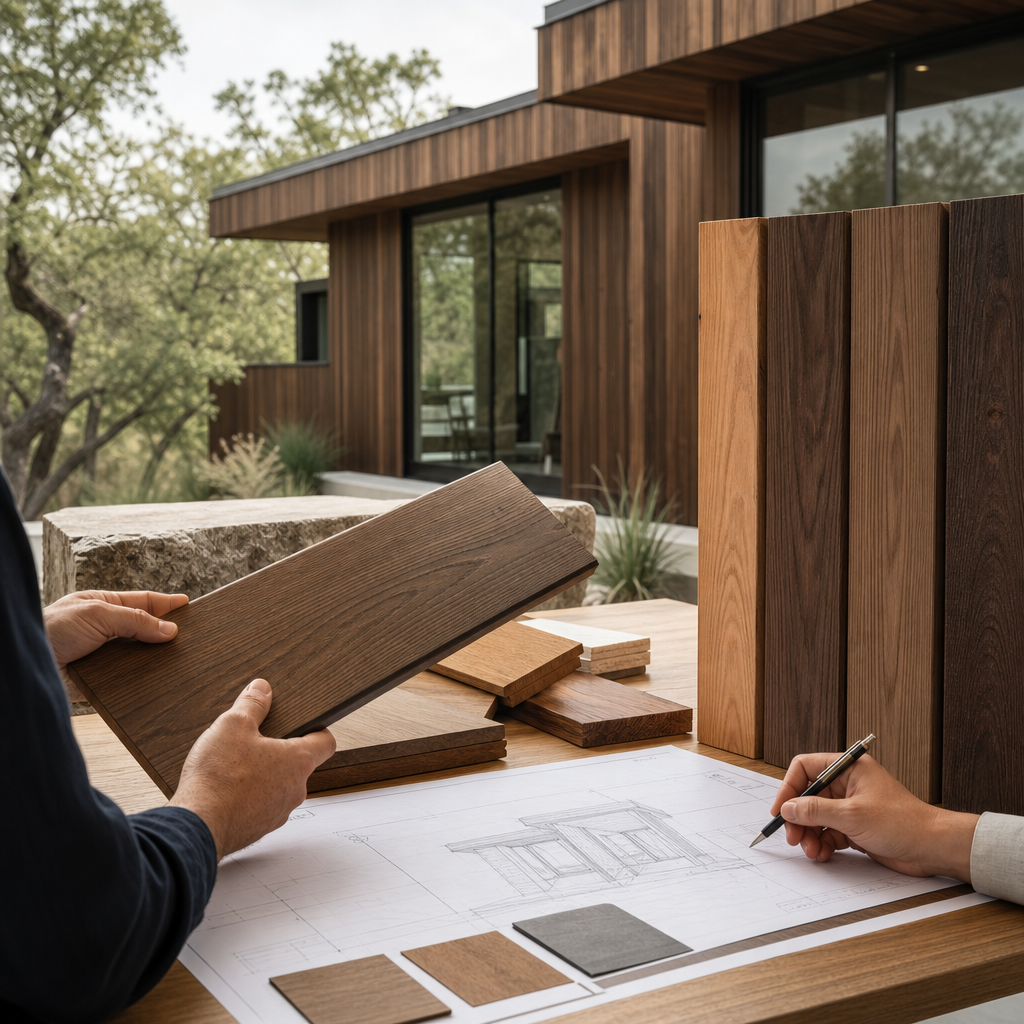
Standard wood siding on a 3,000-square-foot home of premium contemporary design typically requires re-siding or significant restoration within 10-15 years. Re-siding costs $15,000 to $30,000 in material and labor, plus design disruption. That’s the true cost comparison.
Thermowood installed at project inception typically requires no siding replacement or restoration across the life of the home. Routine maintenance, yes. Cleaning, selective re-staining if desired, minor fastener adjustments. But the fundamental material integrity persists.
For a $500,000 to $2M+ custom home, thermowood’s upfront cost represents 2-4% of total project cost. The avoided re-siding cycle represents 5-8% of total project cost across the building’s life. That math is unambiguous.
Beyond cost, consider client satisfaction and your reputation. Thermowood homes age beautifully and perform reliably. Standard wood homes become maintenance burdens. Over decades of practice, that difference in client experience accumulates substantially.
The decision framework: Calculate your project’s total cost of ownership across 25 years. Include material, labor, and the intangible cost of maintenance disruption. Thermowood almost always wins.
Getting Started with Your Thermowood Project
The path forward is straightforward. Share your project specifications, design intent, and timeline with us. We’ll provide material recommendations, sourcing options, and transparent pricing. We’ll help you navigate species selection, finishing approaches, and installation sequencing.
For architects in Austin, the Hill Country, and across Texas seeking premium thermowood suppliers, we’re positioned uniquely. We manufacture and distribute. We understand contemporary design. We deliver material that holds up and looks exceptional for decades.
Contact us with your next project. We’ll deliver the thermowood and support your design deserves.
To place orders, order samples, or talk with a live person.
Frequently Asked Questions (FAQ)
What makes thermally modified wood different from standard wood siding for Austin’s climate?
We source thermally modified wood that undergoes a heat treatment process removing moisture and increasing density, which makes it dramatically more stable in our Texas heat and humidity swings. Unlike standard wood that can warp, crack, or cup, our thermally modified products maintain their integrity year after year. This stability is especially critical for the clean lines and precise aesthetics that modern architects like those inspired by Lake|Flato demand in their designs.
Do we carry WUI Class A fire-rated wood products, and why does this matter for Austin builders?
Yes, we supply a complete line of WUI Class A fire-rated wood products for siding, cladding, decking, and fencing. Given Austin’s proximity to wildland areas and increasingly stringent building codes, having architect-grade materials that meet Class A fire ratings eliminates design compromises. We understand that our architect partners need solutions that satisfy safety requirements without sacrificing the natural wood aesthetic their clients expect.
Can we provide FSC certified thermally modified wood for architects who prioritize sustainability?
We absolutely stock FSC certified thermally modified wood products including Thermally Modified Ash, Pine, Poplar, and Ayous. Our certification ensures our suppliers meet rigorous environmental standards, giving you the documentation your projects need while delivering the durability and beauty your designs require.


