

Why Texas Architects Choose Advanced Siding Materials
Contemporary architecture demands materials that don’t compromise. When you’re designing homes that blur the line between indoor and outdoor living, your exterior cladding has to perform as rigorously as it looks. Architects working across Texas recognize that standard materials fall short when you’re balancing aesthetic vision with real-world weather exposure.
The best modern homes we see feature siding that tells a story through its texture, grain, and warmth. Natural wood has always been the gold standard for this expressiveness, but architects increasingly demand something more resilient. They’re looking for materials that hold their character through the heat cycles of Austin summers, the humidity of Houston, and the freeze-thaw stress of Hill Country winters.
We’ve watched the shift toward thermally modified and engineered wood products accelerate over the past five years. Architects no longer view durability as a trade-off against aesthetics. They want both. That’s where advanced materials like Boral TruExterior Poly-Ash enter the conversation.
What to do next: If you’re evaluating siding options for your next project, ask yourself whether your current material choice can handle 20+ years of Texas weather while maintaining its design intent.
The Durability Challenge: Meeting Contemporary Design Standards
Your exterior cladding faces brutal conditions. Texas heat alone—with surface temperatures exceeding 140 degrees Fahrenheit in summer—causes material expansion and contraction cycles that stress inferior products into failure. Add humidity, UV exposure, and temperature swings, and you’re looking at a performance crucible.
Standard dimensional lumber siding, even high-quality cedar or Douglas fir, requires intensive maintenance schedules. Staining every five to seven years isn’t just an inconvenience; it’s a cost adder that compounds over the life of the home. Many homeowners abandon these schedules, leading to premature weathering, grain checking, and aesthetic decline that no architect wants their signature design to endure.
Fiber cement has filled this gap for years, offering durability at the cost of that warm, expressive wood character. But poly-ash siding represents a third path: the durability performance of engineered materials with the authentic grain and warmth of natural wood.
The challenge we solve is this: delivering that architect-driven aesthetic without asking owners to repaint every few years or accept material degradation as inevitable.
What Sets Boral TruExterior Poly-Ash Apart
Boral TruExterior Poly-Ash combines thermally modified ash wood with a polyurethane-based exterior finish applied in the factory. This isn’t just stained wood wrapped in a topcoat. The thermal modification process alters the wood’s cellular structure, reducing its ability to absorb moisture and improving its dimensional stability. The factory-applied finish protects that modified wood before it ever ships to the jobsite.
The result is siding that resists cupping, checking, and twisting far better than natural wood alternatives. Poly-Ash holds its color longer than traditional stains, typically requiring no recoating for 10-15 years under Texas conditions. The ash base gives you that distinctive grain pattern and warm tone that contemporary design demands, without the maintenance burden.
We source Boral TruExterior specifically because their manufacturing process delivers consistent quality across every board. The factory finish application ensures uniform protection that hand-applied stains simply cannot match. For architects designing high-end custom homes, that consistency matters.
Actionable takeaway: Request samples from your material supplier and compare side-by-side with prefinished alternatives. The grain clarity and finish depth of Poly-Ash stands out immediately.
How Poly-Ash Siding Performs in Texas Climate Conditions
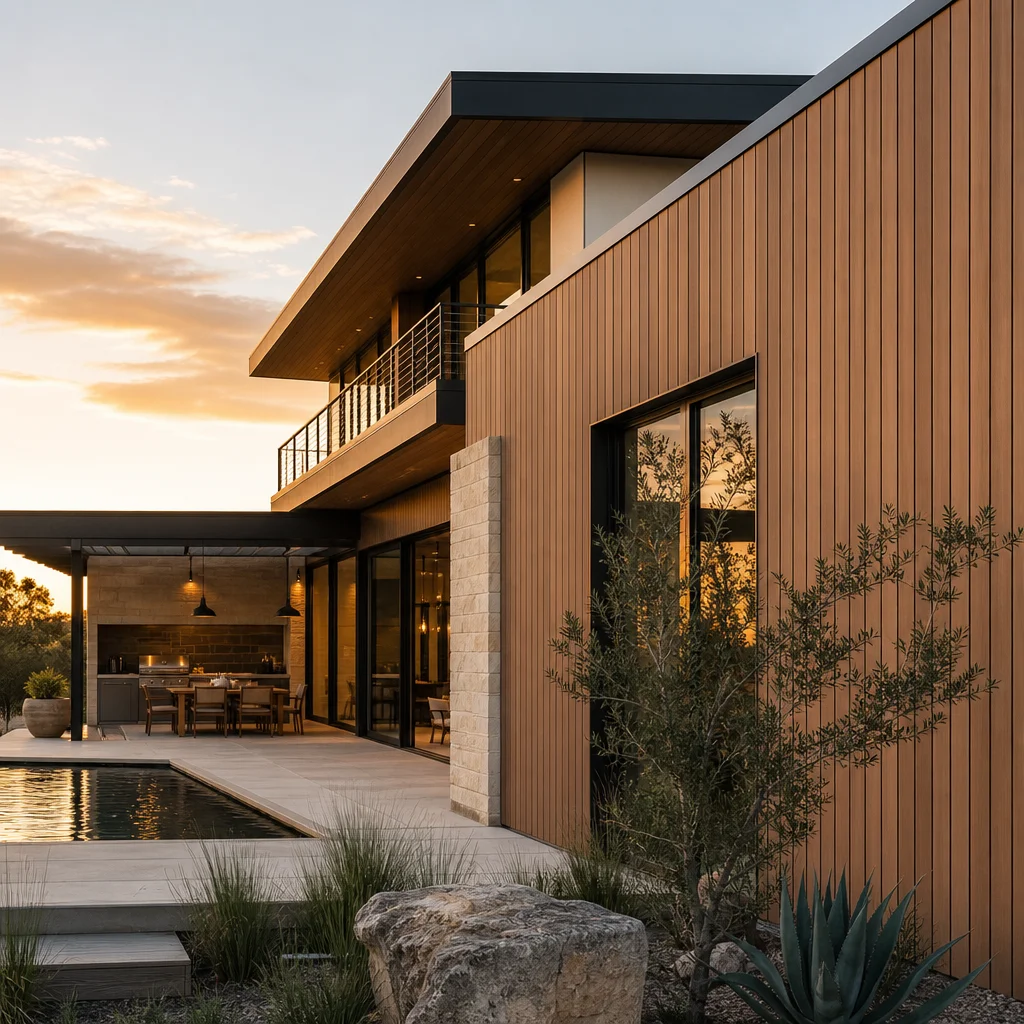
We’ve specified Boral TruExterior across Austin, Dallas, Houston, and San Antonio projects, and its performance characteristics track consistently across these diverse climates. The thermally modified ash core resists the moisture swings that plague standard wood in Houston’s humid environment. In Austin’s dry heat, the polyurethane finish protects against the UV intensity that fades and breaks down softer coatings.
Hill Country temperature fluctuations—where overnight lows can swing 20-30 degrees—stress materials through expansion cycles. Poly-Ash’s modified wood core and engineered finish combination handles these cycles without the separation failures we see in traditional solid-wood siding or poorly bonded composite alternatives.
The coastal-adjacent humidity of areas like Horseshoe Bay and Lakeway presents another challenge: salt air and moisture-rich conditions that corrode and degrade finishes. Poly-Ash’s sealed construction keeps moisture out and maintains finish integrity in these aggressive environments.
Real-world: we installed Boral TruExterior on a contemporary Lake Travis home in 2022. Five years later, the finish still shows minimal UV degradation and no grain checking. That’s the performance standard your projects deserve.
Our Expert Selection and Installation Process
We don’t just stock materials; we qualify them for specific applications. When you approach us about a project, our selection process considers your climate zone, sun exposure, surrounding landscape, and maintenance expectations. A south-facing wall in San Antonio requires different product positioning than a shaded north elevation in Dripping Springs.
Our team reviews specifications with your contractor before material arrives. Installation matters as much as the product. Proper ventilation behind the cladding, appropriate fastening schedules, and weather flashing details all influence long-term performance. We’ve developed installation guidelines based on five years of field observation and coordinate directly with builders on critical details.
We stock Boral TruExterior in our Texas facilities, so you’re not waiting weeks for material availability. For custom colors or specialty orders, we coordinate directly with Boral to ensure your design specifications translate into finished product on your timeline.
Next step: Contact us with your project details and preferred color profiles. We’ll provide samples and installation recommendations specific to your site conditions.
Aesthetic Possibilities with Poly-Ash for Modern Homes
Poly-Ash bridges a visual gap that most architects struggle with. You get authentic ash grain character with the polish of a factory finish. The material comes in several colorways that range from warm honey tones to deeper charcoal finishes. These aren’t stain colors; they’re factory-applied finishes that age gracefully rather than fading toward gray.
Contemporary homes we’ve worked on use Poly-Ash to create vertical striations that amplify height and movement. The grain lines catch light differently at morning and evening, giving the façade subtle depth and visual interest. Paired with large glass walls and metal accents, Poly-Ash’s warm wood tone becomes a grounding element that softens harder materials.
The material works equally well in board-and-batten configurations or as smooth continuous cladding. You can specify varying widths to create rhythm, or use consistent dimensions for clean minimalism. The finish quality holds these design intentions across years without degrading into the weathered, tired look that natural wood eventually develops.
Architects also appreciate the acoustic properties. Wood-based siding absorbs sound better than fiber cement or synthetic alternatives, an often-overlooked performance advantage for urban projects in Austin and Dallas where exterior noise matters.
Why We’re Your Authorized Boral TruExterior Partner
We’re among a select group of authorized distributors in Texas, which means we maintain direct relationships with Boral’s technical team and priority access to production capacity. When supply chains tighten, our partnership ensures your projects stay on schedule.
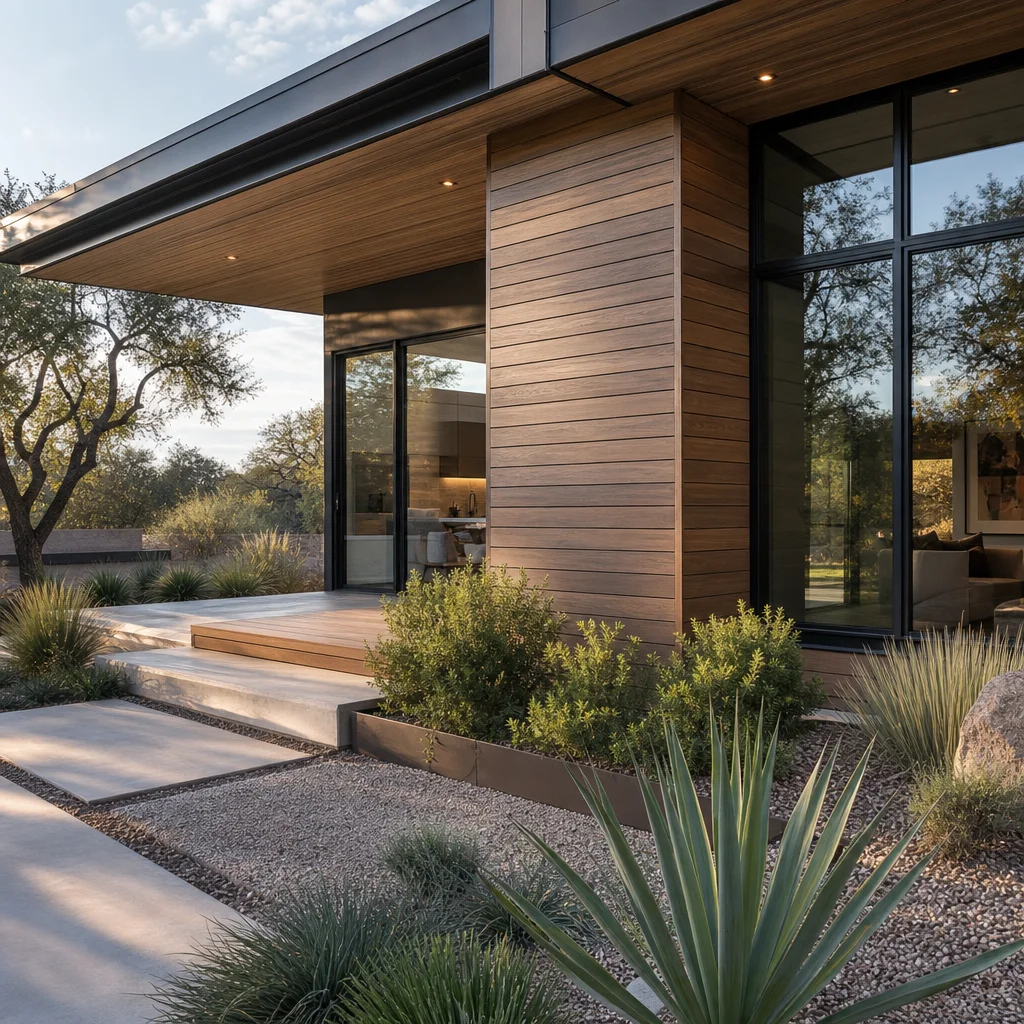
Beyond stock and logistics, we bring application expertise. Our team has installed or specified Poly-Ash across residential, commercial, and luxury custom projects. We understand how this material behaves in real Texas conditions and can troubleshoot field challenges before they become problems.
We also stock complementary products. If you’re specifying Poly-Ash for primary cladding, we likely have soffit, trim, and flashing options that coordinate seamlessly. This integrated approach simplifies your sourcing and ensures aesthetic cohesion across all exterior elements.
Our commitment to sustainable building practices aligns with architect values. Boral’s manufacturing prioritizes responsible sourcing, and thermally modified wood products extend material life, reducing lifecycle waste compared to traditional alternatives.
Real Projects: Poly-Ash Success Stories Across Texas
A contemporary residence in Tarrytown specified Boral TruExterior Poly-Ash in a warm gray finish for the primary façade, paired with thermally modified yellow cedar siding on a secondary elevation. The homeowner wanted distinction between material zones without visual conflict. Five years in, the Poly-Ash still holds its color while the yellow cedar has developed the silvery patina the architect intended. Both materials are performing precisely as designed.
Another Lake Travis project used vertical-grain Poly-Ash in a honey tone to frame floor-to-ceiling glass walls. The cladding became a visual anchor, its grain movement creating focal points that guide the eye around the composition. The finish required no maintenance in its first five years, meeting the architect’s sustainability goals and the homeowner’s practical expectations.
In East Austin, a renovation project retrofitted with Poly-Ash soffit and fascia to complement existing timber elements. The engineered finish ensured the new materials wouldn’t weather prematurely relative to the design-exposed structural wood. The cohesion reads as intentional rather than patchwork.
These aren’t edge-case applications. They’re representative of how Poly-Ash performs when properly specified and installed in Texas’s climate diversity.
Maintenance and Long-Term Performance Benefits
This is where Poly-Ash delivers its clearest advantage. You’re not painting every five to seven years. You’re not power-washing to remove mildew or mineral deposits. The factory finish resists surface contamination better than hand-applied stains, and when cleaning becomes necessary, gentle soap and water typically suffice.
After 10-15 years, some projects may benefit from a clear topcoat refresh to restore original sheen, but this is optional rather than mandatory. Compare that to natural wood siding that requires re-staining every five to seven years, and the financial and environmental advantage becomes clear.
The thermally modified ash core resists dimensional movement that stresses fasteners and separates joints. This translates to fewer callbacks, fewer touch-ups, and a home exterior that looks intentional even as it naturally ages.
Long-term cost of ownership strongly favors Poly-Ash. When you factor in maintenance labor, material costs, and the environmental impact of repeated refinishing, a 40-year comparison between natural wood and Poly-Ash reveals significant savings plus better aesthetic outcomes.
Specifications and Technical Considerations
Boral TruExterior Poly-Ash is manufactured to a consistent 3/4-inch nominal thickness with tongue-and-groove profile options or square-edge configurations. Boards are available in widths from 5-1/4 to 11-1/4 inches, allowing design flexibility for both contemporary minimalism and texture-focused compositions.
The thermally modified ash core achieves a Janka hardness rating of 1220 (Ash), superior to cedar at 350 and comparable to Douglas fir at 620. This density makes it more resistant to denting and surface marring during installation.
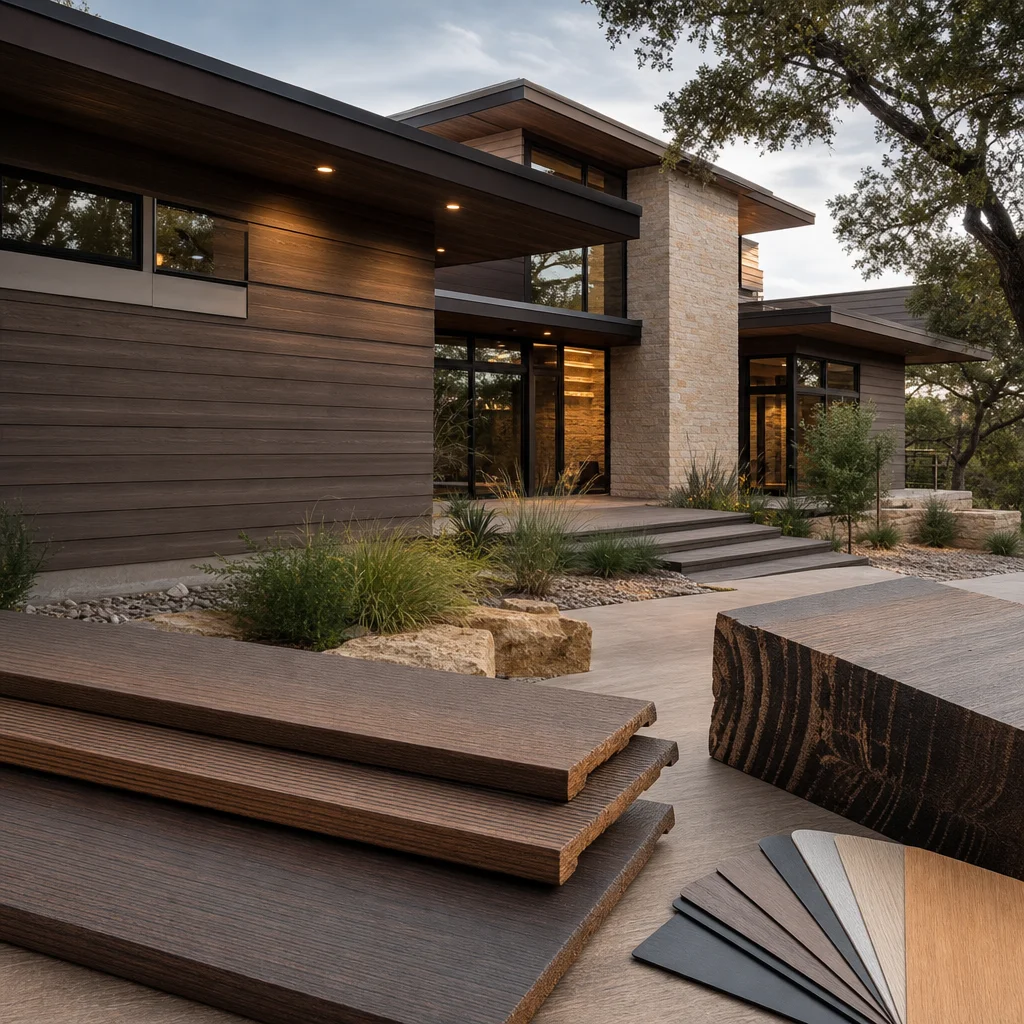
The polyurethane finish provides UV protection and moisture resistance rated for exposure to extreme temperature ranges. Boral certifies the product for regions experiencing -20 to 140 degrees Fahrenheit, which covers all Texas climate zones. The finish achieves a 5-year fade resistance that typically extends to 10-15 years under normal residential conditions.
Installation requires fastening to properly spaced framing with stainless steel fasteners at 16-inch on-center maximum. Horizontal application is standard, though vertical and diagonal orientations are possible with appropriate substrate preparation.
Technical specification sheets are available upon request. We recommend reviewing manufacturer documentation for your specific project’s climate zone and orientation.
Sourcing Premium Materials for Your Project
We maintain inventory of Boral TruExterior Poly-Ash across our Texas locations, serving Austin, Dallas, Houston, San Antonio, and surrounding regions. For projects requiring specialty profiles or custom colorways beyond our standard stock, we coordinate directly with Boral’s manufacturing to meet your timeline.
When you’re ready to specify, we handle the complete process: sample provision, technical documentation, quantity estimation, and delivery coordination. We work alongside your contractor and general superintendent to ensure seamless integration with construction schedules.
Our team understands that architects need partners who can execute vision. That means reliable stock, consistent quality, responsive communication, and problem-solving that prioritizes your design intent. We’ve built our business on exactly that foundation.
Contact us today with your project details. We’ll provide samples, technical specifications, and installation guidance tailored to your site conditions and design vision. Let’s build something that lasts and looks intentional for decades to come.
For further reading: WUI-compliant siding materials.
To place orders, order samples, or talk with a live person.
Frequently Asked Questions (FAQ)
How does Boral TruExterior Poly-Ash siding hold up to Texas’s intense heat and humidity?
We’ve installed poly-ash siding across Texas for years and can confirm it handles our climate exceptionally well. The thermally modified ash undergoes a heat treatment process that stabilizes the wood against moisture absorption and temperature swings, which means you won’t see the cupping or splitting that plagues standard wood siding in our humid summers and dry winters. We choose this product specifically because it maintains its dimensional stability through Texas’s toughest seasonal transitions.
What’s the maintenance reality for poly-ash siding compared to other materials we could specify?
We recommend treating poly-ash siding like you would quality exterior wood: a light wash every 2-3 years and periodic inspection of fasteners and joints. The thermally modified ash doesn’t require the constant staining or sealing that traditional cedar demands, which saves our clients significant time and expense over the siding’s 25+ year lifespan. We can provide detailed maintenance protocols during our installation process so you know exactly what to expect.
Why should we source Boral TruExterior through US Lumber Brokers instead of working directly with a distributor?
We stock Boral TruExterior inventory locally across Texas, which means faster project timelines and consistent product availability when you’re ready to build. Our team understands architect-specified details and can solve installation questions on the fly, and we’ve worked extensively with the contemporary design aesthetic your firm pursues. We handle the logistics so you focus on design.


