

Why Architects Choose Sustainable Wood Over Alternatives
Texas architects designing residential and commercial projects increasingly reject composite decking and vinyl siding in favor of authentic wood. The reason is straightforward: nothing delivers the warmth, authenticity, and visual richness that clients expect from architect-driven contemporary homes quite like real wood.
Composites mask their environmental footprint behind marketing claims. They’re petroleum-based, difficult to recycle, and lack the material expressiveness that defines modern design. Vinyl? It looks cheap from most angles and degrades in Texas heat. Traditional softwoods like untreated pine or cedar offer genuine aesthetic appeal but fail in durability, weather resistance, and the fire-rated compliance that increasingly defines Texas construction codes.
Sustainable wood represents a third path. It delivers authentic material character while meeting structural performance demands and environmental responsibility standards that today’s architects demand. We’ve found that when architects specify sustainable wood products, they’re solving multiple project constraints at once: design integrity, code compliance, long-term durability, and honest material sourcing.
Your takeaway: Start with your material philosophy first, then specification requirements. Sustainable wood aligns both in ways composites and traditional wood cannot.
Kebony’s Thermal Modification Process and Environmental Benefits
Kebony uses a proprietary thermal modification process that fundamentally transforms wood at the cellular level. Unlike surface treatments, this process penetrates throughout the wood’s structure, improving durability and stability without chemical coatings, preservatives, or toxic additives.
Here’s how it works: raw wood is exposed to controlled heat and minimal oxygen in a specialized chamber. This process reduces the wood’s moisture absorption capacity, making it far more resistant to rot, fungal decay, and dimensional instability. The wood becomes naturally durable in the way tropical hardwoods are, but without the environmental concerns of rainforest harvesting.
The environmental story matters to your clients and your firm’s values. Kebony sources FSC-certified softwoods like pine, ash, and poplar, then thermally modifies them to deliver tropical-hardwood-level performance. This means no clear-cutting of slow-growth species; no carbon-intensive shipping from distant continents. We’re extending the life of fast-growing, renewable domestic species while reducing embodied carbon compared to conventional hardwood imports.
The modification also makes the wood naturally more stable across Texas’s extreme seasonal humidity swings, reducing warping, checking, and movement that can compromise design integrity over time.
What to do next: Request material source documentation and FSC certification details when specifying thermally modified siding or thermally modified decking. We provide complete chain-of-custody transparency for every project.
Performance Advantages for Texas Climate and Building Codes
Texas presents brutal conditions for exterior wood: intense UV exposure, dramatic humidity swings, occasional high winds, and wildfire risk in Hill Country regions. Thermally modified wood handles all of this without compromise.
Traditional cedar and Douglas fir gray significantly in Texas sun. Kebony’s thermal modification creates a dense, oxidation-resistant surface that weathers to a silvery-gray more gradually and uniformly. More importantly, the wood doesn’t lose structural integrity under UV exposure the way untreated softwoods do. After five years in direct Austin sun, Kebony maintains its dimensional stability where conventional cedar or hemlock would have already shown checking and movement.
Moisture swings between 15% humidity in winter and 70%+ in summer cause traditional wood to expand and contract unpredictably. This affects everything from attachment consistency to cladding alignment. Kebony’s thermal process locks in dimensional stability by reducing moisture uptake by up to 50%, meaning fewer callbacks and longer periods between maintenance cycles.
For WUI (Wildland-Urban Interface) zones throughout the Texas Hill Country, Austin’s West Lake Hills area, and San Antonio’s surrounding regions, Kebony meets or exceeds Class A fire-rating requirements when properly specified. This matters for properties in Spicewood, Dripping Springs, Driftwood, and Bee Cave where fire codes increasingly demand non-combustible or fire-resistant exterior materials.
Actionable step: Cross-reference your project location against Texas fire marshal guidelines and request Kebony’s fire-rating documentation. We’ll help you specify compliant profiles for your jurisdiction.
Design Versatility Across Contemporary and Modern Aesthetic Projects
The best sustainable material is one that your design actually calls for. Kebony works beautifully within the architectural language that defines practices like Lake|Flato and Page: warm-toned, expressive wood surfaces that blur indoor-outdoor boundaries through generous glazing and natural material honesty.
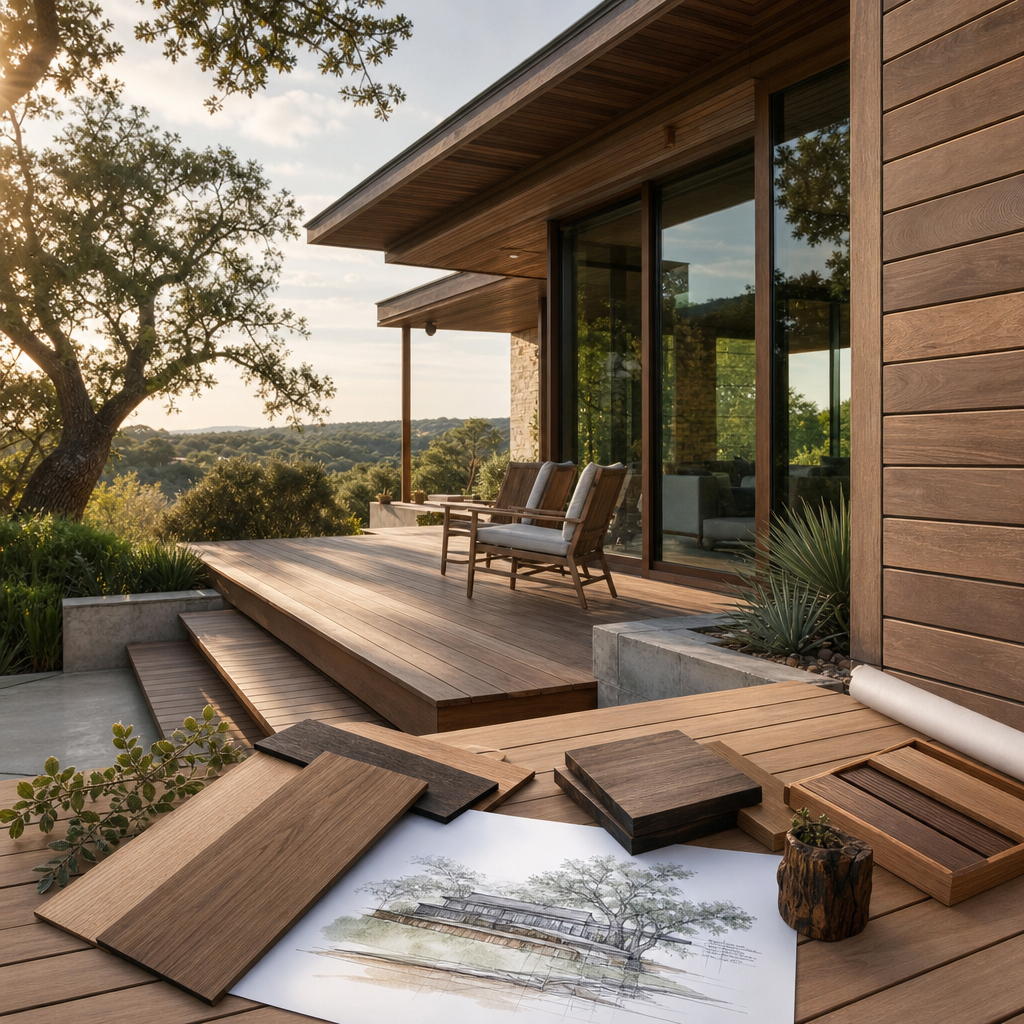
Kebony comes in multiple profiles suited to different contemporary expressions. Smooth boards create clean lines and minimalist elegance. Fluted or textured profiles add visual depth and shadow play, especially effective when paired with expansive glass walls. The wood’s natural color range, from warm honey to deeper gray tones as it weathers, provides subtle variation that enhances rather than distracts from overall design composition.
The material also accepts custom finishes. Some architects specify clear protective coatings that preserve the original warm tone longer, while others embrace the silver-gray weathered aesthetic as part of the design’s evolution. Both approaches work structurally and visually because Kebony’s thermal process ensures stable performance regardless of finish choice.
Kebony integrates seamlessly with the other honest materials your designs favor: substantial timber framing, natural stone, concrete, and glass. It reads as authentically as these materials because it is authentically wood, not a surrogate material pretending to be something else.
Design consideration: Create material sample boards with actual Kebony profiles, multiple finish options, and weathered samples side-by-side. This allows you to evaluate how each variant will contribute to your overall aesthetic as sun and weather change it.
Durability Comparison: Kebony vs. Composite and Traditional Wood
Let’s be direct about the durability hierarchy. Traditional softwoods like untreated cedar and Douglas fir serve many applications well, but their lifespan in exposed Texas conditions is typically 8-15 years before significant degradation requires remedial work. That’s a built-in replacement cycle that adds cost and disruption.
Composite decking and siding market themselves as “maintenance-free” alternatives. In reality, they discolor, fade unpredictably under Texas UV exposure, can develop mildew in humid conditions, and show their petroleum-based origins within 5-7 years. They’re also difficult to repair or refinish once damage occurs, and they’re troublesome to recycle at end of life. Cost per square foot looks competitive initially, but the total cost of ownership across 20+ years tells a different story.
Kebony delivers the durability of premium tropical hardwoods like ipe or cumaru, but with the workability and cost profile closer to traditional softwoods. Field performance across North America shows Kebony lasting 20-30+ years with minimal intervention in residential applications. In commercial settings with proper maintenance, we’re seeing reliable performance beyond 40 years.
The thermal modification process actually deepens the wood’s natural resistance to attack. Unlike surface-applied treatments that degrade over time, the cellular-level changes are permanent. There’s no coating wearing away; there’s no chemical restocking required. The wood gets better and more distinctive as it weathers.
What this means for your projects: Specify Kebony and you’re designing longevity into the home from inception. Your contemporary design today becomes a timeless home tomorrow, not a building that requires major exterior renovation in 10-15 years.
Our Kebony Inventory and Customization Options
We stock a comprehensive range of Kebony profiles in multiple species, all thermally modified to Kebony’s specifications. Our inventory includes Kebony ash, pine, poplar, and ayous in siding, decking, and cladding profiles suitable for everything from residential feature walls to large commercial applications.
Beyond Kebony, we maintain full inventory of complementary sustainable wood products that work in tandem with thermally modified materials. FSC-certified vertical grain Douglas fir, clear western red cedar, hemlock, and cypress serve as options for specific design requirements or budget adjustments. We also stock premium hardwoods like ipe, cumaru, garapa, massaranduba, and tigerwood for architects who want maximum durability or bold color expression in specific applications like featured decking areas or accent cladding.
Customization matters. We work directly with architects to specify mill-run profiles, unique dimensions, and custom finishes that standard suppliers can’t deliver. Need 8-inch vertical grain Douglas fir boards with a specific reveal pattern? Custom fluted cladding in a non-standard width? We source directly from manufacturers and can facilitate special runs for signature projects.
We also distribute established brands like Arbor Wood, Tantimber, TimberTech, Trex, and Fiberon for architects who need composite or hybrid options alongside solid wood specifications. This integrated approach means we’re solving material requirements comprehensively, not pushing a single product line.
Next step: Share your material specifications and we’ll provide sample boards, milling options, and availability timelines. We typically source special runs within 4-6 weeks.
Real-World Applications in Texas Residential and Commercial Projects
Kebony performs spectacularly in the specific applications that define contemporary Texas architecture. In Hill Country modern homes with floor-to-ceiling glass walls, Kebony siding creates the warm exterior envelope that frames expansive interior spaces. The thermal stability ensures that the cladding remains perfectly aligned with the glass planes year-round, maintaining clean sight lines and architectural intention.
For residential decking adjacent to those glass walls and living spaces, Kebony decking delivers a walking surface that remains dimensionally stable as the wood weathers. Unlike traditional wood decks that develop soft spots or uneven boards within 5-10 years, Kebony decks maintain their structural integrity and appearance across 20+ years, allowing the design language to evolve gracefully rather than decline toward replacement.
Commercial applications benefit equally. We’ve specified Kebony extensively for hospitality projects, office buildings, and mixed-use developments across Austin, San Antonio, Dallas, and Houston where design integrity and long-term performance are non-negotiable. The wood’s dimensional stability is essential in environments where precision tolerances matter for both function and aesthetics.
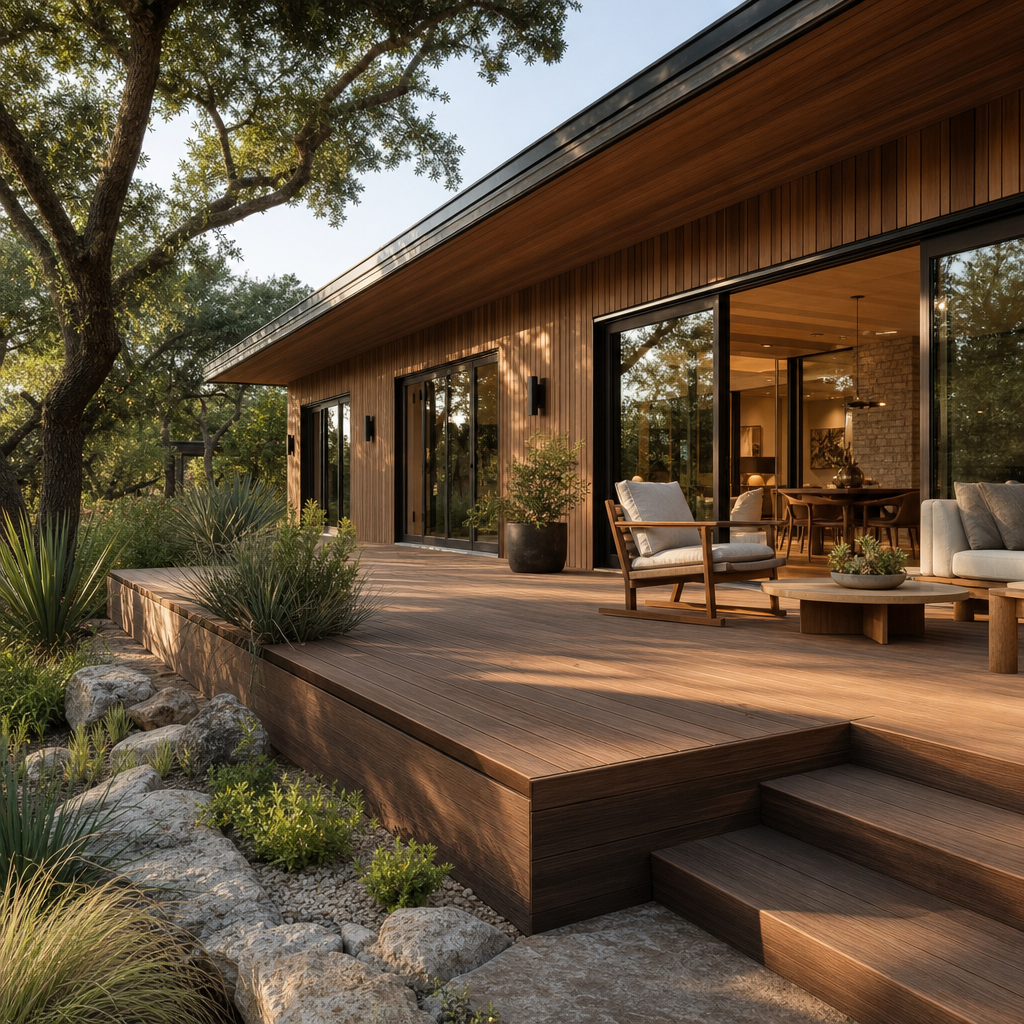
East Austin renovation projects increasingly call for Kebony because it offers genuine material authenticity that gentrification often tries to fake with artificial finishes. Downtown Austin boutique hotels, Tarrytown residences, and West Lake Hills luxury homes all benefit from Kebony’s honest performance and timeless character.
Consider: How is your current project positioned for maintenance cycles? Specify Kebony if you want to eliminate major exterior renewal as a line item in the owner’s long-term budget.
Integration with Glass and Natural Material Design Philosophy
Your architectural philosophy depends on honest material expression. Glass isn’t trying to be anything but transparent. Stone or concrete isn’t pretending to be wood. In this context, thermally modified wood like Kebony becomes the logical choice because it’s wood being its best self, not a manufactured surrogate.
Kebony’s color range and weathering pattern integrate beautifully with the materiality-driven design that characterizes contemporary Texas architecture. As the wood weathers from warm tones to silver-gray, it establishes visual dialogue with concrete, stone, and glass rather than competing for attention. The material becomes a conversation between surfaces, not a single dominant element.
The workability of Kebony also matters. Unlike dense hardwoods that require specialized tooling and skills, Kebony machines and installs like quality softwood. This means your builders and subcontractors aren’t struggling with material unfamiliar to them. Installation happens cleanly, which translates directly to better craftsman quality and fewer site adjustments.
Paired with natural light and generous glazing, Kebony’s wood grain and subtle texture variations create visual warmth that no composite or artificial material can replicate. As daylight moves across a Kebony facade throughout the day, the wood’s depth and character respond in ways that strengthen the overall design intention.
Design principle: Specify Kebony alongside your glass and hardscape materials as part of a unified material story. The wood doesn’t compete; it completes.
WUI Class A Fire Rating and Compliance for Texas Regions
Texas fire codes increasingly require Class A fire ratings for exterior materials in Wildland-Urban Interface zones. If your project sits within defined WUI areas anywhere from the Hill Country to suburban Austin, Dallas, Houston, or San Antonio, fire rating isn’t optional.
Kebony achieves Class A fire rating when properly specified and installed. The thermal modification process increases the wood’s fire resistance by improving its char-forming properties. Under fire exposure, Kebony develops a protective char layer that slows deeper wood ignition, meeting or exceeding ASTM E84 standards required for Class A designation.
This is critical because traditional cedar or Douglas fir typically don’t achieve Class A ratings without chemical fire-retardant treatments, which introduce toxins and compromise sustainability. Kebony delivers fire compliance through material science, not chemistry. Your design maintains its integrity while meeting code requirements.
We provide complete fire-rating documentation and work with local building officials to ensure specifications are accepted without revision cycles. For projects in Spicewood, Dripping Springs, Bee Cave, and surrounding Hill Country developments, we handle the technical compliance so you and your builders focus on design and construction quality.
Compliance step: Have us verify your project’s fire zone designation and provide applicable Kebony fire-rating documentation early in the specification process. This eliminates last-minute surprises during plan review.
Cost-Benefit Analysis for Architect-Driven Custom Homes
Budget conversations require honesty. Kebony costs more per square foot than conventional cedar or softwood but less than premium tropical hardwoods or high-end composite systems. The typical range we see is roughly 15-25% higher than untreated cedar, significantly lower than ipe or cumaru.
Where Kebony dominates the cost-benefit calculation is across the building lifecycle. A cedar deck specified at $15/sq ft that requires major restoration or replacement at year 12 costs substantially more than Kebony at $18-20/sq ft that delivers reliable performance for 25+ years. The maintenance differential alone justifies the initial investment.
For custom homes where the owner’s long-term satisfaction matters—where these homes often remain in families or drive significant resale value in markets like Lake Travis, Horseshoe Bay, or prestigious Austin neighborhoods—Kebony eliminates the “exterior refresh” project that becomes necessary with other materials. This absence of future capital expenditure translates directly into value retention for the homeowner.
Commercial projects benefit from reduced maintenance labor costs and elimination of structural replacement cycles. A hotel or office building specified with Kebony simply performs better over 20-30 years than conventional wood or most composites, reducing operational costs while maintaining design integrity.
We can model lifecycle costs for your specific project if desired. In nearly every scenario, Kebony delivers the lowest total cost of ownership across 20+ years, making the initial premium irrelevant from a financial perspective.
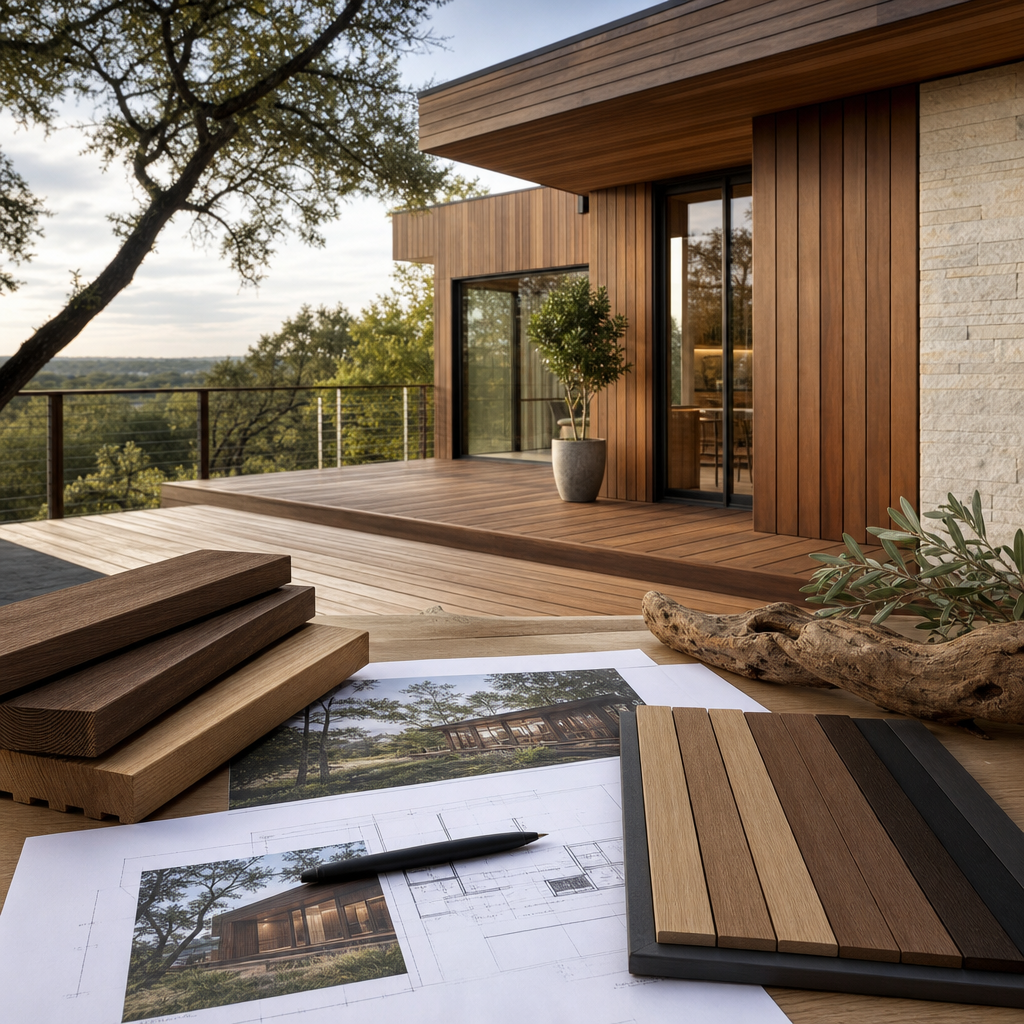
Financial takeaway: Present Kebony to your clients as the option that eliminates costly exterior renovation 10-15 years into ownership. This framing shifts the conversation from cost to value retention.
Why Kebony Represents the Gold Standard Solution
After years of specifying and distributing sustainable wood products across Texas, we’re confident that Kebony represents the definitive choice for architect-driven contemporary homes. No other material delivers the combination of authentic wood aesthetics, superior durability, environmental responsibility, and long-term performance stability that Kebony achieves.
Composites promise low maintenance but deliver visual compromises and significant end-of-life waste. Traditional softwoods provide authentic material but lack durability in Texas’s extreme climate. Tropical hardwoods offer durability but introduce environmental baggage and supply chain complexity. Kebony is the only solution that optimizes across all these dimensions simultaneously.
The thermal modification process is the key differentiator. It’s not a surface treatment or chemical additive; it’s a fundamental transformation of wood’s cellular structure that ensures permanent performance benefits. This technology represents genuine material innovation that improves upon nature without corrupting it.
We’ve specified Kebony for residential projects from downtown Austin to Hill Country estates, commercial applications across major Texas cities, and everything between. The material consistently outperforms expectations. Owners appreciate the warmth and authenticity. Architects appreciate the design flexibility and long-term reliability. Builders appreciate the straightforward installation and predictable performance.
For projects where your design vision, budget discipline, and client expectations all need to align, Kebony is the material that makes all three possible.
Getting Started with Our Kebony Selection and Specifications
Start by scheduling a consultation with our team. We’ll discuss your specific project requirements, site conditions, design aesthetic, and performance priorities. From there, we can provide material samples, milling options, finish recommendations, and realistic timelines for your custom specifications.
We provide complete specification support, helping you develop details that work with local building officials and construction teams. We source samples, coordinate with manufacturers, and maintain inventory to ensure your project timeline stays on track. For special runs or custom profiles, we typically deliver within 4-6 weeks of order confirmation.
Once you’ve identified your material, we can connect you with builders and contractors experienced in Kebony installation. We also provide installation guidelines and support to ensure that the material performs as intended on your project.
Kebony is more than a product specification; it’s a commitment to design integrity, environmental responsibility, and long-term performance. We’re ready to help you bring that commitment to your next Texas architectural project. Reach out, and let’s discuss how sustainable wood transforms what you build.
To place orders, order samples, or talk with a live person.
Frequently Asked Questions (FAQ)
Why do we recommend thermally modified wood like Kebony for Texas architects?
We carry thermally modified products because they deliver the aesthetic warmth that contemporary architecture demands while offering superior stability in Texas’s variable climate. Our Kebony inventory—including thermally modified ash, pine, and poplar—resists the warping and checking that plague traditional wood in our heat and humidity cycles, giving your designs the longevity they deserve without compromising on that natural material expression your projects require.
Can we supply WUI Class A fire-rated wood products for projects in high-risk Texas regions?
Yes, we stock a complete line of WUI Class A approved woods for siding, cladding, decking, and framing. Our inventory meets the stringent fire-rating requirements for wildfire-prone areas across Texas, so your designs remain compliant with local building codes while maintaining the authentic wood character that defines your firm’s work.
What customization options do we offer beyond our standard Kebony and hardwood inventory?
We manufacture custom profiles and dimensions in clear and vertical grain cedars, Douglas fir, hemlock, and cypress to match your specific design intent. Beyond our core thermally modified and tropical hardwood lines, we also partner with leading brands like Arbor Wood and Tantimber, giving us flexibility to source or produce exactly what your project needs.


