

Why Architects Choose ThermoWood for Contemporary DFW Designs
Thermally modified wood has become a go-to material for Dallas-Fort Worth architects pursuing contemporary designs with authentic warmth and durability. The material delivers what modern design demands: a rich, visually distinctive surface that weathers beautifully over time, combined with engineered performance that standard lumber simply cannot match.
We’ve watched this trend accelerate over the past five years. Architects working in the Lake|Flato and Page traditions recognize that ThermoWood offers something critical to their aesthetic vision. The thermal modification process deepens wood color naturally, creating depth and character without stains or coatings. For cladding and siding applications across DFW, this translates to exteriors that age gracefully while maintaining structural integrity in Texas heat and humidity cycles.
Beyond aesthetics, ThermoWood checks practical boxes. Its dimensional stability means fewer callbacks for warping or checking. Its resistance to decay and insect damage reduces long-term maintenance costs. For high-performance projects where architects specify exact profiles and finishes, ThermoWood allows precision manufacturing without compromise.
Action step: If you’re working on a contemporary residential or commercial project and considering wood cladding, pull together your design intent and aesthetic target. ThermoWood often outperforms conventional wood on both fronts.
The Challenge of Sourcing Custom Profiles in North Texas
Finding a supplier capable of delivering architect-specified custom ThermoWood profiles in the DFW region remains a genuine bottleneck. Most regional lumber yards stock commodity products, not custom mill work. National distributors impose long lead times and minimum orders that don’t align with the phased timelines typical of architect-designed custom homes.
The challenge intensifies when you need non-standard dimensions, specific grain orientation, or profile combinations that exist in your CAD file but nowhere in standard inventory. A 5/4 x 8 vertical grain Western Red Cedar comb siding is common. A thermally modified poplar fascia with a custom ogee profile? That requires coordination between your design, our milling capabilities, and material sourcing that most suppliers won’t undertake.
We’ve built our business around solving exactly this problem. Working directly with architects across Texas means we understand your specification language, your timeline constraints, and your aesthetic requirements. We carry the inventory depth and custom milling capacity that lets us say yes to profiles that would stall a project elsewhere.
Action step: When you’re developing material specifications, don’t restrict yourself to what you assume is “standard.” Reach out early with your profile sketches and dimensions. We can often accommodate custom work without the lead-time penalty you’d expect.
What Makes ThermoWood Ideal for High-Performance Cladding
Thermal modification is a heat treatment process, not a chemical one. Wood is heated to 160-240 degrees Celsius in a controlled oxygen-free environment, fundamentally altering its cellular structure. This creates wood that is dimensionally more stable, more decay-resistant, and naturally darker than its unmodified counterpart.
For DFW cladding applications, this matters intensely. Texas summer heat and the humidity swings between seasons create stress on exterior wood. Thermally modified wood’s reduced moisture movement translates directly to tighter joints, fewer stress cracks, and longer intervals between maintenance. The color shift from the modification process is permanent, so you’re not relying on finishes to age beautifully.
We source thermally modified woods in ash, pine, poplar, and Ayous species, each bringing distinct character to contemporary designs. Ash delivers a subtle grain with warm undertones. Pine offers bold grain character. Poplar provides a fine, uniform appearance. Ayous brings a creamy base tone that reads as deeply warm without the brown depth of cedar.
Fire performance is another advantage. Many of our ThermoWood products meet WUI Class A ratings, critical for projects in fire-prone Hill Country regions and increasingly relevant across North Texas as building codes tighten.
Action step: Specify ThermoWood for any exterior application where long-term dimensional stability and minimal maintenance align with your design vision. It’s not a cost-cutting choice, but a performance upgrade.
Our Custom Milling Capabilities for Architect-Specified Profiles
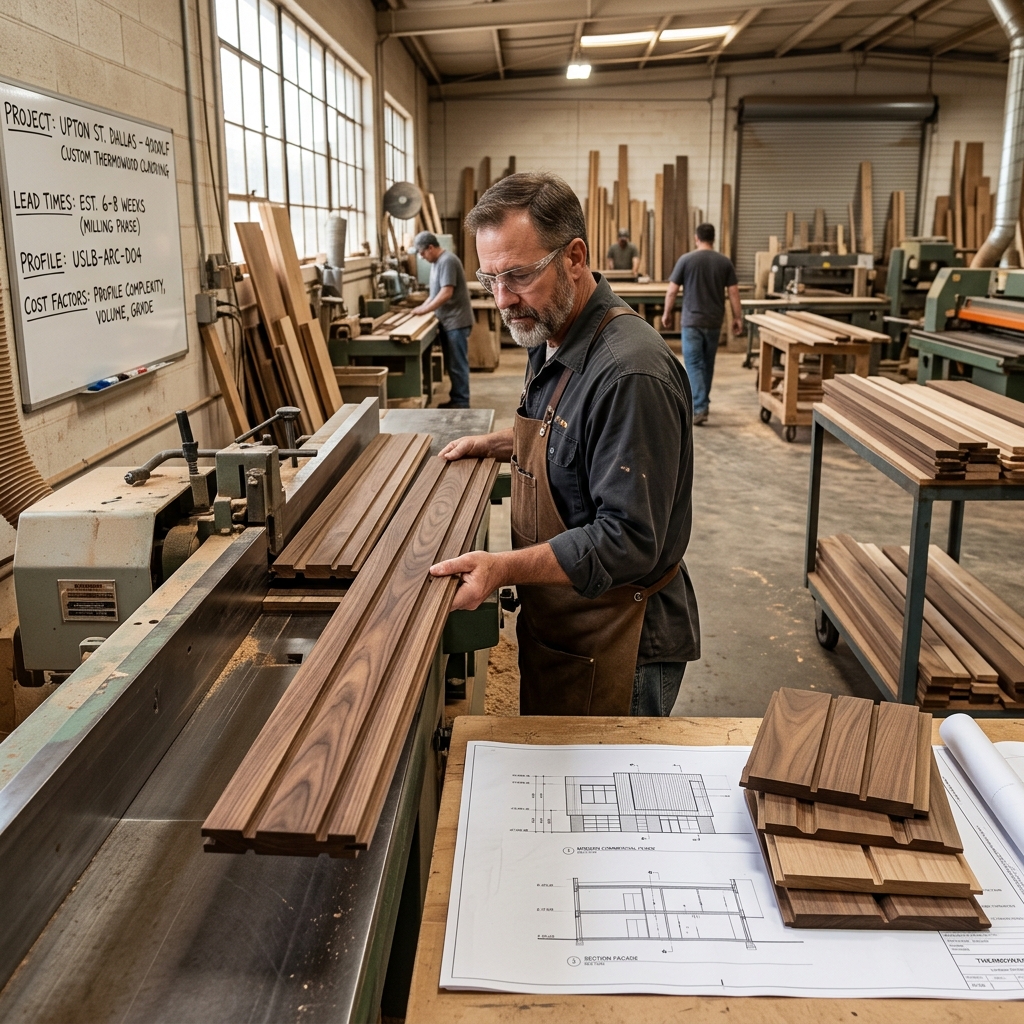
We operate a full milling facility equipped to handle custom profile work that goes well beyond standard commodity shapes. Your architect can specify bespoke details, and we can deliver them in ThermoWood or complementary species at predictable lead times and pricing.
Our milling capabilities include:
- Radius and ogee edge profiles for aesthetic detailing
- Custom width and thickness dimensions for non-standard applications
- V-groove and shiplap milling for architectural effect
- Specialty trim and fascia shapes
- Multiple species coordination within a single project
When you submit specifications, we evaluate what we can source as blanks versus what requires custom milling from raw stock. This assessment directly impacts your timeline and cost. A custom fluted cladding profile in thermally modified ash, for example, typically runs 3-4 weeks from order confirmation to delivery. Standard reprofile work on existing stock moves faster.
We maintain relationships with mills across North America capable of specialty work beyond our facility, expanding what we can deliver without manufacturing bottlenecks.
Action step: During your design development phase, loop in your lumber supplier with profile sketches and typical dimensions. Early coordination prevents specification changes that compress already-tight construction timelines.
Typical Lead Times for Custom ThermoWood Orders
Lead time expectations vary by profile complexity and material sourcing requirements. Understanding these windows helps you build realistic project schedules.
Standard ThermoWood profiles in common dimensions (typical thermally modified siding widths, standard thicknesses) run 2-3 weeks from order to delivery when we hold inventory. Custom milling of profiles from thermally modified blanks we stock extends this to 3-4 weeks. When we’re sourcing blank stock for custom work, plan 4-6 weeks.
Material-specific timing matters too. Thermally modified ash and pine typically have shorter sourcing windows than Ayous or specialty imports. If your design specifies a particular ThermoWood species and custom profile combination, we’ll confirm sourcing availability and timeline within 24 hours of receiving specs.
Seasonal variations affect lead times slightly. Summer months see heavier demand from residential projects; spring and fall often allow for tighter windows. We manage our raw material inventory to smooth these variations, but transparency about timing is critical when you’re coordinating with general contractors and trade schedules.
Action step: Request lead-time confirmation in writing when you place custom profile orders. Include this timeline in your construction schedule as a fixed dependency, not a variable.
Cost Factors and Budget Planning for Modified Wood Projects
ThermoWood costs more than standard lumber, but the performance premium and aesthetic authenticity justify the investment for contemporary custom work. Understanding cost drivers helps you budget accurately and explain value to owners and builders.
Thermally modified wood typically runs 30-50% above comparable conventional species for equivalent dimensions. The thermal modification process itself adds cost, as does the quality control and handling required to preserve the material’s properties. Custom milling adds another 15-25% depending on profile complexity and production setup time.
Species selection influences cost. Thermally modified pine and ash typically run lower than modified Ayous or imported tropical species. Volume discounts apply; larger projects with consolidated orders see better unit pricing. Lead-time priorities also affect cost; expedited sourcing for compressed schedules comes with premium charges.
We provide detailed line-item quotes that break out material cost, custom milling, finishing (if applicable), and freight. This transparency lets you understand where budget is flowing and where value concentrations lie. For architects building long-term relationships, we often coordinate on material planning across multiple phases of a larger project, creating efficiency gains that reflect in overall pricing.
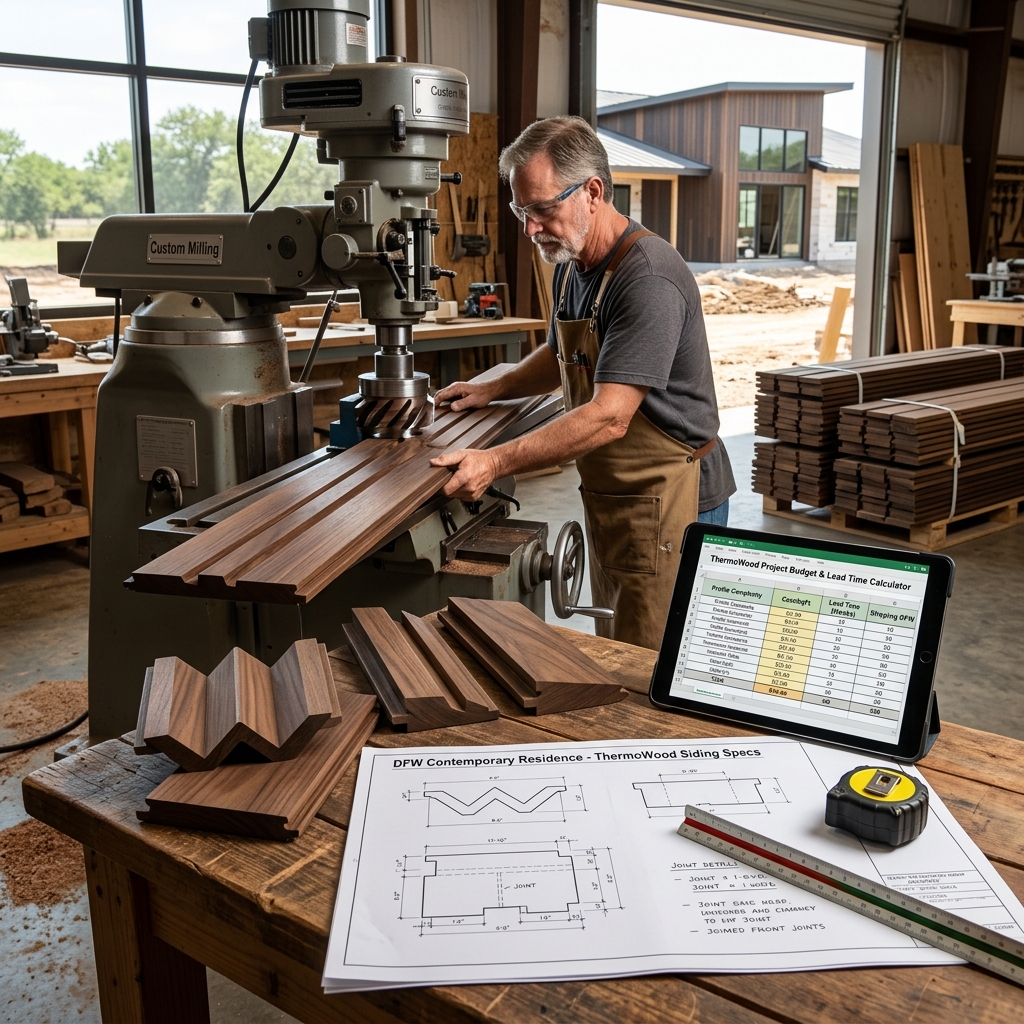
Action step: Request quotes early in design development, not just at specification lock. Understanding cost-per-linear-foot for different profile and species combinations informs your design decisions while you still have flexibility.
Profile Options We Offer for DFW Commercial and Residential Work
Our standard profile catalog covers the most common architect specifications for contemporary work. We also regularly add custom profiles based on demand from projects we’re supporting.
Standard offerings include:
- Vertical grain and clear grain boards in 1×4, 1×6, 1×8, and 1×10 dimensions
- Ship-lap and shiplap variants in multiple species
- V-groove profiling for architectural shadow-line effects
- Trim and fascia profiles including crown, rake, and soffit details
- Heavy timber dimensions (4×6, 4×8, 6×8, and larger) for structural expression
- Specialty grooved and fluted patterns for contemporary visual interest
For commercial applications across DFW, we’ve supplied custom ThermoWood profiles to hospitality projects, office buildings, and mixed-use developments where durability and aesthetic consistency matter. Residential applications range from large Hill Country estates to urban infill projects in East Austin and Tarrytown.
Every custom profile we develop becomes available for future projects, gradually expanding our capabilities. If your design requires a profile we haven’t milled before, we treat it as an opportunity to expand our offerings for the architectural community we serve.
Action step: Review our current profile inventory as a starting point for your design. Specify standard profiles where they align with your intent, and request custom work only where it materially strengthens the design outcome.
How We Source and Quality-Control Our ThermoWood Inventory
We maintain direct relationships with ThermoWood manufacturers in North America and Europe, ensuring consistent quality and supply reliability. Our sourcing strategy prioritizes FSC-certified materials where applicable and builds redundancy into supply chains to prevent project delays.
Incoming material inspection is rigorous. We grade ThermoWood to consistent standards, checking for moisture content stability, color uniformity, and structural integrity before material enters our system. Thermally modified wood is already dimensionally stable, but we verify that stability through moisture meter testing and visual inspection.
Our milling facility applies the same quality discipline. Custom profiles are milled to tolerance, dried if necessary, and visually inspected before shipping. We photograph custom orders during production so you can verify profile compliance with your specifications before material arrives on site.
We also maintain technical documentation on each ThermoWood species and product we carry, providing architects and builders with performance data, fire ratings, and finishing recommendations. This documentation supports both specification writing and field installation.
Action step: Request material certifications and quality documentation early. Lenders and inspectors increasingly ask for proof of material sourcing and conformance; we provide this documentation as standard practice.
Integration with Your Design Vision and Specifications
The best outcomes happen when we’re involved early in your design process, not brought in at specification lock. We can advise on profile feasibility, cost implications of specific choices, and sourcing realities that shape your material decisions.
Our role is to understand your aesthetic intent, your performance requirements, and your project constraints, then problem-solve at the material level. If your design specifies a custom profile in thermally modified poplar but sourcing presents a timeline conflict, we can propose an alternative species or profile variant that preserves your design vision while meeting schedule realities.
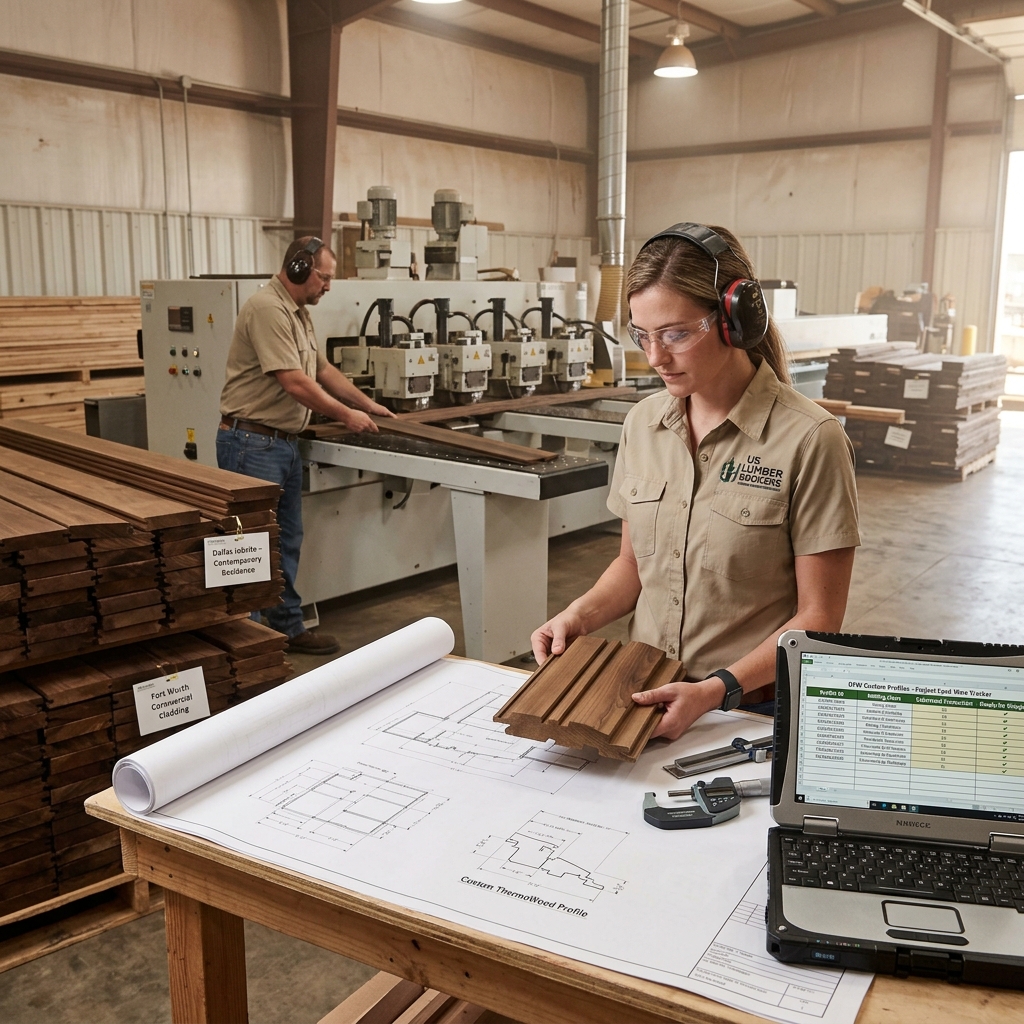
We provide detailed product information and sample boards so you and your clients can evaluate color, grain, and finish appearance before committing to an order. For custom profiles, we can produce small samples that demonstrate the proposed detailing and allow final refinement before production begins.
Coordination with general contractors, installers, and other trades is part of our service. We provide installation guidance, clarify any on-site questions about material handling or fastening, and remain available throughout the project should any questions arise about material performance or appearance.
Action step: Introduce us to your design team and general contractor during pre-construction. Regular three-way communication prevents misalignment and accelerates problem-solving when questions arise.
Getting Started with Custom Profile Quotes and Timelines
Beginning a custom ThermoWood project with us is straightforward. We need your specifications, design intent, and timeline, then we provide a comprehensive quote and feasibility assessment within one business day.
Here’s what to prepare:
- Profile sketches or CAD details showing dimensions and cross-sections
- Material species preferences (or openness to alternatives)
- Quantities in linear feet or pieces
- Project timeline and target delivery date
- Any specific quality or certification requirements
- Finishing preferences (unfinished, prefinished, or stained)
You can reach us at 737.260.7431 with your specifications, or email detailed drawings and material notes. We’ll review your specs, confirm sourcing and lead-time feasibility, and return a quote with a clear timeline and delivery commitment.
For architects working on multiple projects or managing ongoing relationships, we often establish standing orders or material schedules that streamline future quotes and support phased project delivery.
Action step: Gather your profile sketches and reach out this week if you have a project in the planning phase. Early consultation costs nothing and often identifies solutions that save time and budget downstream.
To place orders, order samples, or talk with a live person.
Frequently Asked Questions (FAQ)
What lead times should we expect for custom ThermoWood profiles in the DFW area?
We typically deliver custom thermally modified wood profiles within 6-8 weeks from order confirmation, depending on profile complexity and current milling capacity. Rush orders are available at a premium rate with 4-week turnarounds when scheduling permits. We recommend coordinating your project timeline with us early so we can lock in production slots and avoid delays on your critical path.
Can we source specific thermally modified wood species with custom milling for architect-specified profiles?
We mill custom profiles in our full range of thermally modified stock, including Thermally Modified Ash, Pine, Poplar, and Ayous tailored to your exact specifications. Our milling team works directly from your architect’s drawings to ensure dimensional accuracy and surface finishes that match your design intent. We also source premium ThermoWood imports when your project requires species or profiles beyond our in-house capabilities.
How do we factor costs for custom ThermoWood milling into budget planning?
Custom profile pricing depends on profile complexity, species selection, and order volume, so we provide detailed quotes after reviewing your specification drawings. Thermally modified wood typically costs 15-25% more than standard softwoods but delivers superior durability and performance for high-exposure applications. We recommend discussing your budget parameters early in the design phase so we can suggest profile options and species combinations that deliver the aesthetic you want within your cost framework.


