

The Architect’s Design Challenge: Achieving Visual Texture and Warmth
Modern architecture thrives on materiality. Your clients expect spaces that feel intentional, warm, and distinctly their own. Wall systems that merely enclose a room miss the mark. The most compelling contemporary homes use architectural woodwork to create rhythm, depth, and character that responds to light throughout the day.
Fluted and reeded wood panels deliver this tactile richness, but they’re not interchangeable solutions. The choice between them shapes not just the visual outcome, but also the structural approach, material performance, and construction timeline. Getting this decision right early in design development prevents costly revisions and ensures the finished product matches your vision.
We work with architects across Texas who understand that wood finishes are never purely decorative. A well-chosen wall system becomes the signature element of a space, influencing how light moves, how sound behaves, and how the home ages over time. The right partnership with a materials supplier who understands both design intent and practical execution makes all the difference.
Understanding Fluted Wood Panel Systems and Their Applications
Fluted wood panels feature vertical channels or grooves running the length of the board. These parallel lines create strong visual movement and shadow play that shifts with natural light. Unlike flat cladding, fluted systems add depth to walls without increasing thickness, making them ideal for interior accent walls, exterior rain screens, or even full-facade applications.
Fluted panels work exceptionally well in open-concept layouts where a single wall becomes an architectural focal point. In a modern Hill Country home, a fluted cedar accent wall behind a primary living area draws the eye and anchors the space. The vertical lines elongate the room visually while the wood grain and natural patina add warmth that no painted surface can match.
The groove depth matters significantly. Shallow fluting (1/4 inch to 1/2 inch) creates subtle texture and reads more refined from a distance. Deeper channels (3/4 inch to 1.25 inches) make a bolder statement and cast more pronounced shadows, especially effective in galleries or statement entryways. We help architects specify the exact profile that serves their design intent.
Fluted systems adapt to different configurations. Some designs stack narrow boards vertically for a contemporary lineup. Others use wider boards with wider spacing, creating a more relaxed, organic rhythm. The material choice amplifies this effect: Douglas fir fluting presents rich grain and warm honey tones, while vertical grain Western Red Cedar offers cooler, more uniform aesthetics with superior dimensional stability.
Exploring Reeded Wall Systems: Design Capabilities and Limitations
Reeded panels are the inverse of fluted. Instead of grooves, the wood protrudes in vertical ribs or reeds, creating raised linear elements that catch light from their peaks. This approach delivers dramatic shadow patterns and a more pronounced sculptural quality.
Reeded systems excel at creating geometric interest on large wall planes. A two-story reeded wall in a luxury residence creates an undeniable focal point. However, reeded designs present practical constraints that architects must weigh early. The raised profile collects dust more readily than fluted channels. In humid environments or areas with particulate exposure, maintenance becomes more demanding.
The structural approach differs too. Reeded panels require slightly thicker stock to maintain reed integrity, and installation demands careful alignment to avoid the visual disruption of misaligned vertical lines. Any deviation reads as a flaw. Fluted systems, by contrast, are more forgiving in installation because the eye follows the continuous groove rather than expecting perfect reed alignment.
Reeded walls also occupy slightly more space. If you’re working with constrained dimensions or planning future renovations that might move around the reeded wall, the added thickness can complicate layout. Fluted systems maintain a shallower profile, preserving usable floor space while still delivering strong visual impact.
Material Quality and Wood Species Selection: Where We Excel
The wood species you select fundamentally changes how your fluted or reeded system performs and ages. This is where partnership with a knowledgeable supplier becomes essential.
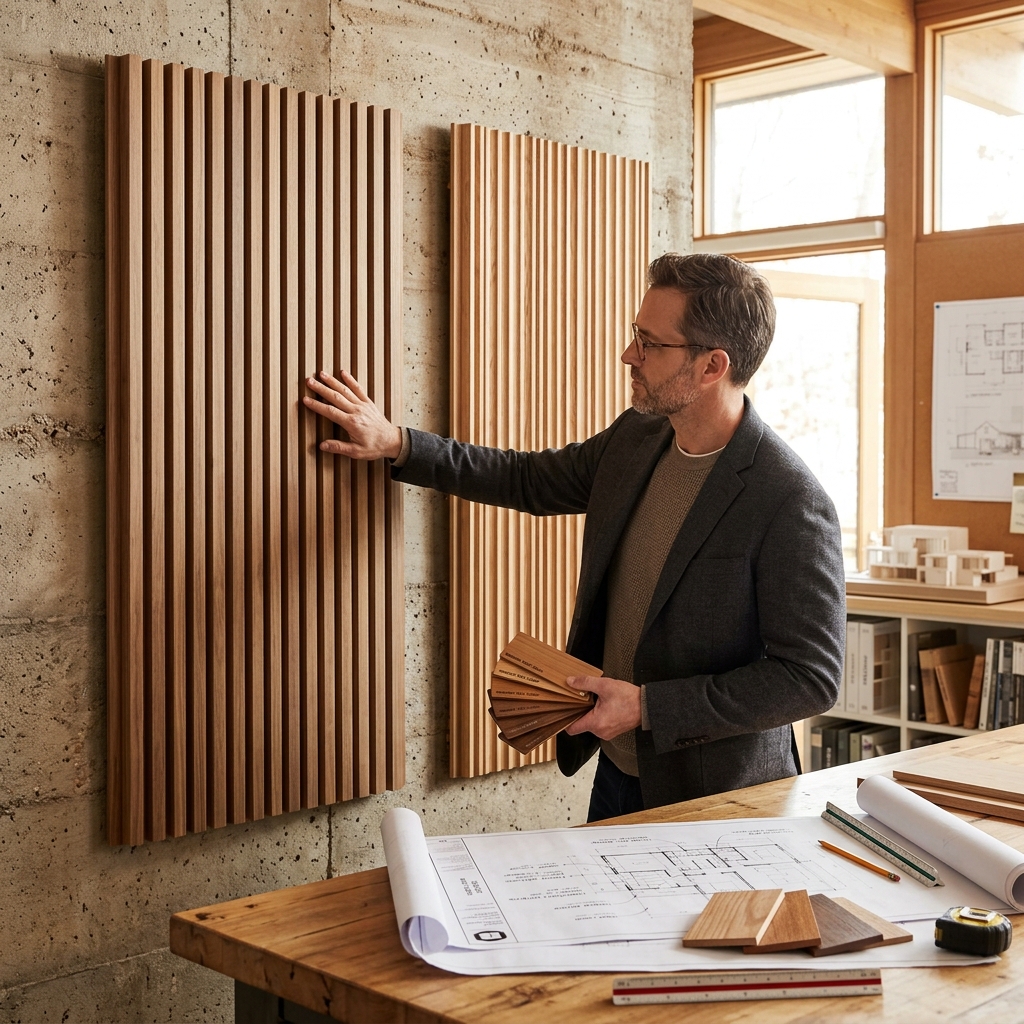
We stock vertical grain Western Red Cedar, hemlock, Douglas fir, and Cypress in clear grades ideal for fluted and reeded applications. Each brings distinct characteristics. Douglas fir offers pronounced grain figures and warm coloration that intensifies over time. Western Red Cedar provides dimensional stability and naturally pleasing color that weathers gracefully. Cypress delivers unmatched durability and tight grain structure, perfect for applications where minimal grain “fuzz” after machining matters.
For architects seeking non-traditional warmth, our thermally modified wood products open new possibilities. Thermally modified ash, pine, and poplar develop richer, deeper tones than their untreated counterparts while gaining enhanced dimensional stability and decay resistance. These materials perform exceptionally well in fluted applications where consistent color and minimal movement are priorities.
We also supply hardwood species like Ipe, Cumaru, and Garapa for exterior fluted and reeded cladding systems. These tropical hardwoods deliver superior longevity and can be machine-fluted or reeded without splintering, crucial for high-touch interior applications or weather-exposed facades.
FSC certification is standard across our inventory. Your projects deserve materials sourced responsibly, and your clients increasingly expect it. We maintain relationships with mills that prioritize forestry stewardship, so you can specify with confidence.
Durability and Long-Term Performance Comparison
Fluted systems generally prove more durable in the long term. The groove profile sheds water more effectively than flat surfaces, and the mechanical protection of the recessed channel guards against minor impacts and abrasion. In high-traffic hallways or multipurpose spaces, this matters.
Reeded walls, while visually bold, require more attentive maintenance. The raised reed edges, though beautiful, are more vulnerable to damage from furniture movement or accidental contact. In residential applications where clients expect minimal upkeep, this becomes a consideration worth discussing early.
Wood species selection directly impacts longevity. Untreated softwoods like standard cedar or hemlock require periodic finish application or will weather to a silvery gray patina within 3-5 years. For architects envisioning this natural weathering, it’s beautiful and intentional. For those wanting color retention, specifying thermally modified wood or naturally durable hardwoods eliminates ongoing maintenance.
Moisture movement represents another durability factor. Fluted panels in high-moisture environments (bathrooms, kitchens, coastal applications) perform best when milled from quarter-sawn or vertical grain stock, which resists cupping and warping. We ensure all material destined for fluted or reeded profiles is properly acclimated and graded for your specific climate zone and application.
Customization Flexibility for Bespoke Projects
Luxury residential architecture demands materials that bend to vision, not the other way around. We excel here.
Custom flute and reed profiles are entirely possible. If your design calls for asymmetrical groove spacing, variable channel depths, or hybrid fluted-reeded combinations, we collaborate with clients to execute these specifications. We work with mills capable of custom profile tooling, so your material serves your design intent rather than constraining it.
Width flexibility extends customization further. Standard fluted boards run 5.5 to 11.25 inches wide. We source wider stock and cut to specification, or source narrower boards and install them more densely for tighter visual rhythm. This granular control becomes essential in high-visibility applications.
Edge profiles add another layer. Eased edges provide a softer, more refined appearance. Sharp edges deliver bold, contemporary attitude. Some architects specify different edge treatment on face-side flutes versus reverse sides, a subtle detail that demonstrates design intentionality.
We also customize finish and color. Pre-finishing fluted stock simplifies job-site application and ensures uniform color across large installations. Natural finishes, matte stains, or clear sealants all perform differently on fluted surfaces and should be tested on your exact material and profile before full production.
Thermal and Acoustic Performance Benefits
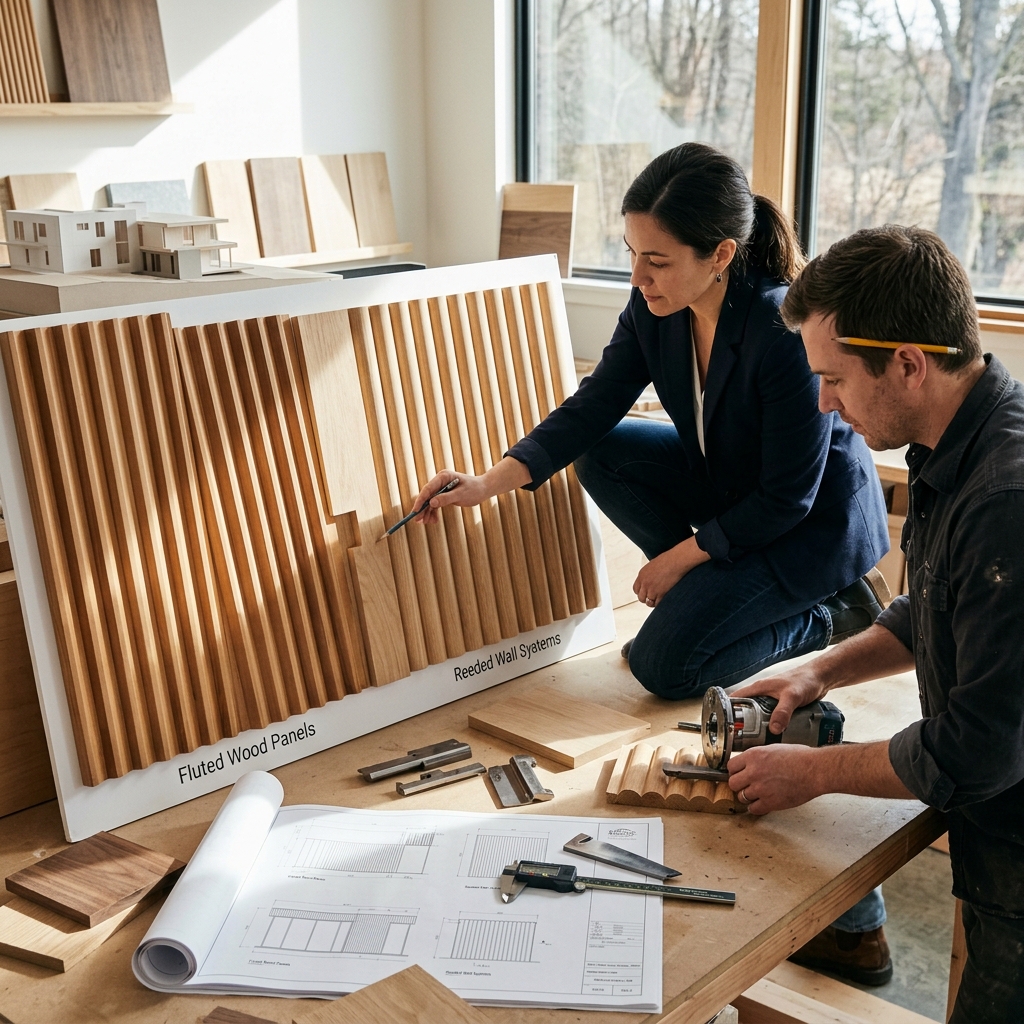
Fluted and reeded wood walls deliver thermal and acoustic benefits that flat drywall or other finishes cannot match.
The air movement within flute channels creates a slight thermal buffering effect. Wood itself is a moderate insulator, and the depth profile amplifies this. In exterior applications, fluted cladding systems over properly specified sheathing and insulation reduce thermal bridging and improve overall envelope performance.
Acoustic advantages prove even more significant. The irregular surface of fluted or reeded wood diffuses sound waves instead of reflecting them in hard echoes. A fluted accent wall in a modern open-plan home softens acoustics without requiring acoustic panels that compete visually. For music rooms, home theaters, or spaces where clients seek refined audio behavior, wood fluting solves the problem aesthetically.
The groove depth again matters. Deeper flutes (3/4 inch or more) outperform shallow profiles acoustically. If your design includes a fluted element in a high-sound-intensity zone, specify accordingly and test acoustics early in the design phase rather than discovering problems during construction.
Installation Complexity and Project Timeline
Fluted panels generally install faster and with fewer complications than reeded systems. The grooves allow slight flexibility in board-to-board alignment without visual disruption. Installers can focus on fastening, shims, and flashing while less concerned about microscopic alignment variations.
Reeded systems demand more precision. Each reed must align vertically with its neighbors. Any board that’s slightly off-plumb becomes obvious. This requires patient installation, sometimes more frequent shimming, and quality control throughout the process. Budget accordingly for experienced trim carpentry.
Custom profiles require lead time regardless of flute versus reed. Stock profiles ship readily. Custom tooling and milling adds 4-8 weeks to material delivery, a detail important for construction scheduling. We manage this timeline closely and coordinate with your builder to ensure material arrives when the wall system framing is ready.
Moisture and acclimation timing also influence the schedule. Material should acclimate at the job site for at least two weeks before installation, allowing wood to reach equilibrium with the local climate. Rushing this step invites post-installation movement and alignment problems, especially in reeded systems.
Cost Considerations and Value Proposition
Fluted and reeded wood systems cost more than standard drywall or flat cladding, but the value proposition justifies the investment in luxury residential work.
Material cost for fluted cedar or Douglas fir runs roughly 3-5 times that of conventional wall finishes. Custom profiles add 15-30% premium over stock fluting. Hardwoods like Ipe cost significantly more but deliver unmatched durability and require no ongoing finish maintenance. Installation labor typically adds 40-60% to material cost because the work demands skilled carpentry.
Value, however, outstrips cost. A dramatic fluted focal wall becomes the signature element clients describe to visitors and remember when deciding whether to return to the same design team. The wood’s natural warmth and movement with light create an asset that photographs beautifully and ages with character. These are not maintenance burdens but design features that strengthen with time.
We position ourselves to maximize value without wasted expense. We specify the right wood species for each application, eliminating overspending on material properties you don’t need. We source direct from mills and manufacturers, reducing intermediary markups. We know which profiles deliver the most impact for your budget and which customizations return true design value versus those that complicate without improving the outcome.
Why US Lumber Brokers Is Your Definitive Partner
We understand architectural intent because we partner with architects daily across Texas and beyond. We’re not a commodity supplier. We’re a material consulting partner who helps you specify correctly the first time.
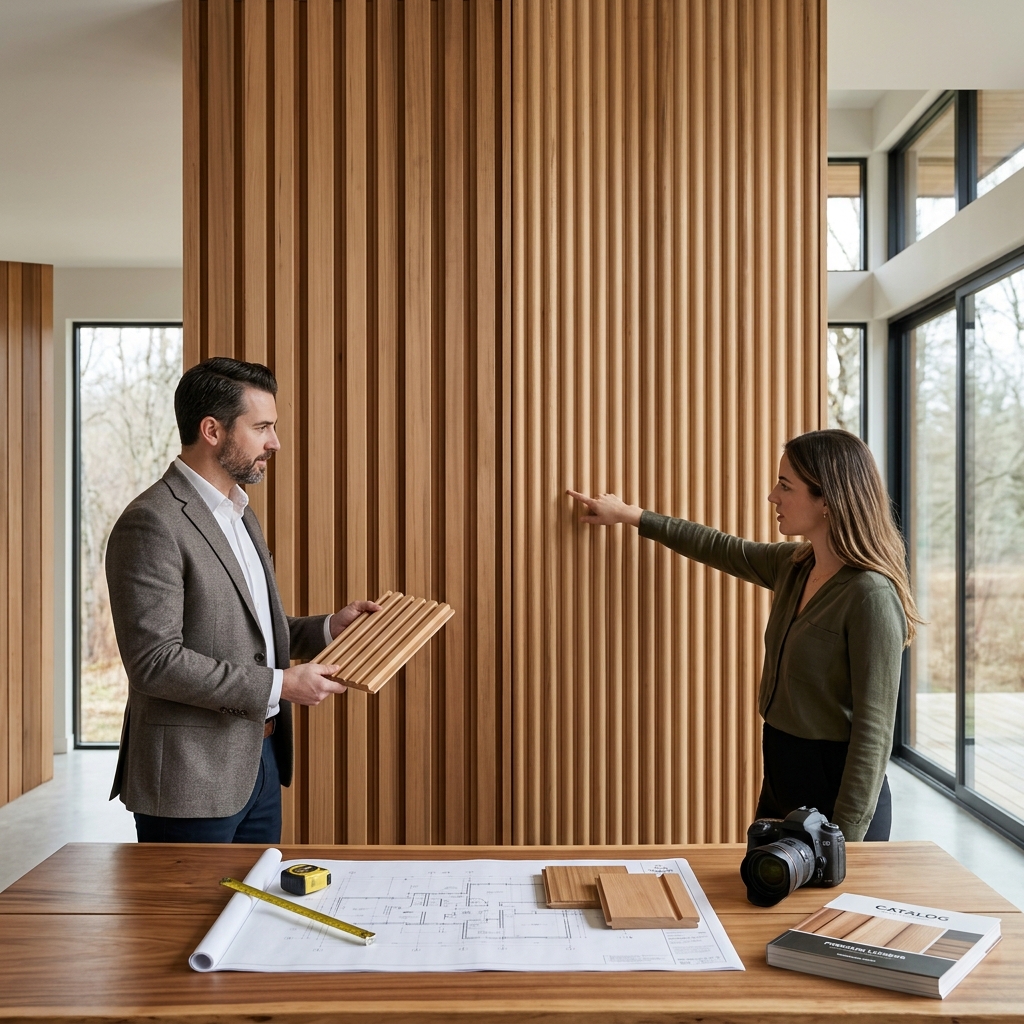
Our inventory depth is unmatched in the region. We stock vertical grain Western Red Cedar, hemlock, Douglas fir, Cypress, and Southern Yellow Pine in clear grades. We maintain hardwood inventory including Ipe, Cumaru, Garapa, and Massaranduba. We’re also an approved Arborwood Cladding dealer and supply thermally modified wood products that expand your design palette beyond conventional options.
Custom milling and profile work happens in-house or through our established mill partnerships. We don’t outsource relationships. When you need a profile refined, scaled, or tested before full production, we manage that conversation directly with the manufacturer and keep your project on track.
FSC certification and sustainability standards are built into our sourcing. Your clients expect responsible forestry. We deliver it without requiring you to compromise on material quality or specification flexibility.
Quality control matters tremendously in fluted and reeded work. We inspect every board before delivery, reject material with defects that would become obvious once installed, and coordinate closely with your builder on acclimation and storage. Poor material early becomes expensive rework later. We prevent that.
Bringing Your Vision to Life with Our Expertise
Your modern architectural vision demands material partners who understand both design aspiration and practical execution. Fluted and reeded wood systems aren’t generic products. They’re custom expressions of your design intent, and they deserve a supplier capable of bringing that vision to life without compromise.
Start by clarifying your design intent. Are you seeking bold sculptural drama, or refined textural sophistication? Does the application demand durability against moisture and wear, or is this a protected interior accent? What color evolution do you envision over years? These conversations shape material and profile specifications that ensure your finished project exceeds expectations.
We invite your team to visit our showroom or request samples of fluted and reeded profiles in your preferred species. Seeing light interaction with actual wood profiles—not renderings—clarifies design decisions and prevents surprises. We also provide detailed specifications, installation guidelines, and long-term maintenance recommendations so your builder executes flawlessly.
Your next step is straightforward. Contact us with your project parameters, preferred wood species, and design intent. We’ll develop material recommendations, provide samples, and establish a timeline that aligns with your construction schedule. We’ll be your partner from design specification through final installation, ensuring every board performs beautifully and your architectural vision stands undeniably apart.
To place orders, order samples, or talk with a live person.
Frequently Asked Questions (FAQ)
What wood species do we recommend for fluted and reeded wall systems in high-performance applications?
We stock vertical grain Western Red Cedar, Hemlock, and Douglas Fir as our primary softwood choices for decorative paneling, each offering distinct grain patterns and durability profiles. For architects seeking superior performance in moisture-prone environments, we also supply thermally modified wood options like Thermally Modified Ash and Accoya, which we’ve found deliver exceptional stability and longevity without sacrificing the visual expressiveness your designs demand. Our hardwood inventory including Ipe and Cumaru provides even greater durability for commercial or exterior applications where traditional options fall short.
Can we accommodate custom profile specifications for bespoke fluted and reeded wall systems?
Yes, we manufacture custom wood profiles tailored to your exact architectural specifications rather than limiting you to standard patterns. Our manufacturing capability allows us to work directly with your design details during the specification phase, ensuring the final product integrates seamlessly into your modern contemporary aesthetic. We’ve completed numerous projects across Texas and nationwide where our custom profiles became defining design elements rather than afterthoughts.
How do fluted panels compare to reeded systems when considering installation timelines and project scheduling?
Fluted panels typically install faster since they’re pre-manufactured with consistent profiles, while reeded systems often require more field adaptation and finishing work that extends your project schedule. We provide detailed installation guidance and can supply materials in pre-finished or raw states depending on your builder’s workflow preferences. Our Texas-based inventory means we can support tight timelines without the lead time delays you’d encounter with distant suppliers.


