

Why Commercial Rooftops Demand FSC Certified Hardwoods
Commercial rooftop projects sit at the intersection of performance, compliance, and reputation. Your building envelope is exposed to relentless UV radiation, temperature swings, moisture cycles, and foot traffic. When you specify hardwoods for roofing applications, you’re making a statement about durability and environmental responsibility that extends far beyond the project timeline.
We work with architects and project managers who understand that material selection affects both immediate performance and long-term asset value. FSC certification signals to stakeholders, tenants, and regulatory bodies that you’ve chosen wood from responsibly managed forests. This matters for LEED compliance, corporate sustainability commitments, and client confidence.
The density and natural oil content of tropical hardwoods make them inherently resistant to decay, insects, and weathering without heavy chemical treatment. Unlike softwoods that require periodic maintenance and retreat, our FSC certified hardwoods age gracefully while maintaining structural integrity across decades. Your rooftop specification becomes a selling point, not a liability.
Action item: Before material selection, confirm your project’s sustainability requirements and any mandatory certifications with your design or procurement team.
The Performance Requirements Your Rooftop Project Faces
Rooftop conditions are punishing. Sun exposure creates thermal stress that causes wood to move and shrink. Standing water or poor drainage introduces moisture that penetrates grain boundaries. Temperature fluctuations between night and day can exceed 50 degrees Fahrenheit seasonally. Foot traffic from maintenance crews adds abrasion and point loads that softer woods cannot withstand.
Your hardwood rooftop material must meet several criteria simultaneously:
- Janka hardness rating above 1000 to resist abrasion and indentation
- Dimensional stability (low movement in response to moisture changes) to prevent cupping, checking, and fastener failures
- Natural decay resistance without relying on chemical preservatives
- Durability in full sun exposure without significant color degradation or surface checking
- Adequate fastening properties to hold mechanical connections under expansion/contraction cycles
Commercial projects also face load requirements. Roofing materials must support concentrated loads from HVAC equipment, parapet wall systems, or snow accumulation. We specify hardwoods with clear documentation of their structural properties, modulus of elasticity, and crushing strength.
Action item: Request load calculations and deflection analysis from your structural engineer before finalizing hardwood thickness and joist spacing.
Understanding IPE: Density, Durability, and Long-Term Value
IPE decking is the benchmark material for commercial hardwood roofing. With a Janka hardness rating of 3680 (among the hardest woods available), IPE withstands severe weathering, high foot traffic, and UV exposure without surface degradation. Its density of approximately 42 pounds per cubic foot provides both structural strength and dimensional stability that softer alternatives cannot match.
IPE’s natural heartwood contains silica and tannins that function as built-in preservatives. This means IPE rooftops remain sound for 25 to 30 years or longer with minimal maintenance beyond occasional cleaning. You won’t face the cycle of treatment reapplication that compromises both budget and environmental goals.
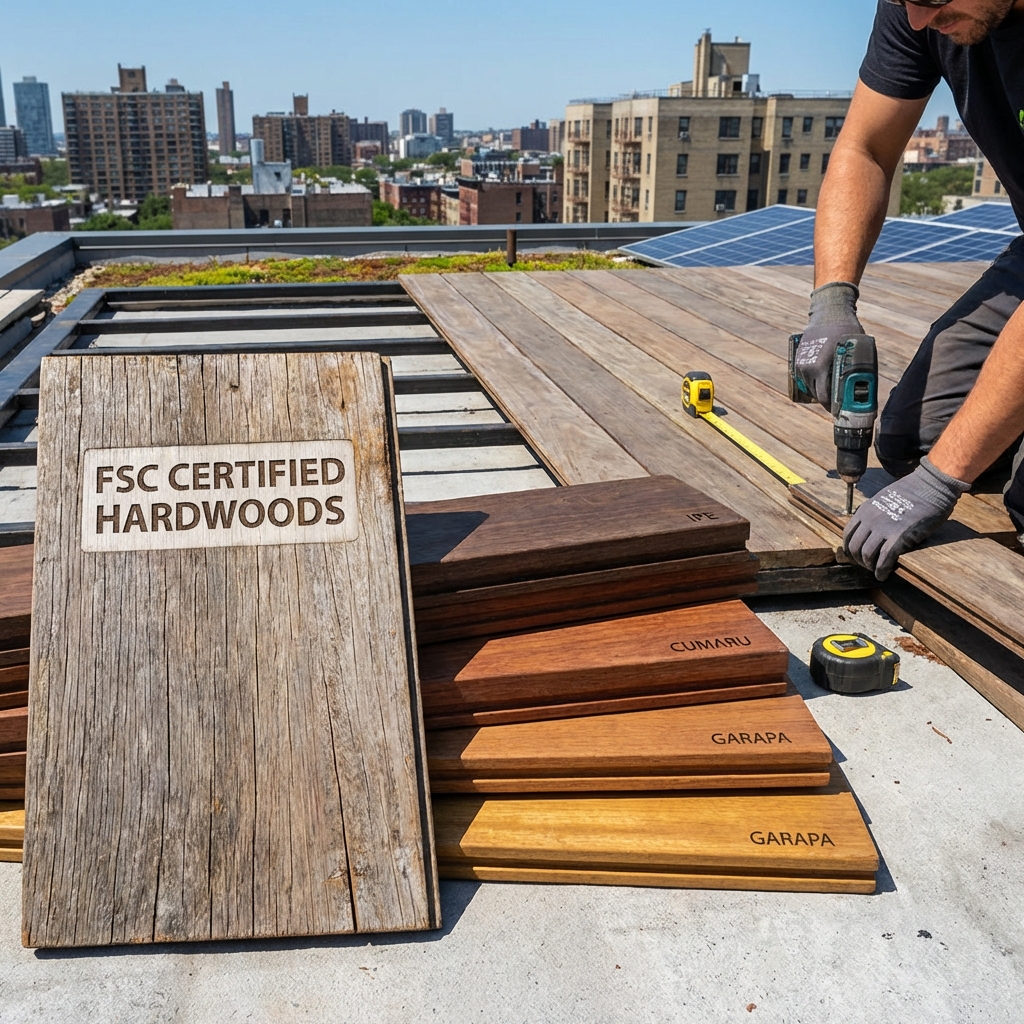
The tight grain structure of IPE makes it inherently fire-resistant and difficult for insects to penetrate. Unlike softwoods that attract carpenter ants and termites, IPE requires no chemical barriers for pest protection. For commercial properties in Texas where summer heat accelerates wood degradation, IPE’s dimensional stability prevents the fastener corrosion and cupping failures we see in less stable materials.
We stock IPE decking in standard commercial thicknesses (5/4, 8/4, and larger). We also provide IPE timbers for structural applications where roofing systems require heavier load-bearing members or exposed beam design.
Action item: Request sample boards to verify the color, grain pattern, and working characteristics before finalizing large-volume specifications.
Cumaru and Garapa: Sustainable Alternatives Without Compromise
When budget constraints or sustainability preferences make 100% IPE impractical, Cumaru and Garapa deliver measurable performance at a lower specification cost. Both are Brazilian hardwoods with strong FSC certification credentials and structural properties suited to commercial roofing.
Cumaru (also called Tonka bean wood) offers Janka hardness of 2350, placing it firmly in the premium category. Its dimensional stability rivals IPE for most applications, and its natural resistance to decay matches expectations for long-term rooftop performance. Cumaru carries a warm golden-brown color that develops an elegant silver-gray patina over time. Many architects prefer this aesthetic for visible roofing applications or parapet fascias.
Garapa provides Janka hardness around 1700, making it softer than IPE or Cumaru but still substantially harder than North American softwoods. Its strength-to-weight ratio and workability make it an excellent choice for projects requiring easier installation or custom shaping. The color ranges from pale yellow to golden brown, offering visual variety without sacrificing durability.
Our Brazilian woods inventory includes all three options in FSC certified grades. We help you match performance requirements to budget reality, ensuring your specification doesn’t compromise on the attributes that matter most for your roofing system.
Action item: Develop a comparative cost analysis across IPE, Cumaru, and Garapa using actual project dimensions. The per-board-foot savings often vanish once installation labor and fastening requirements are calculated.
How FSC Certification Protects Your Project and Reputation
FSC certification proves that harvested wood originates from forests managed to rigorous environmental and social standards. This matters for commercial projects in multiple ways. First, it protects you from reputational risk. Specifying uncertified tropical hardwoods exposes your project to criticism from environmental advocates and may trigger LEED point penalties or corporate sustainability policy violations.
Second, FSC certification validates chain of custody. We maintain documentation from forest to your jobsite, proving that IPE, Cumaru, and Garapa sourced through our inventory come from responsibly managed operations. This transparency becomes critical when your client requires audit trails or third-party verification.
Third, FSC certification often attracts favorable financing, insurance terms, and tenant interest. Properties documented as using certified sustainable materials command better rents and resale value. In competitive commercial real estate markets, this advantage justifies the modest cost premium.
We source exclusively from suppliers who hold current FSC certifications. Every hardwood roofing product we recommend carries documentation that stands up to scrutiny from building officials, sustainability consultants, and corporate procurement teams.
Action item: Request FSC certificates from your supplier before placing orders. Verify that certifications cover the specific dimensions and grades you’re specifying.
Our Complete Hardwood Inventory for Commercial Specifications
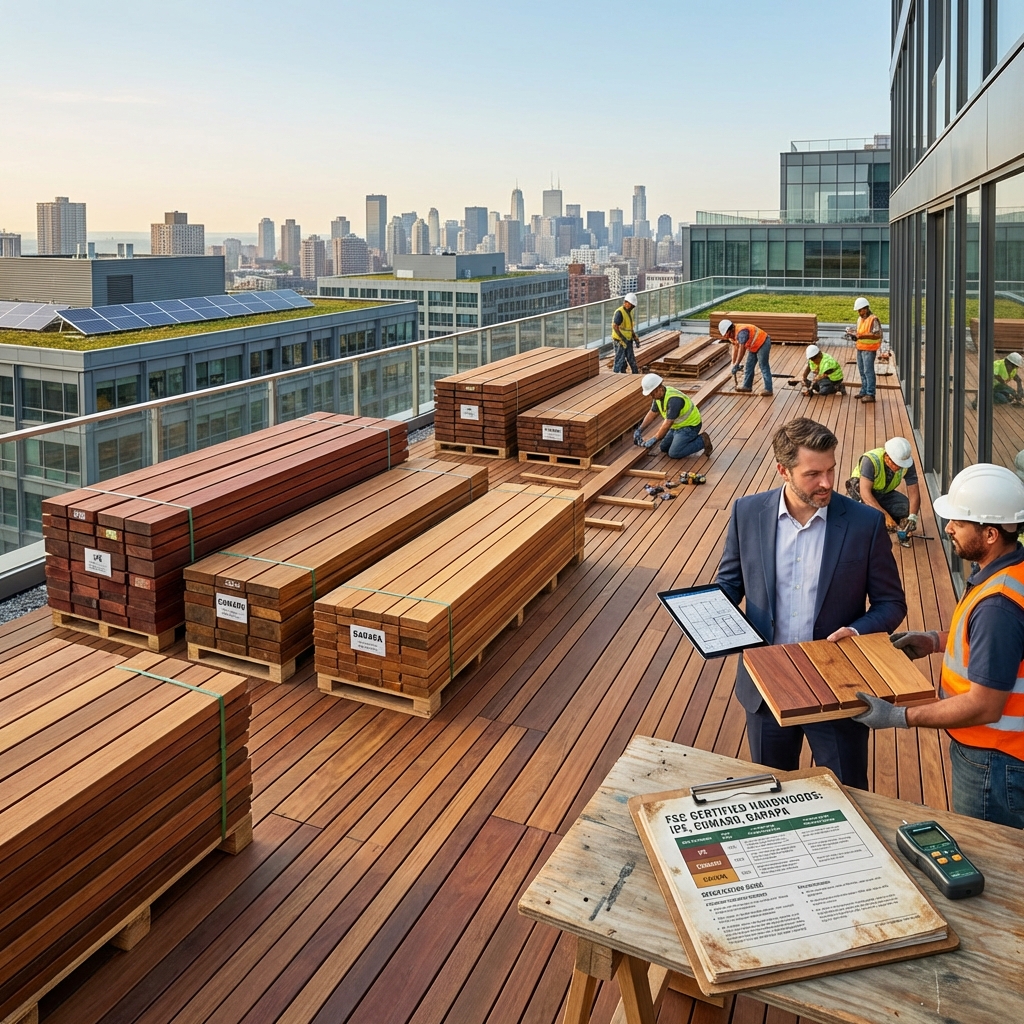
We maintain stock of premium hardwoods in sizes and grades designed for commercial roofing and exterior cladding applications. Our inventory includes IPE, Cumaru, Garapa, and Massaranduba in standard deck thicknesses plus larger timbers for structural applications.
For specifications requiring dimensional stability without tropical hardwood sourcing, we supply thermally modified ash, pine, and poplar products. These domestically produced alternatives meet many commercial durability requirements while supporting regional supply chains and reducing transportation costs.
We also stock complementary materials including fastening systems, finish products, and structural hardware engineered for hardwood roofing applications. Our technical team can confirm compatibility between hardwood species and the mechanical systems your design requires.
Beyond raw materials, we support your project timeline through reliable inventory management and rapid delivery across Texas and nationwide. Commercial schedules depend on material availability; we eliminate delays by maintaining adequate stock of fast-moving premium grades.
Action item: Schedule a consultation with our technical team to review your roofing specification and confirm that our inventory aligns with your project timeline and dimensional requirements.
Structural Specifications and Load-Bearing Capabilities
Commercial rooftop design requires precise calculation of structural capacity. We provide engineering specifications for IPE, Cumaru, and Garapa including modulus of elasticity, crushing strength parallel to grain, and horizontal shear capacity. These properties determine safe joist spacing, deflection limits, and load-bearing capacity for your roofing system.
IPE delivers approximately 2.1 million PSI modulus of elasticity, making it suitable for long-span applications with minimal deflection. Cumaru approximates 1.8 million PSI, while Garapa ranges around 1.5 million PSI. For most commercial roofing applications, these differences mean modest changes in joist spacing or member sizing that our structural team can help optimize.
Fastening design becomes critical with hardwoods. Pre-drilling is mandatory to prevent splitting in material this dense. We recommend stainless steel or hot-dipped galvanized fasteners; standard steel fasteners will stain the wood and corrode prematurely. The fastening layout must accommodate seasonal wood movement while maintaining structural integrity across repeated moisture and thermal cycles.
Action item: Work with a structural engineer familiar with tropical hardwood design to specify member sizing, spacing, and fastening patterns. We provide material properties; your engineer translates those properties into safe, code-compliant details.
Installation Best Practices for Commercial Hardwood Rooftops
Hardwood roofing installation differs from conventional softwood work in ways that affect both timeline and quality. Pre-drilling every fastener hole prevents splitting and ensures proper seating. We recommend a pilot hole diameter of 70 to 80 percent of fastener diameter for the hardwoods we supply.
Spacing must accommodate seasonal movement. In Texas heat and humidity, hardwoods expand and contract with moisture cycling. Install fasteners in oversized or slotted holes that allow lateral movement without binding. Leave 1/8 to 1/4 inch gaps between deck boards to accommodate expansion without cupping or buckling.
Finish systems matter. We recommend clear finishes or semi-transparent stains that preserve the natural wood appearance while UV-protecting the surface. Solid stains and opaque coatings can trap moisture and actually accelerate degradation by preventing the wood from drying after rain exposure.
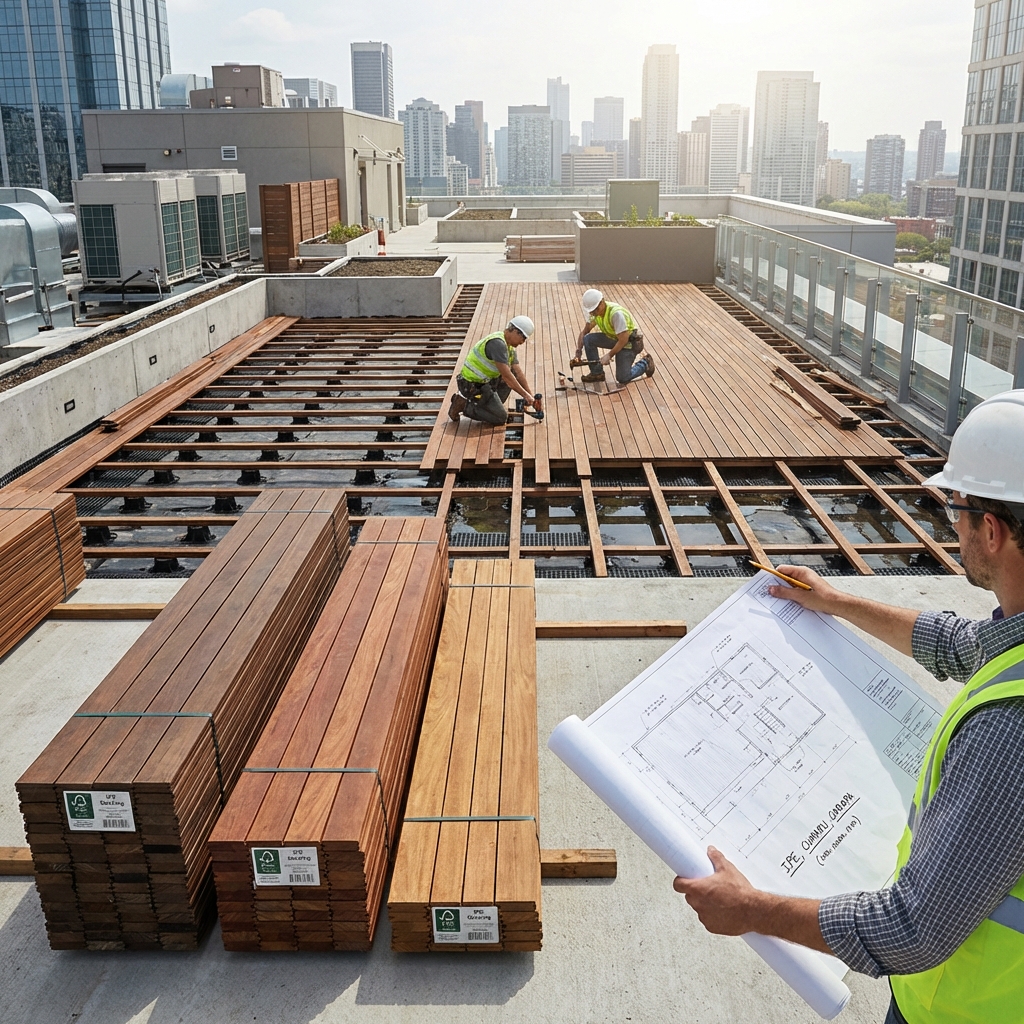
Maintenance reduces lifetime cost. Annual inspection for fastener corrosion, debris accumulation, and drainage integrity prevents expensive repairs. We provide guidance on cleaning protocols and finish touch-up schedules that maximize hardwood rooftop service life.
Action item: Engage an installer experienced with commercial hardwood roofing. The few dollars saved by using general carpenters often translates to installation defects that compromise years of material performance.
Cost-Benefit Analysis: Why Premium Hardwoods Pay Off
The initial material cost for IPE or Cumaru roofing exceeds softwood alternatives by 300 to 500 percent. This fact often triggers budget discussions that miss the lifetime value calculation. Premium hardwoods pay for themselves through operational advantages and extended service life.
Consider a 5,000 square foot commercial rooftop over 30 years. Softwood roofing requires re-staining or re-sealing every 3 to 5 years at roughly $1 to $2 per square foot per application. That’s $5,000 to $10,000 every cycle, totaling $30,000 to $60,000 in maintenance costs. Hardwood roofing needs occasional cleaning and finish touch-ups, averaging $500 to $1,000 annually.
Material replacement cycles matter. Softwood roofing typically requires full deck replacement at 15 to 20 years. Hardwood roofing often remains structurally sound at 25 to 30 years, deferring capital replacement and operational disruption by a full decade.
Insurance costs sometimes favor documented premium materials, and tenant appeal and lease rates often reflect environmental certification and material quality. When you sum material longevity, maintenance costs, operational disruption, and tenant-related advantages, premium hardwoods typically deliver total cost of ownership 20 to 40 percent lower than conventional alternatives.
Action item: Develop a 30-year cost model comparing your hardwood specification against likely softwood alternatives. Include maintenance cycles, replacement timing, and operational disruption costs alongside initial material investment.
Why We’re Your Preferred Specification Source in Texas
We’re a Texas-based specialty wood supplier serving commercial projects across the state and nationwide. Our team combines deep material knowledge with practical understanding of how hardwoods perform in Texas heat, humidity, and UV exposure. We don’t just sell lumber; we help you specify materials that meet performance, compliance, and budget requirements.
Our inventory of FSC certified hardwoods, thermally modified products, and complementary materials puts solutions within reach when your roofing system requires premium materials. We maintain stock specifically for commercial applications, eliminating the delays and substitution hassles that plague project timelines.
We support your project from specification through installation. Our technical team reviews your roofing design, confirms material compatibility, provides structural data your engineer requires, and coordinates delivery timing with your construction schedule. When installation questions arise, we connect you with experienced contractors who understand hardwood roofing work.
For commercial roofing projects requiring FSC certified hardwoods, sustainable sourcing, and documented performance, we’re positioned to deliver materials and guidance that make your specification successful. Contact us at 737.260.7431 or visit our website to discuss your roofing material requirements and explore how IPE, Cumaru, Garapa, or our other premium options align with your project goals.
Next step: Reach out with your roofing plans and performance requirements. We’ll review your specification, confirm material availability, and provide the technical information your design team needs to move forward with confidence.
To place orders, order samples, or talk with a live person.


