

Why Architects Specify Fiber Cement Over Traditional Wood Products
Austin’s architecture scene demands materials that marry aesthetic vision with uncompromising performance. The Hill Country heat, seasonal humidity swings, and increasingly stringent fire codes create a perfect storm of environmental stressors. We work with architects across Texas who’ve discovered that James Hardie fiber cement delivers the sophisticated exterior expression modern homes require while handling Central Texas conditions with proven durability.
This isn’t about compromising design for practicality. It’s about choosing a substrate that lets your architectural intent shine while standing up to what nature throws at it.
Fiber cement sits at the intersection of genuine material warmth and engineered reliability. Unlike natural wood siding, which requires ongoing maintenance and can warp or decay despite treatment, James Hardie products are factory-engineered to resist the specific degradation pathways that plague traditional materials.
We’ve seen architects choose fiber cement for several concrete reasons:
Dimensional stability – Wood moves with moisture. Fiber cement doesn’t. This means no expansion gaps widening, no paint failure at butt joints, and no callbacks years into a home’s life. For contemporary designs with tight reveals and clean lines, this matters enormously.
Paint and finish longevity – James Hardie’s ColorPlus technology bonds finish to the substrate at a molecular level, meaning the color you specify on design day is the color homeowners see a decade later. Wood requires repainting every 7-10 years; fiber cement extends that interval significantly.
No biological attack – Termites won’t touch fiber cement. Neither will rot, mold, or the fungal decay that thrives in Texas humidity. For architects designing homes meant to last generations, this eliminates an entire category of failure modes.
Design consistency across scale – When you detail a luxury custom home in Austin’s Tarrytown neighborhood or out toward Dripping Springs, you need materials that perform identically whether you’re cladding a two-story accent wall or a full elevation. Fiber cement’s manufacturing tolerance means no surprises.
Actionable takeaway: If you’re choosing between wood and fiber cement for a residential project in Texas, request samples of both and observe them in direct sunlight during late afternoon—the light quality that will define your home’s character. James Hardie’s finish stability becomes visually obvious.
James Hardie’s Performance Edge in Central Texas Heat and Humidity
Austin summers push materials hard. Temperatures exceed 95 degrees regularly, humidity spikes during afternoon thunderstorms, and the UV index at our latitude is unforgiving. Traditional fiber cement can check, crack, or fade under this assault. James Hardie’s engineering specifically addresses it.
Their factory-applied ColorPlus finish resists fading because the pigments are engineered to reflect rather than absorb solar radiation. We’ve compared 10-year-old James Hardie specimens to competitive products on homes throughout the Hill Country—the difference in color hold is striking.
Thermal cycling is where many materials fail. The big diurnal temperature swing (90-degree day to 60-degree night) stresses fasteners and sealants. James Hardie’s substrate has a lower coefficient of thermal expansion than some competitors, reducing stress at transitions and penetrations. For a contemporary home with large glass sections and minimalist details, this translates to fewer stress cracks at window frames and door openings.
The humidity component matters too. Texas humidity can spike from 30% to 80% in hours. Materials that absorb and release moisture rapidly experience dimensional cycling that loosens fasteners and creates nail pops. Fiber cement’s density mitigates this—it doesn’t absorb water the way wood does, and it doesn’t trap moisture the way some synthetic products do.
Actionable takeaway: If you’re specifying exterior materials for a Hill Country home with high-performance windows or glass features, James Hardie’s thermal stability becomes a structural asset, not just an aesthetic one. Request test data specific to Central Texas exposure conditions.
Fire Ratings and WUI Compliance for Austin Area Projects
Austin’s wildfire-urban interface zones are expanding. Properties in areas from Dripping Springs and Spicewood down through the Hill Country increasingly fall under WUI (Wildfire-Urban Interface) Class A requirements. Insurance companies now condition coverage on Class A-rated materials for homes in these zones.
James Hardie fiber cement achieves Class A fire ratings without chemical treatment or compromise to aesthetics. The material itself is non-combustible—fiber cement is inorganic cement matrix with cellulose reinforcement that doesn’t propagate flame.
We supply several WUI-compliant fiber cement options for siding, cladding, and soffit applications. For architects working on luxury custom homes in Kerrville, Boerne, or the northwest Austin corridor, this eliminates a major specification headache. You design the home first; fire rating compliance follows naturally rather than driving material choices.
The practical benefit: homeowners see their insurance premiums reflect the actual fire risk reduction that Class A materials provide. We’ve worked with builders whose insurance companies reduced annual premiums by 15-20% when fiber cement replaced traditional wood siding on homes in high-risk zones.
Actionable takeaway: Verify Class A rating documentation for any fiber cement product you specify in WUI zones—not all fiber cement products carry this rating equally. Request published testing data from your material supplier, and cross-reference it with local Austin and Hill Country building department requirements, which have tightened considerably since 2024.
Design Flexibility and Aesthetic Continuity With Contemporary Homes
Modern architecture thrives on visual continuity and material expression. James Hardie understands this better than some builders realize.
Their product lines include smooth finishes for minimalist aesthetics, wood-grain profiles for homes that want tactile warmth, and specialty textures for contemporary accent walls. The ColorPlus finish palette ranges from understated neutrals to dramatic darks, all with the same durability profile.
Contemporary homes in Austin’s Tarrytown, Rollingwood, and Bee Cave neighborhoods often pair siding with cladding and accent elements. You might run vertical-grain cedar aesthetic down one facade, transition to fiber cement panels at a glass corner, and detail soffit returns with matching material. James Hardie’s product consistency lets you achieve this visual flow without compromising performance.
The substrate takes paint well too. If your design calls for a custom color beyond the factory palette—say, a warm gray inspired by limestone—fiber cement accepts premium exterior paint systems beautifully. We’ve seen architects specify James Hardie as the base layer, then detail custom finishes that would be risky on wood but reliable here.
Detailing matters. Contemporary homes demand tight reveals, clean intersections, and minimal shadow lines. Fiber cement’s dimensional accuracy makes this achievable. There’s no cupping or warping to hide; your revealed edges land clean.
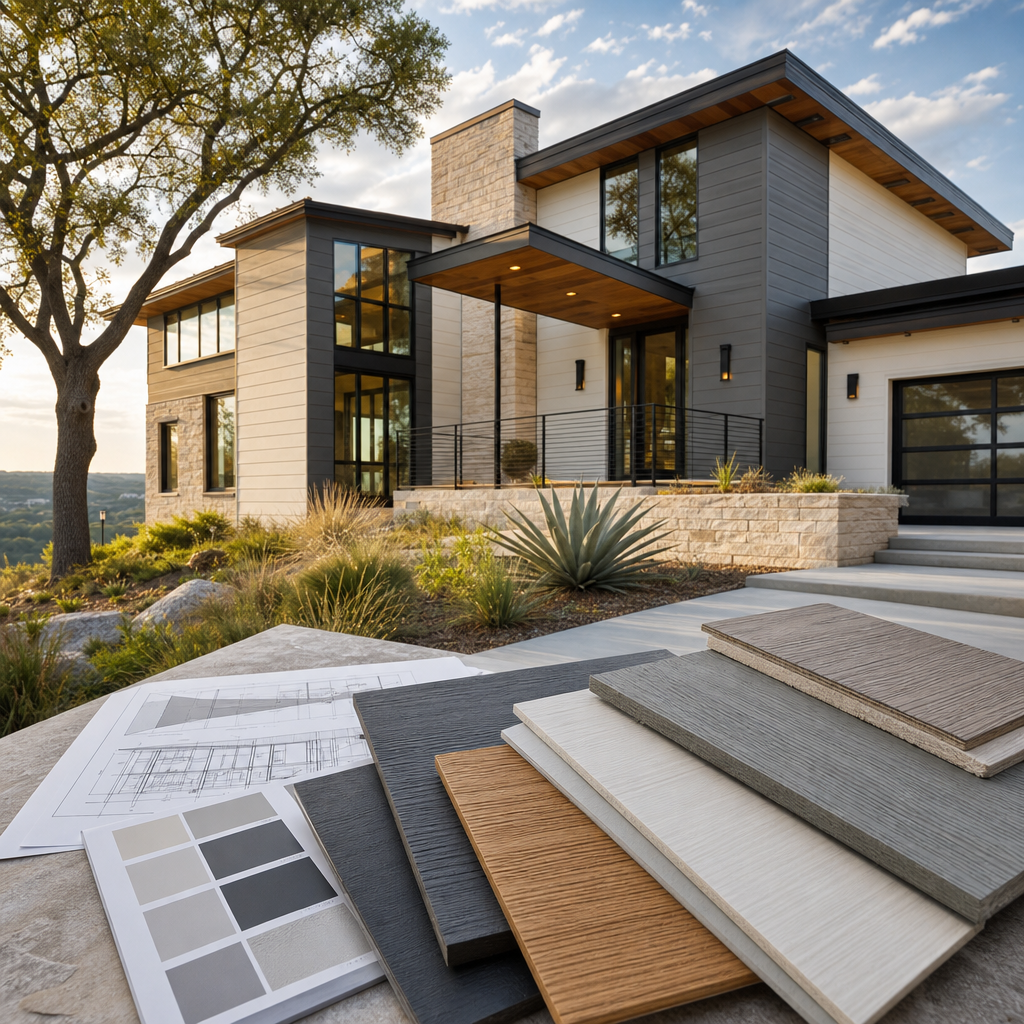
Actionable takeaway: When designing a contemporary home with mixed materials (fiber cement siding, glass, metal accents, possibly wood trim), request detailed trim samples from your fiber cement supplier showing corner treatments, window frame intersections, and color transitions. This prevents surprises during construction and ensures your aesthetic vision doesn’t compromise during installation.
Our James Hardie Installation and Supply Expertise Across Texas
We stock James Hardie products for immediate delivery across Texas—from Austin and San Antonio through the Hill Country, to Dallas, Fort Worth, Houston, and The Woodlands. Whether you’re sourcing materials for a single luxury custom home in Dripping Springs or coordinating deliveries across multiple projects, we manage the logistics.
Our relationship with James Hardie spans years. We understand their product specifications, installation tolerances, and design capabilities deeply. When architects bring us detailed specifications, we can validate them against James Hardie’s current technical documentation and flag potential conflicts before they reach the job site.
We also offer consultation on material selection. Not every fiber cement product is ideal for every application. Board-and-batten details have different fastener requirements than traditional lap siding. Soffit applications demand moisture management different from wall cladding. We help architects and builders match James Hardie’s product portfolio to specific design intent.
Installation matters as much as material choice. We can connect you with experienced installers throughout our service areas who understand fiber cement’s requirements—proper fastening, adequate substrate, correct joint treatment. A beautifully detailed James Hardie exterior depends on execution that respects the material’s engineering.
Actionable takeaway: Before finalizing your James Hardie specification for a project, reach out to us with your architectural plans. We’ll review the details, confirm current product availability and lead times, and identify any coordination needs with your other material selections.
Sustainability and Maintenance Considerations for Luxury Residential
Today’s architects—especially those designing for forward-thinking clients in Austin’s contemporary neighborhoods—factor sustainability into every material choice. James Hardie’s lifecycle story holds up well.
The manufacturing process is energy-intensive, but the material’s longevity offsets this. A fiber cement exterior typically lasts 25-30 years with minimal maintenance, compared to wood siding that demands repainting every 7-10 years. Over a structure’s life, fewer replacement cycles mean lower embodied carbon.
Maintenance is minimal. You’re not staining, sealing, or painting wood siding. A occasional pressure wash keeps the surface clean; that’s essentially it. This appeals to homeowners who want beautiful materials without the burden of constant upkeep.
If sustainability certification matters for your project, some fiber cement products meet LEED criteria. James Hardie has pursued third-party certifications for specific products, and they publish transparency reports on manufacturing practices. We can point you toward specific products that align with your project’s sustainability goals.
The material is also fully recyclable at end-of-life, though the likelihood of removal before 30+ years is low given durability.
Actionable takeaway: If you’re designing for a client with strong sustainability commitments, request James Hardie’s environmental product declarations and third-party certifications for the specific products you’re specifying. This documentation supports LEED applications and provides homeowners with genuine performance data.
How US Lumber Brokers Supports Your Architectural Vision
We’re here to be your material partner, not just a supplier. That means understanding your design intent, validating your specifications against real-world performance data, and ensuring seamless project delivery.
For architects across Texas—whether you’re based in Austin, working regionally, or coordinating projects nationwide—we stock James Hardie products and maintain relationships with experienced installers. We can provide samples, technical documentation, and honest counsel on whether a particular specification will perform as intended in Central Texas conditions.
We also understand that contemporary architecture sometimes calls for mixed material strategies. If your design pairs James Hardie fiber cement with IPE cladding for accent elements, or incorporates Accoya siding for specific applications, we supply and advise on all of it. Our broad product portfolio lets us support comprehensive architectural visions, not just single-material solutions.
The next step is simple: share your project details and material specifications with us. We’ll review them against current product availability, confirm lead times, discuss any technical considerations specific to Austin or Hill Country conditions, and ensure your team has everything needed for successful specification and installation.
Your architectural vision deserves materials that perform as beautifully as they look. James Hardie fiber cement does exactly that.
To place orders, order samples, or talk with a live person.
Frequently Asked Questions (FAQ)
What makes James Hardie fiber cement the right choice for Austin’s climate?
We specify James Hardie because it handles Central Texas heat, humidity, and temperature swings better than traditional wood products. The fiber cement resists warping, swelling, and rot that can compromise wood siding, while maintaining the authentic aesthetic your designs demand. For architects committed to durability without sacrificing appearance, James Hardie delivers performance that wood simply cannot match in our environment.
How does James Hardie meet WUI Class A fire-rating requirements for Hill Country homes?
We stock James Hardie products that are Class A fire-rated, meeting the stringent WUI compliance standards required for properties in high-risk fire zones across the Hill Country and surrounding areas. When you’re designing homes in these regions, we ensure your material selections satisfy both building codes and insurance requirements without compromising your design intent. Our team can guide you through the specific product lines and finishes that deliver both protection and the contemporary aesthetic your projects require.
Can James Hardie achieve the warm, natural material expression your designs emphasize?
We’ve found that James Hardie’s range of textures and finishes successfully captures the visual warmth of wood while providing superior durability and low maintenance. When paired thoughtfully with natural materials like glass and other wood elements in your design, fiber cement complements rather than competes with the overall material expression. Our experience installing these products across luxury residential projects shows clients appreciate the authentic appearance combined with the practical benefits architects value.


