

Why Architects Demand Superior Tongue and Groove Systems for Modern Luxury Homes
Tongue and groove wall systems have become the signature detail in contemporary luxury homes across Texas. Architects know that these systems do far more than fill vertical space, they anchor a design’s entire sensory experience. The warmth of wood, the precision of milling, and the authenticity of natural material combine to create interiors that feel intentional and timeless.
We’ve spent years working with Texas architects who share a commitment to craftsmanship and material integrity. Whether they’re designing a Hill Country residence, a downtown Austin loft, or a coastal retreat, the tongue and groove wall system becomes a canvas for expressing architectural vision. The right material, species, and profile can elevate a room from ordinary to extraordinary, while poor choices lead to warping, seasonal movement, and finishes that disappoint within months.
This guide walks you through the decisions that matter: species selection, profile options, durability considerations, and the practical realities of installation in Texas climates. We’ll share how experienced architects specify these systems and why material sourcing from a knowledgeable partner changes the outcome entirely.
Contemporary architecture relies on honest material expression. Unlike drywall or composite panels, wood wall systems make a statement about authenticity and value. Architects specify tongue and groove walls because they deliver on three fronts: visual warmth, structural integrity, and design longevity.
A well-executed tongue and groove system becomes an architectural feature, not an afterthought. The repetitive linear pattern creates rhythm and movement on a wall. Vertical grain patterns in cedar or Douglas fir catch light differently throughout the day. Horizontal installations in a master bedroom create intimacy, while floor-to-ceiling treatments in a great room emphasize height and openness.
Beyond aesthetics, these systems perform. The tongue and groove joint allows for seasonal wood movement without visible gaps or buckling. The continuous interlocking boards provide structural backing for fixtures and finishes. Unlike floating wall panels or decorative veneers, a properly milled tongue and groove system becomes part of the wall assembly itself.
Architects also know that material quality directly impacts project timeline and cost. Kiln-dried, properly milled boards arrive ready to install. Warped or undersized stock means custom shaping, callbacks, and budget overruns. This reality shapes our entire approach to inventory and milling standards.
Next step: Start conversations about wall systems early in design development, not during finish selections. Material choices at the concept phase prevent costly modifications later.
Understanding Wood Species Selection: Cedar, Douglas Fir, and Hemlock Performance Characteristics
Choosing the right wood species depends on climate exposure, color preference, durability requirements, and aesthetic goals. Each species brings distinct characteristics to a tongue and groove system.
Western Red Cedar remains the gold standard for interior applications in luxury homes. It offers natural warmth, moderate density, and exceptional dimensional stability. Clear grade cedar displays minimal knots, creating a clean, contemporary appearance. Vertical grain cedar shows distinctive cathedral patterns that draw the eye and add sophistication. Cedar’s natural oils provide modest resistance to decay, making it suitable for humid environments like bathrooms or kitchen soffits. The wood machines beautifully, allowing precision milling for tight-fitting joints.
Douglas Fir delivers structural strength with visual interest. Tighter grain structure and heavier weight make it ideal for load-bearing applications or spaces requiring durability. Vertical grain Douglas fir displays bold linear patterns that complement modern designs. The species yellows slightly over time, developing a honey tone that deepens with light exposure. For architects seeking visual drama and structural confidence, Douglas fir performs exceptionally well in great rooms and feature walls.
Hemlock provides a softer alternative with subtle grain character. Western Hemlock machines cleanly and takes finish beautifully. It typically costs less than cedar or Douglas fir while maintaining premium appearance. Hemlock works well in protected interior spaces where durability demands are moderate and budget constraints matter.
Moisture content is critical regardless of species. We supply kiln-dried material at 10-12% moisture content, the standard that ensures stability in climate-controlled interiors. Wood that arrives too wet will shrink and create gaps; material that’s over-dried may cup or check. This foundational spec prevents the majority of installation problems we see in the field.
Next step: Request moisture content documentation and milling tolerances from your supplier before ordering. These specifications cost nothing extra but prevent expensive callbacks.
Profile Options That Deliver Visual Impact While Meeting Structural Requirements
The profile you choose shapes both the visual rhythm and the functional performance of your wall system. Standard options range from simple V-groove to elaborate comb siding and fluted wall slat configurations.
V-groove profiles create a classic shadow line between boards. The slight V-shaped groove at the joint emphasizes the horizontal or vertical line of the installation. This profile suits both traditional and contemporary interiors. Installation is straightforward, and the profile accommodates normal wood movement without revealing gaps.
Flush or shiplap-style profiles eliminate the shadow line entirely, creating a seamless appearance. Boards overlap slightly, allowing for modest wood movement while maintaining tight visual continuity. This profile works beautifully in minimalist interiors where you want the wood texture and color to dominate without structural joints competing for attention.
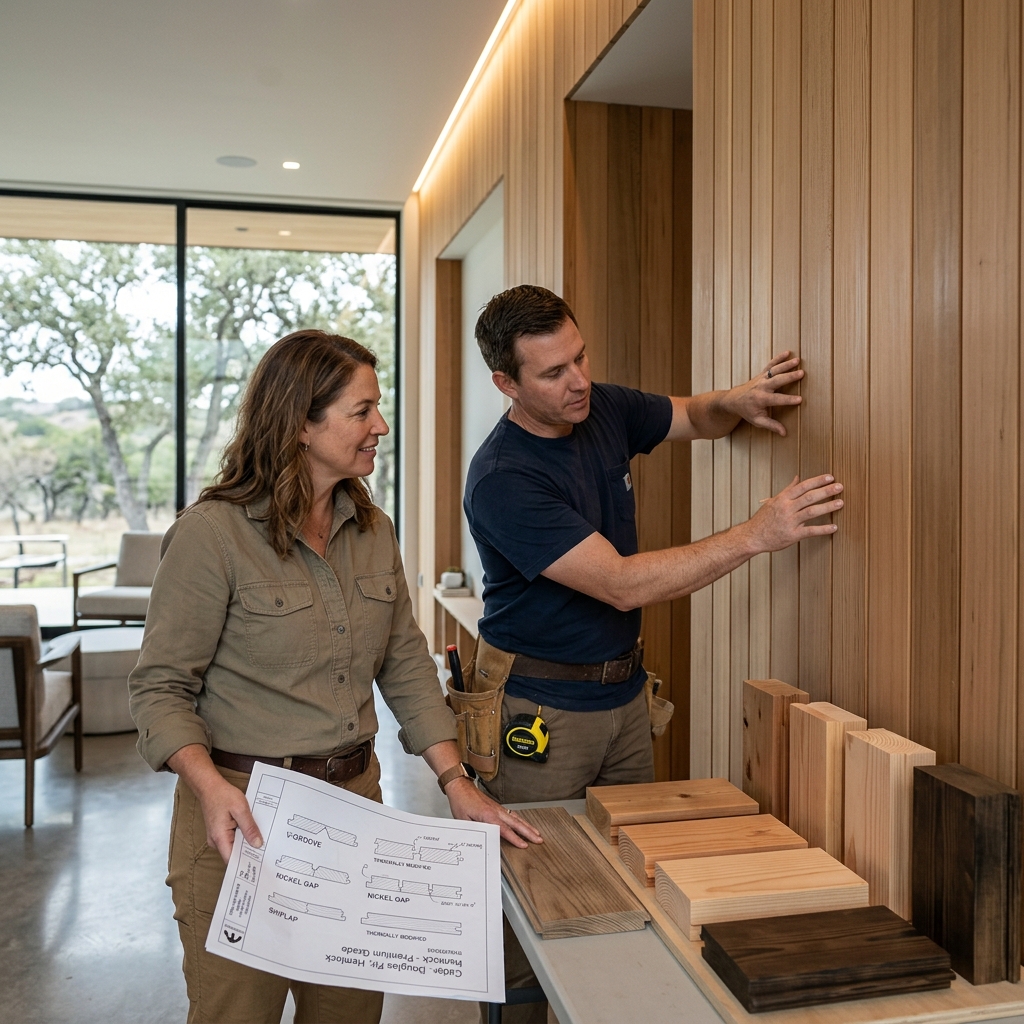
Comb siding and fluted wall slat profiles introduce geometric complexity. Comb designs feature multiple parallel grooves milled into a single board face, creating visual texture and shadow play. Fluted profiles use alternating raised and recessed channels. These designs demand precision milling and careful installation but deliver striking contemporary aesthetics. Architects often specify these profiles in feature walls or statement spaces where the wall itself becomes sculptural.
Veneered or edge-banded tongue and groove systems combine solid wood edges with engineered core materials. This approach reduces material costs, improves stability, and allows for engineered edge profiles that solid wood alone cannot achieve. For architects working within budget constraints or requiring unusual profiles, this hybrid approach delivers premium appearance with practical economics.
The profile directly impacts installation requirements. Deeper grooves require more careful sanding and finishing. Fluted systems demand experienced carpenters familiar with precise milling tolerances. Simple V-groove profiles install faster and tolerate minor installation variations more forgivingly.
Thermally Modified Wood: Enhanced Durability Without Compromising Aesthetic Appeal
Thermally modified wood represents a significant advancement in durability and stability for interior tongue and groove systems. The process heats wood in a low-oxygen environment, fundamentally altering its cellular structure without chemicals or harsh treatments.
The result is wood that resists warping, cupping, and checking far better than conventional kiln-dried material. Dimensional stability improves by 30-50% depending on the species and modification depth. For architects specifying walls in challenging environments, or projects where material movement could affect finishes or fixtures, thermally modified wood eliminates concern.
We stock Thermally modified woods including modified Ash, Pine, Poplar, and Ayous. Each species develops darker tones through the modification process, creating rich color palettes that deepen naturally over time. Modified Ash takes on chocolate and espresso tones. Modified Pine develops amber warmth. These darker tones suit contemporary interiors seeking depth and sophistication.
Durability improvements extend to moisture resistance and decay resistance. Thermally modified wood performs exceptionally well in bathrooms, kitchens, saunas, and other high-moisture spaces where conventional wood might cup or swell. Decay resistance increases substantially, allowing specification in applications that would normally require exotic hardwoods or chemical treatments.
The trade-off is cost. Thermally modified wood typically runs 15-25% higher than conventional kiln-dried softwoods. For architects and builders committed to durability and performance, that premium vanishes within the first decade as the system outperforms cheaper alternatives.
Next step: Request samples of thermally modified species and observe them under the specific lighting conditions of your project space. Color development varies, and advance visualization prevents surprises on site.
Fire-Rated and Class A Wood Solutions for Residential and Commercial Projects
Building codes increasingly demand fire-rated materials in residential and commercial applications. Understanding the options prevents costly specification changes during permitting and keeps projects moving forward.
Class A fire ratings indicate the highest fire-performance rating available. Walls with Class A finishes resist ignition, limit flame spread, and produce minimal smoke and toxic gases. For residential projects in fire-prone areas like the Texas Hill Country, Horseshoe Bay, and Dripping Springs, Class A materials are now standard spec. Commercial projects in downtown Austin and other urban areas frequently require Class A systems.
We supply fire-rated wood products for siding, cladding, decking, soffits, fencing, framing, and pickets. These materials meet Class A standards through precise manufacturing processes and, in some cases, flame-retardant treatments applied during production. The materials perform identically to untreated wood in terms of appearance, workability, and finished aesthetics.
Important distinction: many architects assume they must choose between fire-rated performance and natural wood appearance. That’s no longer true. Class A wood products available today deliver authentic wood character without compromise. You’re not specifying plastic composites or chemically treated materials that feel inauthentic to contemporary design.
For mixed-use projects combining residential and commercial elements, specifying Class A materials throughout simplifies code compliance, creates material consistency, and eliminates the visual discontinuity of switching materials between zones.
Building officials and fire marshals understand these products thoroughly. When you specify Class A-rated wood products from manufacturers with established certifications, permitting typically moves without delays.
Our Complete Inventory: Access to Rare Species and Premium Softwoods
Our role as a specialty wood broker and manufacturer means we maintain inventory depth that standard lumber yards simply cannot offer. We work with architects across all 50 states, but our foundation is Texas.
Our softwood inventory includes Clear and Vertical Grain Western Red Cedar, Yellow Cedar, Hemlock, Douglas Fir, Cypress, and Southern Yellow Pine in profiles specifically milled for tongue and groove applications. Each species is available in multiple grades and moisture contents, selected for the specific climate and application of your project.
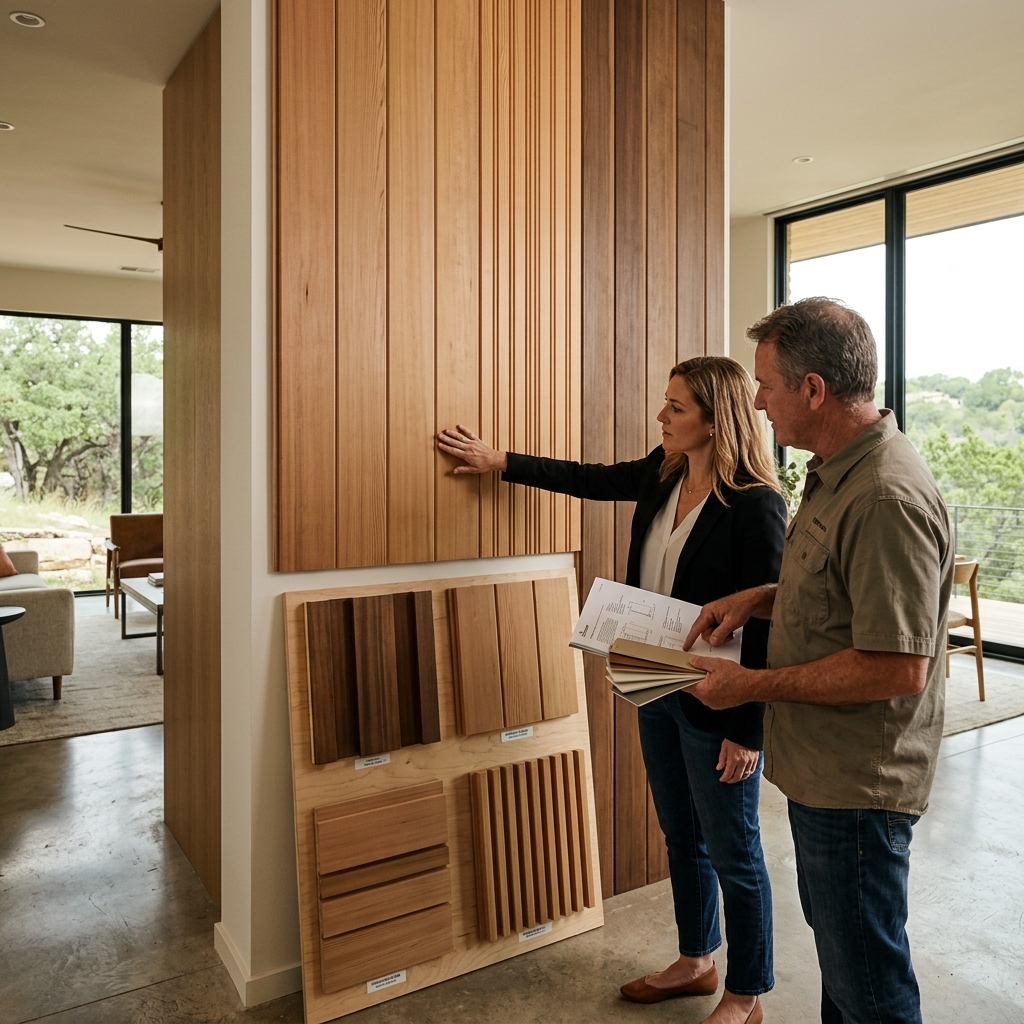
We also stock extensive hardwood inventory including Ipe, Cumaru, Garapa, Massaranduba, and Tigerwood. While hardwoods are traditionally associated with decking and exterior cladding, architects increasingly specify them for dramatic interior accent walls. These species deliver color, durability, and visual impact impossible to achieve with softwoods alone.
In addition to our own milling, we distribute premium brands including Arborwood cladding, Tantimber, TimberTech, Trex, and Fiberon. For projects requiring engineered solutions, these partnerships ensure access to cutting-edge products backed by manufacturer support and warranties.
FSC-certified materials are standard throughout our inventory. Architects and builders increasingly specify certified materials to document sustainable sourcing and responsible forestry practices. We maintain chain-of-custody documentation for all certified products, simplifying project documentation and third-party verification.
The practical advantage: you’re not custom-ordering from distant suppliers and waiting months for delivery. Material arrives when needed, milled to your specifications, with the backing of a local partner who understands Texas projects intimately.
Installation Considerations: Ensuring Lasting Performance in Texas Climates
Texas climate creates specific challenges for wood wall systems. Summer humidity in Houston and East Texas differs dramatically from the dry Hill Country. Seasonal temperature swings range from freezing to 100+ degrees. Installation approaches must account for these realities.
Moisture management begins before installation. Material should arrive at the job site and acclimate to the interior environment for at least 48 hours before installation. This allows the wood to stabilize at the humidity level it will experience in the finished space. Prematurely sealing or installing material that hasn’t acclimated virtually guarantees expansion, contraction, and visible gaps.
Substrate preparation is non-negotiable. Walls must be plumb and flat within tolerances your installer specifies. Any deviation from plumb becomes magnified vertically on a tongue and groove system. Water management behind the wall system prevents moisture intrusion that can cause swelling or decay. Proper ventilation ensures air circulation that prevents moisture accumulation, particularly in bathrooms and kitchens.
Fastening strategy matters tremendously. Pneumatic nail guns drive fasteners quickly but risk splitting grain or crushing soft wood like cedar. Experienced installers use hand-driven fasteners or specialized screw systems that allow for seasonal movement without creating pops or ridges in the finished surface. Fasteners should penetrate into studs, never into the subfloor or header alone.
Finishing extends durability dramatically. Polyurethane seals and protects while allowing wood character to show. Water-based finishes suit contemporary aesthetics while providing protection. Stains deepen color and unify grain variation. Raw, unfinished wood creates authentic appearance but requires homeowner commitment to ongoing maintenance. The finish you choose influences installation sequencing and site conditions during and after installation.
Climate-specific considerations: In humid coastal areas like Houston and Spring, ventilation and drainage become critical. Hill Country projects contend with extreme temperature swings. East Austin lofts in older buildings face retrofitting challenges and settling. Dripping Springs and Spicewood projects often combine interior and exterior wood systems requiring unified moisture management strategies.
Experienced installers familiar with these regional challenges prevent the majority of performance issues before they develop. This is why architect specifications should include installation oversight by or collaboration with carpenters experienced in tongue and groove systems.
Next step: Meet with your installer before ordering material. Their installation plan directly influences milling tolerances, fastening strategy, and acclimation requirements.
Real-World Applications: How Texas Architects Are Specifying These Systems
Architects across Texas are discovering that tongue and groove wall systems anchor contemporary design in a way few other details can.
A Lake Country residence combined vertical grain Douglas fir floor-to-ceiling walls in the great room with thermally modified Ash accent walls in the master suite. The dramatic color contrast reinforced the architectural separation between public and private zones while maintaining cohesive wood character throughout. The project’s setting required Class A materials for wildfire resilience, a requirement that actually elevated the material selection process.
A downtown Austin loft renovation used narrow vertical grain cedar in a fluted profile to soften brutalist concrete structure. The wood system humanized a raw industrial space while celebrating rather than concealing the building’s authentic character. Horizontal runs in secondary spaces created intimacy in bedrooms while vertical orientation in the main living area emphasized the building’s soaring ceiling height.
A Hill Country custom home integrated Ipe accent walls with cedar primary surfaces, using the hardwood’s deep brown tones to frame views and highlight architectural moments. The thermal mass of hardwood actually moderated temperature swings, while the cedar maintained the warm, welcoming primary aesthetic.
A residential project in Boerne specified thermally modified Poplar in a comb profile, creating sculptural wall surfaces that caught light throughout the day. The modified Poplar’s stability proved critical in a climate-controlled luxury residence where any wood movement would disrupt the precise geometric pattern.
These projects share common threads: material was selected early in design development, installation partners were engaged before ordering, environmental conditions informed species and finish choices, and the architects viewed the tongue and groove system as integral to the architecture rather than a decorative afterthought.
Why Material Quality and Milling Standards Matter More Than Price
The lowest-cost tongue and groove system rarely delivers the best outcome. Budget-grade material often contains defects invisible until installation begins: hidden knots that splinter, moisture-content variation that creates gaps weeks after installation, milling tolerances loose enough that joints don’t seat properly.
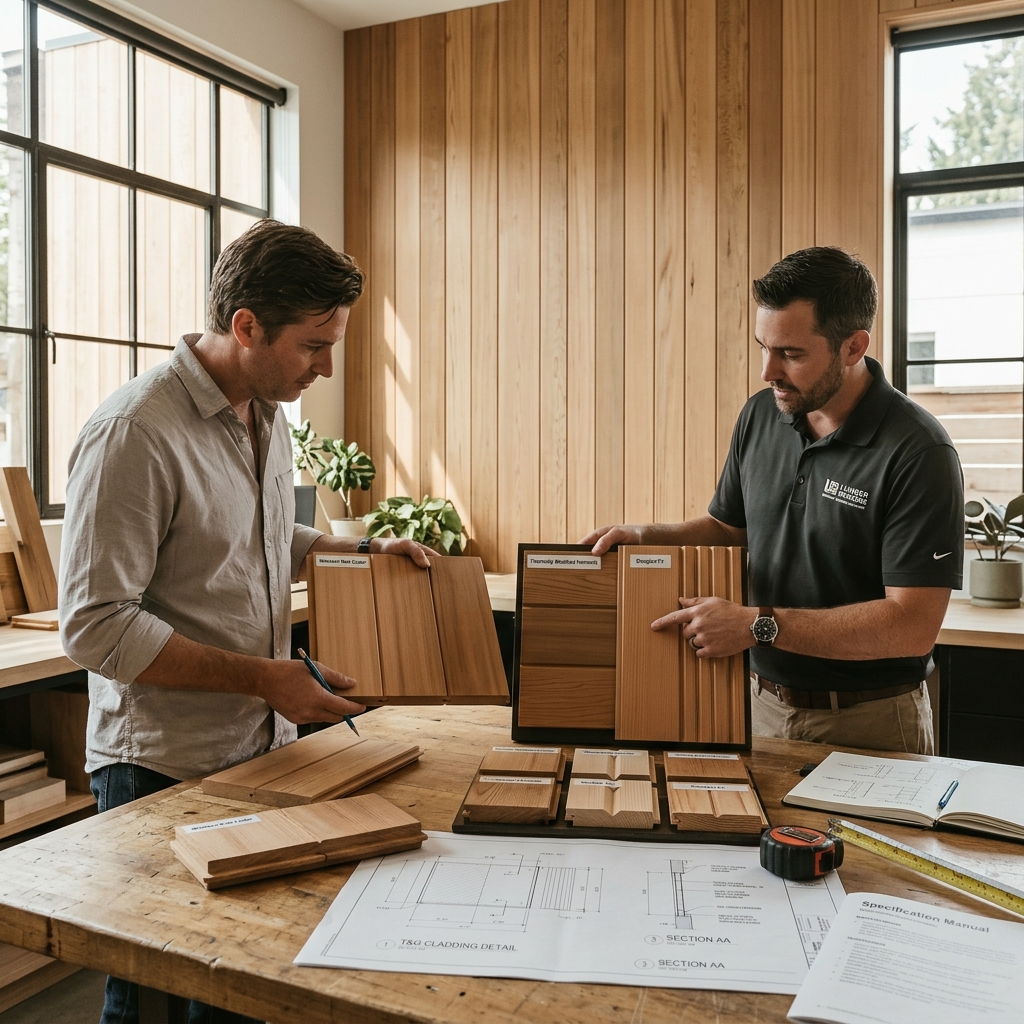
Quality milling demands precision. Tongue profiles must be exactly the correct dimension for the groove. Boards must be flat within 1/16″ over their full length. Knots must be sound and contained, not creating weak points in the joint. Moisture content must be consistent across every board in your order.
We implement milling standards that exceed industry minimums. Material ships straight, flat, and ready for installation. Moisture content documentation accompanies every order. Defects are rare because we prioritize getting it right rather than maximizing output volume.
The cost difference between commodity lumber and premium material typically runs 10-15% of the total wall system cost. On a 1,000-square-foot installation, that’s perhaps $1,500-$2,000 difference. That same amount in installation corrections or material waste from poor-quality stock exceeds the premium almost immediately. Quality material actually reduces total project cost when you account for installation efficiency and the absence of callbacks.
Beyond economics, quality material simply performs better. Gaps don’t develop. Finishes adhere uniformly. Color consistency creates the visual cohesion that separates a professional installation from an amateur attempt. Architects who’ve experienced the difference refuse to specify anything less going forward.
Your Partner for Sourcing, Customization, and Expert Project Support
We exist to simplify the process of sourcing premium wood products for sophisticated projects. Our role extends beyond inventory and milling, into partnership and problem-solving.
When you’re developing specifications for a tongue and groove system, you’re navigating species selection, profile options, finishing choices, installation requirements, and climate considerations simultaneously. The decisions interact, each one influencing the others. Working with a knowledgeable partner prevents costly specification errors and ensures your material arrives ready to perform.
We provide samples, milling specifications, and technical documentation that inform your specifications. We work directly with your installer to clarify fastening strategy and acclimation requirements. We source rare species or specialized profiles when standard offerings don’t meet your vision. We maintain inventory depth so your project isn’t delayed waiting for material to arrive from distant suppliers.
For Texas architects accustomed to designing with intention and executing with precision, we match that commitment at the material level. Our partnership means you’re specifying with confidence, knowing that material will arrive as promised and perform as designed.
Whether you’re specifying western red cedar in a contemporary Hill Country home, thermally modified wood in a high-moisture commercial space, or hardwood accents in an urban loft, we’re your resource for material sourcing, customization, and expert support.
Contact us today at 737.260.7431 to discuss your project specifications. We’ll help you navigate the decisions that matter and source material that delivers the performance and aesthetics your architecture demands.
To place orders, order samples, or talk with a live person.
Frequently Asked Questions (FAQ)
What wood species should we specify for tongue and groove wall systems in high-moisture environments like bathrooms and kitchens?
We recommend Western Red Cedar or Hemlock for their natural moisture resistance and dimensional stability in wet areas. If you need superior performance, our thermally modified options like Thermally Modified Ash or Pine provide enhanced durability while maintaining the aesthetic warmth architects demand. We stock all these species in vertical grain profiles specifically milled for interior applications where movement and cupping are critical concerns.
How do Class A fire-rated wood products impact design options for commercial interiors and residential projects?
Our WUI Class A fire-rated wood products let you maintain the authentic wood aesthetic while meeting building codes for commercial spaces and high-risk residential zones. We source these pre-treated materials in the same premium profiles and species you’d specify for standard applications, so there’s no compromise on visual impact or detail expressiveness that defines contemporary luxury design.
Can we source custom milling or unique profile specifications for architect-designed projects?
We absolutely can work with your specifications for custom profiles and non-standard dimensions. Our manufacturing capabilities combined with our inventory of rare hardwoods like Ipe, Cumaru, and Garapa means we handle both stock items and one-off requirements that make your designs truly distinctive.


