

The Challenge of Specifying Premium Materials for Code-Compliant Stairs
Modern architectural design thrives on bold details that challenge convention. Cantilevered stairs epitomize this ethos, creating that weightless aesthetic where treads appear to float without visible support. Yet the moment you specify a tropical hardwood like Ipe for those treads, the technical demands multiply.
You’re juggling multiple constraints simultaneously. ADA code requirements dictate precise nosing profiles, slip resistance coefficients, and riser-tread geometry. Building officials in Texas enforce these uniformly across jurisdictions. Meanwhile, your architectural vision demands that warm, rich grain and subtle color variation only premium hardwoods deliver. And the structural engineer needs reassurance that a 1.5-inch cantilever won’t deflect under load.
This tension between aesthetics, performance, and compliance is exactly where we help architects and builders succeed. We work with hundreds of high-end custom projects annually, and we’ve learned that treating these constraints as separate problems leads to costly revisions and project delays. Instead, we integrate code requirements into material selection from day one.
Your first step: Request a specification sheet that documents both the mechanical properties and ADA compliance details for your chosen wood species. This single document becomes your reference through design development, construction administration, and punch list.
Why Ipe Outperforms Softwoods in Cantilevered Applications
Ipe (Handroanthus ipê) is a Brazilian hardwood with hardness ratings that exceed most domestic softwoods by a factor of three or more. When you’re designing a cantilevered stair tread, this matters profoundly.
Softwoods like Douglas Fir or Western Red Cedar flex under concentrated loads. A 250-pound person stepping on a cantilevered fir tread creates a stress point that initiates micro-deflections. Over time, those deflections compound, and you get visible sagging. Ipe’s density (around 1100 kg/m³ compared to fir at 550 kg/m³) resists this deflection dramatically. The cantilever remains rigid, preserving both safety and the architectural line.
Beyond stiffness, Ipe offers superior edge retention. Softwood nosings dull and chip with foot traffic. Ipe maintains a crisp edge for years, preserving that precision detailing your architects specified. This is especially critical in commercial mixed-use projects where pedestrian volume runs high.
Ipe also contains natural oils that provide inherent rot and insect resistance without chemical treatment. For humid climates like Houston, Austin, and San Antonio, this translates to longer material life and minimal maintenance. We’ve seen Ipe stairs installed in 2005 that show virtually no weathering degradation today.
The trade-off is cost and machinability. Ipe requires carbide tooling and precise specifications to mill correctly. This is why partnering with a supplier experienced in hardwood stair components matters. We maintain dedicated CNC equipment and hardwood expertise specifically for these precision applications.
ADA Requirements for Stair Treads and Nosing Details
The ADA Standards for Accessible Design (2010 ADA Standards, as adopted in Texas) establish non-negotiable parameters for residential and commercial stairs.
Tread depth must measure between 10 and 11 inches, measured from nosing to nosing. Riser height falls within 4 to 7 inches. All treads and risers within a single flight must be uniform; variation exceeding 3/16 inch creates a tripping hazard and violates code.
The nosing profile is equally critical. Nosings must project between 1.25 and 1.5 inches beyond the riser face. Importantly, the nosing underside must not be undercut. This detail prevents shoe toes from catching during descent. For Ipe, we typically specify a simple radius at the nosing edge rather than sharp angles. A 1/4-inch radius is gentle on the eye while meeting code.
Slip resistance is measured via coefficient of friction (COF). ADA guidelines recommend a COF of at least 0.60 in the dry condition. This is where material finish becomes crucial. We address this in the section below on slip resistance, but understand now that your choice of surface treatment directly impacts code compliance.
All stair flights must have handrails on at least one side, with specific grip diameter, mounting height, and extension requirements. While we focus on treads here, coordinate these handrail details with your structural engineer early. A 1.5-inch hardwood tread integrates beautifully with custom steel or wood handrails when dimensioned consistently.
Document your nosing profile in the construction drawings with a 1:3 scale detail. Include dimensions, material species, and finish specification. This clarity prevents field substitutions that might compromise code compliance.
Load-Bearing Capacity and Cantilever Limits for Ipe
Ipe’s bending strength (modulus of rupture) averages around 14,500 psi. For context, Douglas Fir sits at approximately 8,000 psi. This higher strength translates directly to greater cantilever capacity.
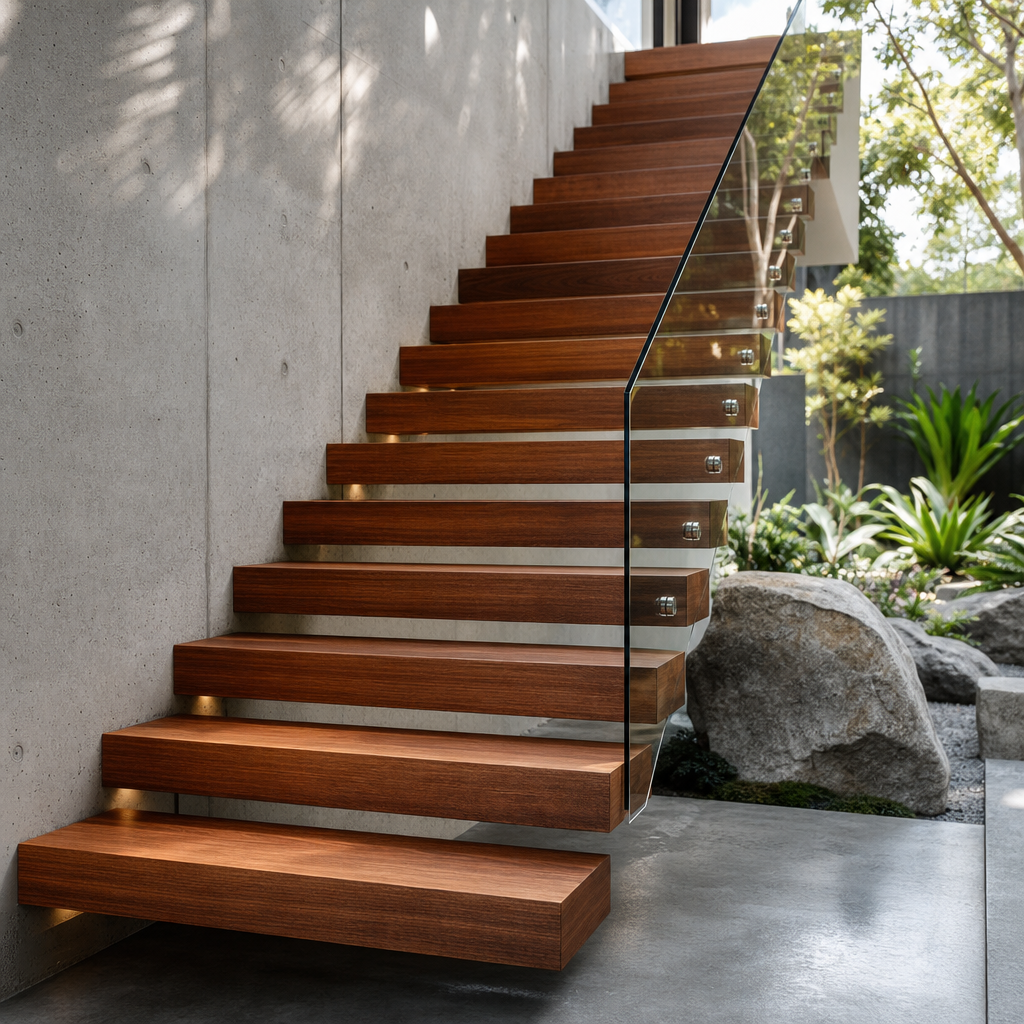
A typical 1.5-inch thick Ipe tread, 12 inches deep, cantilevered 10 inches, will support concentrated loads approaching 500 pounds without exceeding deflection limits. Your structural engineer calculates the actual allowable based on species grade, grain orientation, and your local load assumptions. Texas building codes typically assume 40 pounds per square foot of live load on stairs, though commercial and high-traffic applications may require higher values.
Deflection limits are the practical constraint. Building code allows 1/240th of the span to deflect under live load. For a 10-inch cantilever, this means approximately 0.05 inches of allowable movement. Ipe’s high modulus of elasticity (stiffness) keeps deflection minimal, meaning your stair treads remain visually flat and feel solid underfoot.
The grain orientation matters here. Vertical grain Ipe is superior to flat grain for cantilever applications because growth rings run perpendicular to the tread face, providing more uniform stiffness in the critical direction. We always specify vertical grain Ipe for stair components.
Connecting the cantilevered tread to the stringer is structural reality. Most designs use bolted or welded steel plates embedded within the wood, or alternatively, bolted connections that must be sized for shear and tension forces. Your structural engineer drives these connection details. Our role is ensuring the wood itself is milled to exact tolerances so connection holes align precisely.
Have your structural engineer specify allowable loads in writing early in design, then confirm these loads are achievable with your material supplier before issuing final bid documents. This prevents mid-project surprises.
Designing for Slip Resistance Without Compromising Aesthetics
Slip resistance and visual warmth aren’t mutually exclusive, though many builders treat them as conflicting goals.
Ipe in its natural, hand-planed finish offers moderate slip resistance (COF around 0.55 to 0.60). The slight texture from planing provides adequate grip for most residential applications. For commercial stairs or high-moisture environments, you have three proven options:
Sanded finish with texture. A 120-grit finish provides slightly higher friction than hand-planing while maintaining the wood’s natural appearance. The grain remains visible, color glows warmly, and the COF reaches 0.65 to 0.75.
Applied anti-slip tape. Adhesive-backed safety tape in dark charcoal or bronze tones can be inlayed into a routed recess across the tread nosing. This is reversible, compliant, and visually minimal when executed well. The tape sits flush with the tread surface rather than protruding, preserving the clean line.
Chemical hardeners and sealers. Some finishes designed for hardwood floors incorporate micro-aggregates that increase friction without altering the wood’s appearance. Test these on sample boards before specification, as results vary by tread material and environmental exposure.
We’ve had strong success with option two: a subtle anti-slip tape inlaid into a routed 1/16-inch recess. From standing height, it’s nearly invisible. Under foot, it provides the security clients appreciate, especially on steep cantilever stairs.
The finish you apply must be compatible with Ipe’s density. Typical polyurethane or lacquer finishes work well. We recommend water-based polyurethane to minimize VOC while providing durable wear protection.
Prototype your slip resistance strategy on a mockup tread before committing to full production. Have your design team, builder, and accessibility consultant walk the mockup. This single conversation catches disagreements early.
Fire Rating and Safety Standards for High-Performance Stairs
Fire ratings matter differently depending on occupancy type. A residential custom home in Westlake Hills has different fire requirements than a commercial office tower in downtown Austin.
For residential construction, no specific fire rating is mandated for stair treads, though your fire-rated stringer assembly must meet the wall fire separation requirements. Ipe doesn’t require special fire treatment; it’s inherently a dense, slow-burning wood.
Commercial and multi-family residential projects often require Class A or Class B fire ratings. This is where we provide an important service: we stock WUI (Wildland-Urban Interface) Class A fire-rated wood products, including thermally modified and chemically treated options.
Thermally modified Ipe is treated through a kiln-heating process that enhances its fire properties without chemical additives. This approach aligns well with modern green building standards and appeals to architects prioritizing natural material authenticity. The process darkens the wood slightly and improves dimensional stability, which benefits stair applications.
Alternatively, chemical fire retardant treatments (compliant with ASTM E84) can be applied to standard Ipe. These preserve the wood’s natural color while achieving fire ratings.
The choice depends on your project’s fire code requirements, budget, and design aesthetic. Work with your building official early to confirm which fire rating, if any, applies to your stair assembly.
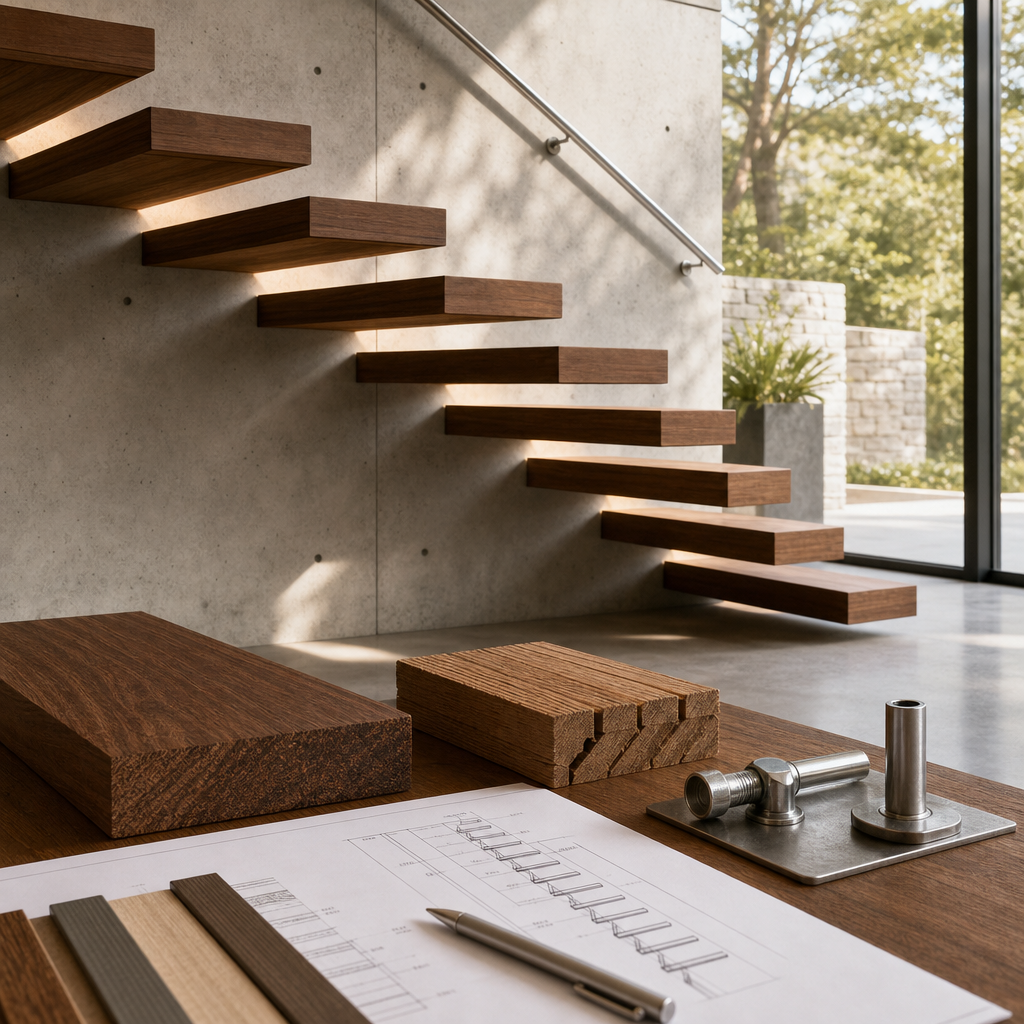
Request third-party fire test certifications from your supplier. Don’t assume treatment application without documented proof. We provide ASTM E84 test reports with every fire-rated product.
How We Source and Mill Ipe for Precision Specifications
Ipe sourcing begins with sustainable forestry partnerships in Brazil and Central America. We work exclusively with FSC-certified suppliers, meaning every tree harvested is tracked and replanted according to strict environmental protocols. For architects committed to responsible material practices, this sourcing story matters.
Milling precision is where the technical expertise lives. Ipe’s extreme hardness dulls standard tools rapidly. We operate CNC equipment with carbide tooling specifically calibrated for hardwood stair components. Tread blanks are milled to exact thickness tolerances (plus or minus 1/32 inch), with nosing profiles routed to specification.
After milling, every tread is individually dried to 12-percent moisture content equilibrium. This stabilizes the wood before installation and minimizes dimensional movement post-installation. We measure moisture content on every piece before shipping.
The final critical step is moisture acclimation. We ship Ipe to the project site, then store it indoors in the climate-controlled space where it will be installed for a minimum of two weeks before installation. This acclimation prevents post-install cupping or warping caused by ambient humidity shifts.
Many suppliers cut corners on acclimation. We treat it as non-negotiable. We’ve seen beautiful stair installations ruined by builders who installed treads directly from outdoor storage. The wood absorbed moisture, swelled, and twisted against rigid connections. Proper acclimation prevents this entirely.
Specify a two-week acclimation period in your construction schedule, and ensure your builder stores materials indoors at controlled temperature and humidity. This is your insurance against material movement.
Coordinating Stair Details with Your Architectural Vision
Your architects drew specific details because they matter to the design narrative. A cantilevered stair in a modern contemporary home isn’t just functional; it’s sculptural. The underside of the cantilever is visible. The grain direction and color consistency affect the entire spatial experience.
We’ve worked extensively with Texas architecture firms like Lake|Flato on precisely these challenges. Their designs often emphasize minimal, clean lines with emphasis on natural wood warmth. Cantilevered stairs execute that vision perfectly when specified with full precision.
Coordinate with us early on three specific details:
Grain orientation and selection. We can source vertical grain Ipe at a premium if your design calls for uniform, linear grain. Alternatively, we can select for figure grain if the design celebrates variation. This choice is made during milling.
Color matching and variance. Ipe typically ranges from golden-brown to dark brown depending on age and finishing. We can sort and sequence boards to achieve consistent color throughout a flight, or we can embrace variation for a more organic appearance. Your choice drives our sourcing approach.
Finish mockups. Before final production, we’ll deliver finish samples in the exact Ipe grade and thickness you’ve specified, with your chosen surface treatment applied. Your design team and builder review these together to confirm the aesthetic outcome.
Regular communication between your design team, builder, structural engineer, and our production team prevents misalignment. We assign a single point of contact for every project and maintain a master specification document that everyone references.
Specification Best Practices for Contractor and Builder Success
A clear specification document is the foundation of successful installation. We’ve seen too many projects derail because the contractor received conflicting information from different team members.
Your specifications should include:
- Material species, grade, and grain orientation (vertical grain Ipe, select grade, etc.)
- Dimensions: thickness, tread depth, riser height, cantilever length
- Nosing profile: dimensions and radius detail
- Slip resistance requirement and method (finish, tape, texture)
- Fire rating requirement (if any) and treatment type
- Finish specification: sealant type, number of coats, cure time
- Moisture content at delivery (12 percent)
- Installation method and fastening specification
- Connection details to stringer assembly
- Acclimation requirement and timing
- Tolerance acceptance ranges for dimensional variation
This specification becomes the contract between you and the builder. When installation issues arise, you reference it. When cost questions emerge, you’re protected by clear scope documentation.
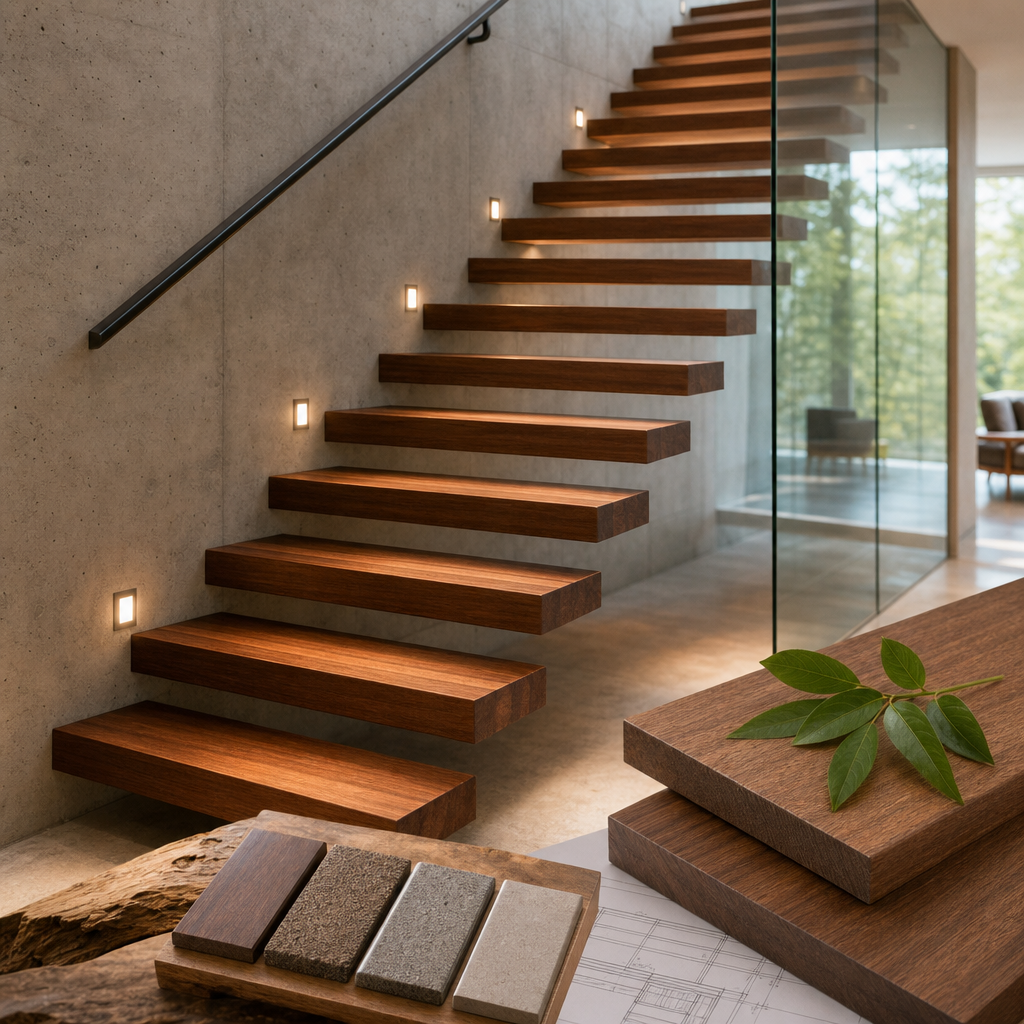
We provide detailed specification sheets for every product grade and dimension we mill. You can use these directly in your construction documents, or modify them to match your specific project details. This saves you hours of technical writing and ensures consistency across your practice’s projects.
Create a master stair specification template for your firm and update it annually as code requirements and product availability evolve. Share it with your structural engineer so they reference the same details in their calculations.
Sustainable Sourcing and Certification for Your Projects
Ipe’s reputation as a tropical hardwood sometimes triggers concerns about deforestation. The reality, with responsible sourcing, is more nuanced.
FSC certification means forests are managed for perpetual yield. Trees are harvested selectively, with replanting requirements exceeded. The environmental impact of responsibly harvested tropical hardwood is substantially lower than many alternatives. We choose FSC-certified Ipe exclusively for this reason.
We also stock thermally modified wood products including Thermally Modified Ash, Pine, and Poplar. These domestic woods are treated through heat processing to achieve hardness and stability approaching tropical hardwoods. For architects prioritizing locally sourced materials, thermally modified options provide an excellent path forward. The trade-offs are slightly lower density than Ipe and higher cost than untreated softwoods. The benefits are domestic sourcing, reduced shipping impact, and excellent performance characteristics.
Your choice among tropical hardwoods, thermally modified woods, or domestic softwoods depends on your project’s specific performance requirements and sustainable sourcing priorities. We can document the environmental profile of any choice you make, providing your clients transparency about material origins and certifications.
Many high-end residential clients increasingly ask about material sourcing. Being able to explain that their stair treads come from FSC-certified forests managed for perpetual yield resonates deeply. It adds depth to the material story you’re telling through design.
Request environmental certification documentation from your supplier for every material you specify. This transparency builds trust with clients and satisfies third-party certifications like LEED.
—
Modern stair design demands precision at the intersection of aesthetics, code compliance, and structural performance. Ipe delivers that performance with the visual warmth and character contemporary architecture celebrates. By addressing material selection, load capacity, slip resistance, fire ratings, and sourcing simultaneously, you position your projects for installation success and long-term durability.
We’re here to translate your architectural vision into specification documents and milled products that contractors install without ambiguity. Reach out with your stair details, and let’s confirm that your cantilevered Ipe treads will exceed both code requirements and your design expectations.
For further reading: Primeline Softwoods.
To place orders, order samples, or talk with a live person.
Frequently Asked Questions (FAQ)
What ADA requirements do we need to meet for cantilevered ipe stair treads?
We ensure our ipe stair treads comply with ADA standards by maintaining minimum 1.25-inch nosing projections, slip-resistant surfaces with a minimum 0.60 coefficient of friction, and consistent tread depths of 10-11 inches. Our specifications also account for proper handrail heights, riser dimensions not exceeding 7 inches, and uniform stair geometry throughout your project. We work directly with your architectural team to document these requirements in detail before fabrication begins.
Why does ipe outperform softwoods like cedar and hemlock for cantilevered applications?
Ipe’s hardness and density provide superior load-bearing capacity, allowing longer cantilever spans with minimal deflection compared to western red cedar or hemlock. We source ipe specifically for high-performance stair applications because it resists cupping, twisting, and movement that softwoods experience over time, ensuring your treads maintain consistent spacing and slip-resistance. This stability is critical when architects design modern cantilevered details where visual precision and structural integrity cannot be compromised.
How do we source and mill ipe to your exact stair specifications?
We work with sustainably harvested ipe suppliers and mill each tread to your architectural drawings, controlling thickness tolerances, nosing profiles, and finish requirements with precision equipment. Our team verifies moisture content, grain orientation, and visual grading to match your design intent before shipping. We also coordinate with your builders and contractors on installation details to ensure our fabrication translates seamlessly into your final design.


