

Why Timber Documentation Failures Cost Architects Time and Money
Incomplete or inaccurate timber documentation is one of the fastest ways a project stalls at municipal review. We’ve seen architects spend weeks resubmitting specifications because fire-rating certifications didn’t match the jurisdiction’s specific requirements, or because structural timber grades weren’t properly documented for the inspector’s approval.
A typical scenario: an architect specifies vertical grain cedar siding with an assumed Class A fire rating. The municipality requests proof. The documentation arrives late or incomplete, and the project sits in review limbo. Meanwhile, the general contractor waits, the client grows impatient, and your timeline shifts by 30 days.
The real cost isn’t just delay. It’s rework. Incomplete documentation often triggers requests for clarification that force you to coordinate with suppliers, re-examine specifications, and resubmit. Each cycle burns billable hours and goodwill with your client.
Beyond administrative friction, weak documentation creates compliance risk. If an inspector has questions about material specifications or fire-ratings during construction, you’re managing issues on site that should have been settled during permitting. That’s exponentially more expensive than getting it right upfront.
Your takeaway: Timber documentation quality directly affects your approval timeline and project budget. Start with a supplier who understands exactly what your jurisdiction demands and can deliver documentation that passes the first review.
Understanding Texas Municipal Building Code Requirements for Wood Materials
Texas municipalities adopt the International Building Code (IBC) as their baseline, but local amendments create variation across Austin, Dallas, Houston, San Antonio, and smaller jurisdictions. What passes in one city may require additional justification in another.
The core requirements focus on three areas: fire rating (especially in Wildland-Urban Interface zones), structural capacity, and material durability. For exterior applications like siding, cladding, and decking, fire rating becomes critical. Interior applications demand different documentation, particularly around smoke development and flame spread.
Austin’s building department, for example, has specific WUI (Wildland-Urban Interface) Class A requirements for properties near hill country terrain. Dallas applies stricter commercial standards to downtown mixed-use projects. San Antonio considers coastal wind loads differently than Austin’s inland standard. Houston adds humidity and moisture considerations that affect material selection and specification.
Each jurisdiction also maintains its own list of acceptable fire-rated products and approved testing standards. Some accept only ASTM E84 testing; others require additional FM or UL certifications. Some municipalities recognize thermally modified wood certifications; others require more traditional documentation pathways.
The variation isn’t random, but it’s real. Before you finalize material specifications, confirm your municipality’s exact code amendments and approved product lists. This prevents the documentation surprise that derails timelines.
Essential Documentation Your Jurisdictions Actually Demand
Inspectors and building officials don’t want generic product data sheets. They want specific documentation tied to your project’s exact materials and applications.
Start with material specification sheets that include:
- Product identification (species, grade, treatment type)
- Fire-rating certifications (test standard, rating class, testing agency)
- Moisture content limits and durability claims
- Installation requirements that align with your architectural details
- Maintenance expectations relevant to the application
For structural timber (posts, beams, framing), you’ll need grade stamps or mill certifications proving the lumber meets the specified grade. For engineered products like composite decking, manufacturer load tables demonstrating capacity for your span and load conditions. For specialty materials like thermally modified wood, you’ll need durability and fire-rating documentation that matches the testing standard your jurisdiction recognizes.
Fire-rated products demand third-party test reports. A product labeled “Class A” needs the actual ASTM E84 or UL 723 test report, not just the manufacturer’s claim. Many jurisdictions will request flame spread and smoke development numbers, so have those figures readily available.

When specifying exterior applications in WUI zones, include the specific Class A certification letter or report. If you’re using a product not on your jurisdiction’s pre-approved list, provide the testing documentation early in the permitting process, not during construction administration.
Include installation specifications that match your architectural details. An inspector approving cedar siding needs documentation showing the fastening pattern, ventilation gaps, and weather-resistive barrier that aligns with your section drawings. Misalignment between your specifications and installation details creates unnecessary review questions.
How We Simplify Material Certification and Fire-Rating Documentation
At US Lumber Brokers, we maintain complete certification packages for every product we supply. When you specify Western Red Cedar, Douglas Fir, Hemlock, or our specialty hardwoods, we provide the exact documentation your jurisdiction needs without delays.
For fire-rated products, we supply the third-party test reports directly. Our WUI Class A fire-rated siding, cladding, decking, and fencing products come with certification letters that specify the testing standard and exact fire-rating classification. We’ve pre-coordinated these certifications with Texas municipalities, so the documentation arrives in the format your inspector expects.
For thermally modified wood products, we provide durability certifications and fire-rating reports that document performance in exterior applications. Thermally modified ash, pine, and poplar products include decay resistance ratings and moisture stability data that satisfy municipal durability requirements.
When you work with us, you’re not managing a documentation hunt across multiple suppliers. We consolidate specifications, certifications, and compliance documentation into a single package organized by material type and application. Your specification sheet, our product certifications, and the municipal requirement align from the start.
We also coordinate with your jurisdiction early. If you’re using a product not on the pre-approved list, we help you submit the certification documentation during design review, not during permitting. That proactive step eliminates approval delays.
Structural Specifications That Satisfy Local Inspectors
Timber structural specifications demand precision. A post, beam, or framing member isn’t just “cedar” or “Douglas Fir.” It’s a specific grade with documented strength properties that meet the engineer’s load calculations.
Inspectors want to see:
- Species and grade designation (e.g., Western Red Cedar, Select Structural or Clear Select)
- Lumber grading organization (Lumber Grading Company or equivalent)
- Moisture content at time of installation
- Grade stamp reference or mill certification
- Span and load conditions the member supports
- Connection details showing how loads transfer to adjacent elements
For clear-span timbers in contemporary designs, specify the exact grade and size that satisfies the structural engineer’s calculations. If you’re using Primeline Softwoods cedar or Doug Fir timbers, we provide grade certification and mill stamps showing the lumber meets Select Structural or Clear designations.
Dimensional tolerance also matters. Modern contemporary architecture often exposes timber frames where visual consistency is critical. Specifying tight grading standards (clear or vertical grain) protects the design aesthetic while also ensuring consistent structural properties.
For hardwood structural applications like Ipe timbers and posts, include density and strength data specific to the species. Ipe’s high density affects fastening and cutting, so your specifications should document fastening patterns and bit requirements that match the material’s properties.
Document moisture content expectations. Timber moves with seasonal humidity changes. In Texas climates, especially in high-humidity areas near coastal zones, specify moisture content limits and include dimensional movement tolerances in your architectural details. This prevents inspector concerns about the structural integrity of connections as timber seasons.
WUI Class A and Specialty Wood Product Certifications
Wildland-Urban Interface regulations have transformed timber documentation in Texas hill country and suburban fringe areas. If your project is in Austin, Kerrville, Dripping Springs, Driftwood, or similar areas near natural vegetation, WUI Class A fire-rating is often mandatory for exterior materials.

Class A means the material scores 0-25 on the ASTM E84 flame spread test. Your jurisdiction may accept this rating for siding, cladding, decking, fencing, and even framing materials in high-risk zones. Some municipalities extend Class A requirements to soffit and picket applications.
The challenge: not all wood products carry Class A certification in their natural state. We supply WUI Class A fire-rated wood products specifically designed for these applications. The fire rating comes through treatment or thermal modification, with third-party testing that documents compliance.
For architects specifying contemporary designs with exposed wood in WUI zones, this opens options. You can use the warm, natural aesthetic of timber while meeting stringent fire codes. The certification documentation makes municipal approval straightforward.
Specialty wood products like thermally modified wood also appear in WUI specification packages. Thermally modified ash or pine products combine durability advantages with fire-rating certifications, making them ideal for high-performance exterior applications. The documentation includes both fire-rating results and decay resistance data, covering municipal requirements in a single product.
When specifying these products, include the certification reference in your material schedule and attach the third-party test report to your permit documents. This demonstrates upfront that your material selection aligns with local code requirements.
Creating Comprehensive Timber Schedules That Expedite Approvals
A well-organized timber schedule is the document that moves your project through municipal review. It’s not a list of materials. It’s a matrix that connects your architectural details, structural specifications, fire-rating requirements, and municipal code citations into a single reference.
Structure your timber schedule by application (exterior siding, deck framing, interior posts, etc.). For each application, include:
- Material specification (species, grade, dimension)
- Fire-rating classification or structural grade designation
- Finish or treatment type
- Code section or standard it satisfies
- Reference to supporting documentation (test report, certification, grade stamp)
For a contemporary cedar clad exterior, your schedule might read: “Exterior siding: Western Red Cedar, vertical grain, Clear grade, 6-inch face width, 1-inch nominal thickness, WUI Class A fire-rated (ASTM E84 certification attached). Code compliance: Fire-rating requirement in Section 602.2, Application Sheet X.”
This level of detail eliminates ambiguity. An inspector reviewing your plans sees exactly what you’re specifying, how it meets code, and where the supporting documentation lives in your submission package.
Link your schedule directly to your architectural sections and details. If your section shows a specific fastening pattern or ventilation gap, reference that detail number in the schedule. Consistency between your drawings, specifications, and schedule accelerates review.
For complex projects with multiple timber applications (structural frame, exterior cladding, soffit, deck, interior finishes), create separate schedules by application. This prevents confusion and makes it easier for the inspector to verify compliance for each material type.
Our Role as Your Complete Documentation Partner
We’re not just a lumber supplier. We’re your timber documentation resource from specification through installation verification.
When you’re finalizing material selections, we provide specification-ready documentation that matches your architectural intent and your jurisdiction’s code requirements. You don’t submit generic product brochures. You submit our certification packages, fire-rating reports, and structural documentation that satisfy municipal inspectors immediately.
We understand the specific requirements across Texas jurisdictions. Austin’s WUI standards differ from Dallas mixed-use requirements, which differ from San Antonio commercial standards. We’ve worked with municipalities across the state and know what documentation each one demands. That experience accelerates your design process and eliminates specification surprises.
We also coordinate with your structural engineer. If the engineer specifies a particular timber grade or species to meet load calculations, we confirm the material is available with proper grading documentation. If the engineer requires thermally modified timber for durability in a specific application, we source it with the appropriate certifications.
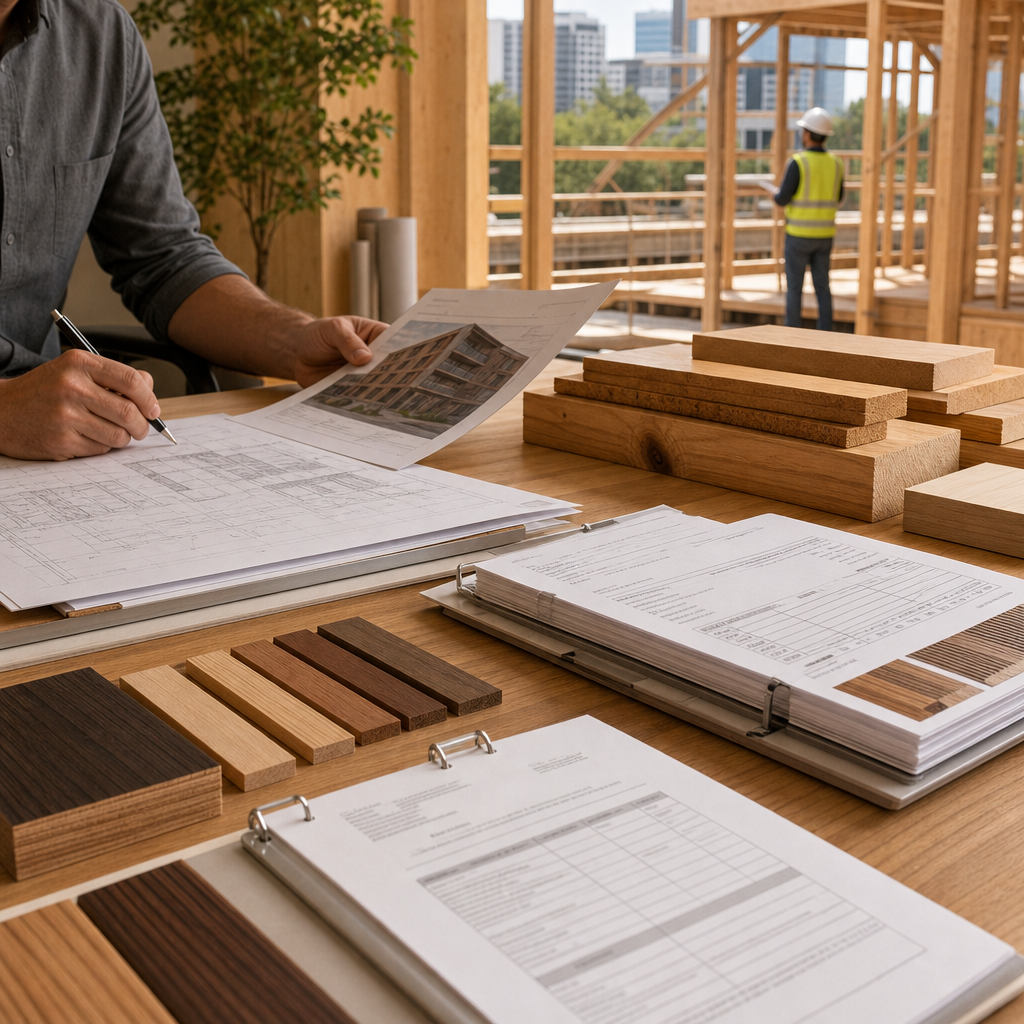
During construction administration, we support material verification. When the contractor receives timber shipments, we provide documentation confirming the material matches your specifications. Grade stamps, mill certifications, and fire-rating labels align with your permit documents. This prevents field issues where an inspector questions whether the delivered material matches the approved specifications.
From Specification to Installation Compliance
Your documentation doesn’t end at permit approval. It continues through construction, where inspectors verify that installed materials match your specifications.
Coordinate with your general contractor and installer well before material delivery. Share your timber schedule, fire-rating certifications, and structural specifications with the site team. This ensures everyone understands what’s arriving, where it’s going, and what documentation will be required at inspection.
When timber arrives on site, the contractor should verify that grade stamps, fire-rating labels, and dimension match your approved schedule. For specialty products like thermally modified wood or fire-rated hardwoods, the labels and shipping documentation should reference the certification reports you submitted to the municipality.
For structural applications, the inspector will likely request to see grade stamps on posts, beams, and framing members before they’re covered. Have that documentation readily available on site. For fire-rated products, certification labels should remain visible on shipped materials so the inspector can verify them during rough construction.
Documentation also covers installation. Your architectural sections showing fastening patterns, spacing, and ventilation gaps become the standard the inspector uses to evaluate workmanship. A well-detailed section that matches your material specifications prevents the installer from guessing how to attach or finish the material.
We can assist with field documentation support. If questions arise during construction about material specifications or fire-rating compliance, we provide additional certification documentation or technical guidance to resolve them quickly.
The goal is seamless continuity from your specification sheets through final inspection. Complete, accurate timber documentation at the design phase prevents field surprises and keeps your project on schedule.
Start with your jurisdiction’s specific code requirements, organize them into a clear timber schedule, source materials with complete certifications, and coordinate installation documentation early. That foundation transforms timber specifications from a compliance burden into a straightforward project step.
Ready to simplify your timber documentation? We’re here to provide the certified products, specification support, and compliance documentation that moves your Texas projects through municipal review efficiently.
To place orders, order samples, or talk with a live person.
Frequently Asked Questions (FAQ)
What documentation do we provide to ensure your projects meet Texas building code requirements?
We supply comprehensive material certifications, fire-rating documentation, and structural specifications tailored to your jurisdiction’s specific demands. Our team coordinates directly with municipal building departments across Texas to ensure every wood product we specify includes the certification paperwork inspectors actually require, from WUI Class A approvals to FSC documentation and thermally modified wood testing reports.
How does our sourcing process reduce approval delays on your timber projects?
We maintain direct relationships with manufacturers and distributors of specialty wood products, which means we can quickly access and verify all necessary certifications before you specify materials on drawings. Rather than waiting weeks for documentation after submission, we provide complete material specs and approvals upfront, allowing your designs to move through municipal review without unexpected holds.
Why do we focus on WUI Class A and fire-rated wood products for Texas projects?
We recognize that wildland-urban interface requirements and fire-rating specifications are critical compliance issues across Texas, particularly in Hill Country and Austin-area projects. By specializing in approved WUI Class A products and maintaining current certifications for all our inventory, we help you specify materials that satisfy code officials immediately rather than forcing redesigns during the review process.


