

The Architect’s Decking Challenge: Performance Meets Budget
Every Texas architect we work with faces the same tension: your designs demand wood that performs flawlessly in our climate while delivering the warmth and visual authenticity your clients expect. A deck isn’t just structural. It’s where those expressive wood-and-glass boundaries you’ve carefully crafted actually live, subject to intense sun, humidity swings, and heavy foot traffic.
The challenge deepens when you’re comparing materials at genuinely different price points. Specifying IPE feels premium and justified. Suggesting Douglas Fir might seem like a cost compromise. Yet both can serve signature projects when matched correctly to the right design vision and maintenance expectations.
We’ve worked with enough Austin-area architects to know that the real decision framework isn’t “what’s best,” but “what’s best for this specific project, client, and timeline.” The material that makes sense for a contemporary Lake Travis home overlooking the water differs from the choice for an East Austin renovation where intimate scale matters more than fortress durability.
Why Tropical Hardwoods and Softwoods Serve Different Design Visions
This distinction matters more than most builders admit. Tropical hardwoods like IPE and Garapa bring density, color depth, and visual permanence to a deck. They age with gravity and authenticity. Softwoods like our vertical grain Douglas Fir offer a different aesthetic entirely: lighter tone, finer grain pattern, and a warmth that reads “natural” in a subtly different register.
Contemporary architecture inspired by Lake|Flato and Page emphasizes material honesty. That honesty comes through differently depending on the wood species. IPE’s deep chocolate-brown patina signals endurance and craftsmanship. Douglas Fir’s silvering over time communicates something lighter, more organic, and in some climates, more humble.
The performance difference is equally real. Tropical hardwoods resist rot, insect damage, and checking far better than softwoods. They require different fastening approaches entirely. Softwoods demand more aggressive maintenance schedules but reward discipline with decades of reliable service. Neither approach is wrong. The architecture should drive the choice.
IPE Hardwood Decking: Unmatched Durability and Visual Impact
IPE is the material when durability and visual statement align. We source FSC-certified IPE from suppliers committed to responsible forestry, and the difference in quality is immediately apparent. This wood carries a Janka hardness rating around 3,680, making it harder than most domestic hardwoods and virtually immune to foot traffic damage or splitting.
Its color arrives as warm golden-brown and deepens to rich chocolate over 12-18 months of exposure. That evolution is aesthetic, not compromise. IPE won’t check, splinter, or soften under Texas heat. It resists termites, fungi, and the wood-boring insects that plague softer species in our humid Hill Country summers.
The visual payoff justifies its cost for signature projects. Imagine a modern concrete structure with expansive glass, where a warm-toned IPE deck becomes the visual anchor that humanizes clean lines. That material choice becomes part of the design intent, not a hidden structural decision.
IPE does require hidden fastener systems because the wood’s density makes pre-drilling essential. Standard screw fastening risks splitting. We work with architects who’ve already designed for these details, so it’s not a surprise, but it’s worth noting in early specification phases.
Garapa Decking: The Balanced Alternative for Contemporary Spaces
Garapa occupies the sweet spot we recommend most often for Texas architects working within reasonable budgets. It’s roughly 60% of the cost of IPE while retaining substantial performance advantages over softwoods. Janka hardness around 2,000 means it won’t match IPE’s impact resistance, but it exceeds every softwood species significantly.
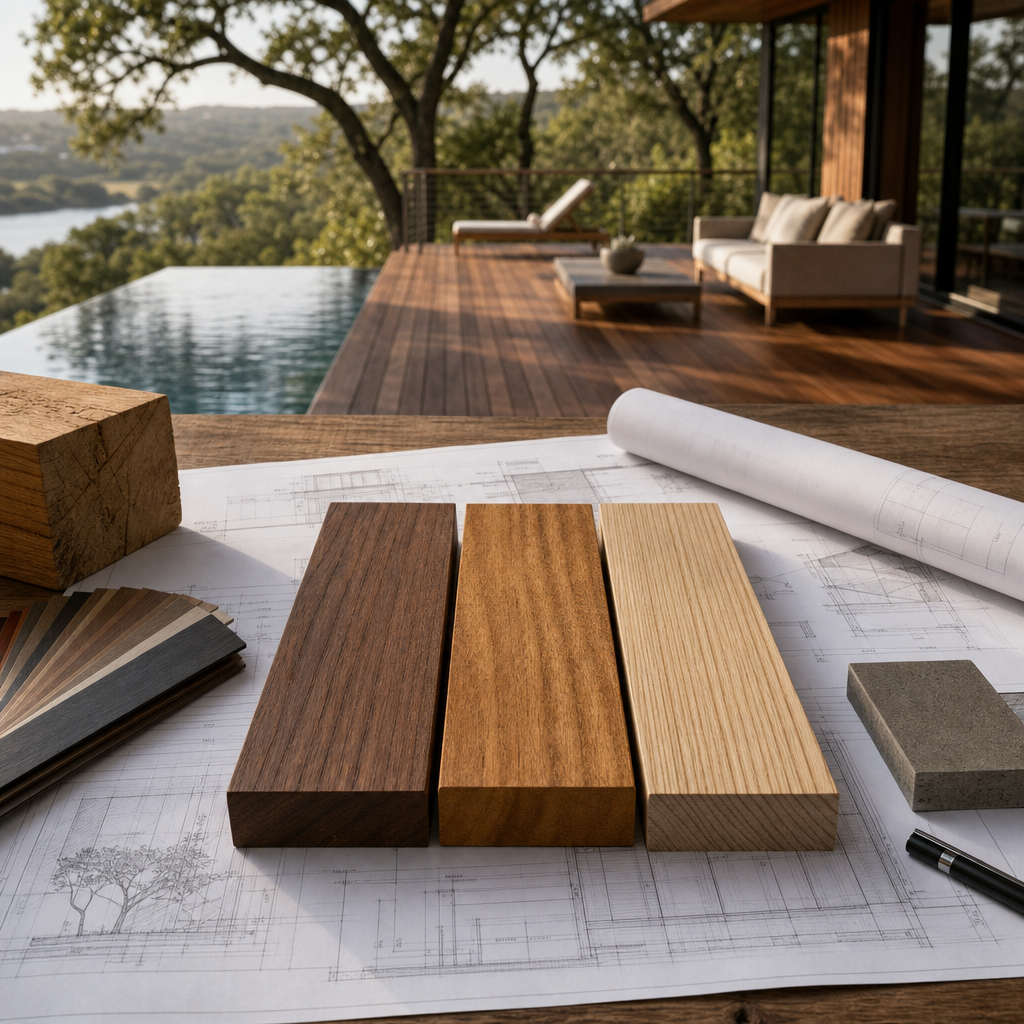
Its visual character differs from IPE in important ways. Garapa arrives with a honey-gold tone and weathers to a silver-gray more readily than IPE. For contemporary spaces where you want warmth without demanding visual dominance, Garapa delivers sophistication at a genuinely different price tier.
We specify Garapa frequently for residential projects where the deck serves the livability goal rather than making a sculptural statement. It’s durable enough to last 15-20 years with moderate maintenance (periodic cleaning and occasional sealing). That timeline aligns with how most homeowners actually use outdoor space before remodeling anyway.
Like IPE, Garapa demands pre-drilling for fastening, but the material is slightly more forgiving during installation. We’ve found it strikes the practical balance between performance aspiration and construction reality on job sites.
Vertical Grain Douglas Fir: Our Native Softwood Excellence
This is where we recalibrate expectations intentionally. Vertical grain Douglas Fir isn’t IPE, and architects sometimes specify it with that misconception, leading to frustration when maintenance becomes necessary.
What it is: a native softwood with legitimate beauty, surprising durability when properly maintained, and a cost structure that unlocks feasibility on larger deck projects. Our Primeline Softwoods selection includes clear vertical grain Douglas Fir that rivals tropical hardwoods aesthetically at roughly one-third the price.
The Janka hardness sits around 620, meaning the wood will dent and mark under heavy use. But here’s the practical reality: most residential decks don’t receive the traffic intensity that demands IPE. A well-maintained Douglas Fir deck in Austin can serve reliably for 12-15 years before significant refresh becomes necessary.
Its grain is tighter and more consistent than flat-sawn material, and that quality shows. The warm honey tone resonates with contemporary architecture focused on authenticity over statement. Many architects choose it specifically because it photographs beautifully and reads as “real wood” rather than “hardwood investment.”
The maintenance requirement is the honest trade-off. Douglas Fir benefits from sealing every 18-24 months and requires more attention to checking and occasional splinter management. That’s not a failure of the material. It’s the cost structure of choosing affordability alongside performance.
Pricing Breakdown: What You Actually Invest in Each Material
Let’s be specific because budget conversations matter in architecture.
IPE typically runs 2.50-3.50 per linear foot for quality decking boards, roughly double Garapa pricing. For a 400-square-foot deck, you’re investing 3,200-4,500 in material alone. That expense carries forward: hidden fastener systems add cost, and specialized contractors familiar with IPE installation command appropriate labor premiums.
Garapa occupies the middle range: 1.50-2.25 per linear foot. The same 400-square-foot deck costs 1,920-2,880 in material. Installation is more straightforward than IPE but still requires competent carpentry familiar with hardwood-specific practices.
Vertical grain Douglas Fir ranges 0.80-1.40 per linear foot, putting material costs between 1,280-2,240 for equivalent square footage. That’s genuine savings that compound across a project, particularly on larger decks where material cost drives overall budget.
But pricing doesn’t end at material. Factor in finishing costs (IPE rarely needs it; Garapa benefits from occasional sealing; Douglas Fir demands regular maintenance investment). A Douglas Fir deck that needs resealing every two years accumulates 500-800 in maintenance costs over a decade. Those numbers deserve transparency when comparing options with clients.
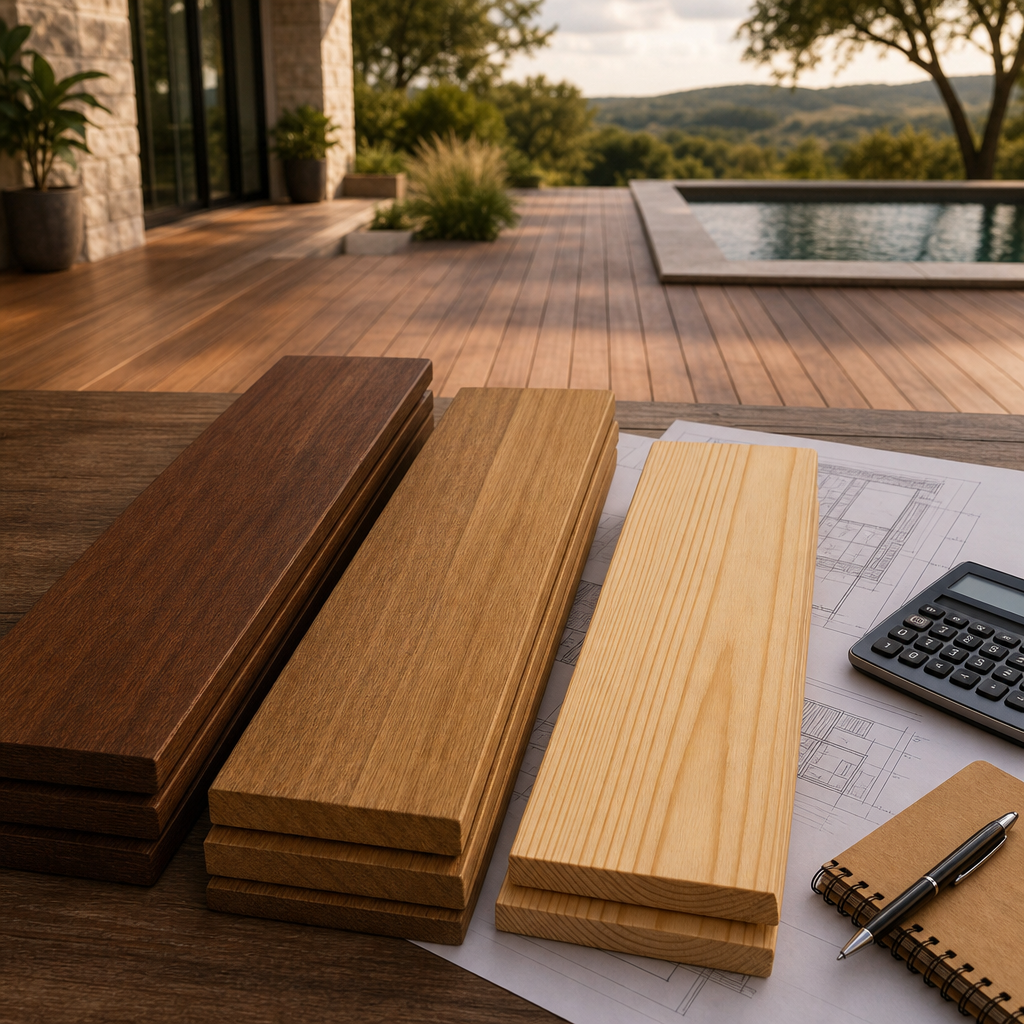
Performance Comparison: Longevity, Maintenance, and Aesthetic Evolution
IPE delivers straight-line durability. It ages beautifully and requires virtually no intervention beyond occasional cleaning. A 20-year-old IPE deck looks intentional and mature. You’re not maintaining it; you’re simply letting it live.
Garapa ages similarly to IPE but slightly faster in the weathering process. At year five, the color difference between new and established Garapa becomes more visible than comparable IPE aging. That’s not deterioration. It’s the material’s character developing more quickly. Some architects love this accelerated patina. Others specify IPE specifically to slow the visual change.
Douglas Fir demands active partnership. It checks in response to UV exposure and humidity swings. Splinters emerge, particularly on bearing surfaces and edges. But here’s what often surprises architects: a properly maintained Douglas Fir deck maintains its warmth and visual appeal longer than unmaintained IPE. The material rewards attention.
The practical timeline works like this: IPE performs reliably for 25-30 years with minimal care. Garapa delivers 15-20 years with basic seasonal maintenance. Douglas Fir offers 12-15 years with consistent attention, or 8-10 years if neglected.
Fire Rating and Sustainability: Meeting Modern Code Requirements
Texas code, particularly in wildland-urban interface zones across the Hill Country and Austin suburbs, increasingly demands Class A fire-rated decking. This is non-negotiable for Horseshoe Bay, Dripping Springs, and similar areas where WUI regulations apply.
We supply Class A fire-rated wood products for decking, and this matters: not all tropical hardwoods or softwoods inherently meet these ratings. Our thermally modified wood products, including thermally modified ash and pine, deliver Class A fire ratings while maintaining the authentic wood aesthetic that hardwood-focused design demands.
Standard IPE and Garapa require chemical treatment or alternative specification to meet WUI Class A standards in fire-prone zones. Thermally modified alternatives perform equivalently while simplifying compliance. For architects designing in regulated areas, this becomes a specification anchor point.
Sustainability similarly differentiates materials. We source FSC-certified tropical hardwoods, confirming responsible forest management. Domestic softwoods like Douglas Fir arrive from North American forests with established stewardship standards. Thermally modified species represent a resourceful approach to extending lifespan, reducing replacement frequency and embedded environmental cost.
Our Recommendation: Why IPE Stands Apart for Signature Projects
When we work with Texas architects on distinctive homes that demand material integrity and visual presence, IPE emerges as the definitive choice for primary deck surfaces.
Here’s why: IPE doesn’t ask you to choose between durability and beauty. It delivers both uncompromised. A contemporary home with refined glass and concrete benefits from IPE’s visual weight and authentic performance. Clients feel that material quality beneath their feet and see it aging with intention. That’s worth the investment for work that will define a practice or a client’s home for decades.
The hidden fastener requirement, which initially feels like complication, actually signals the material’s density and quality. We’ve worked through hundreds of IPE installations, and that complexity becomes invisible once properly specified and executed. It’s not a drawback. It’s the material telling you it’s worth the care.
For the majority of residential projects where budget requires realism, Garapa delivers the next-best choice. It performs substantially better than softwoods at a cost premium that justifies itself through extended lifespan and reduced maintenance burden.
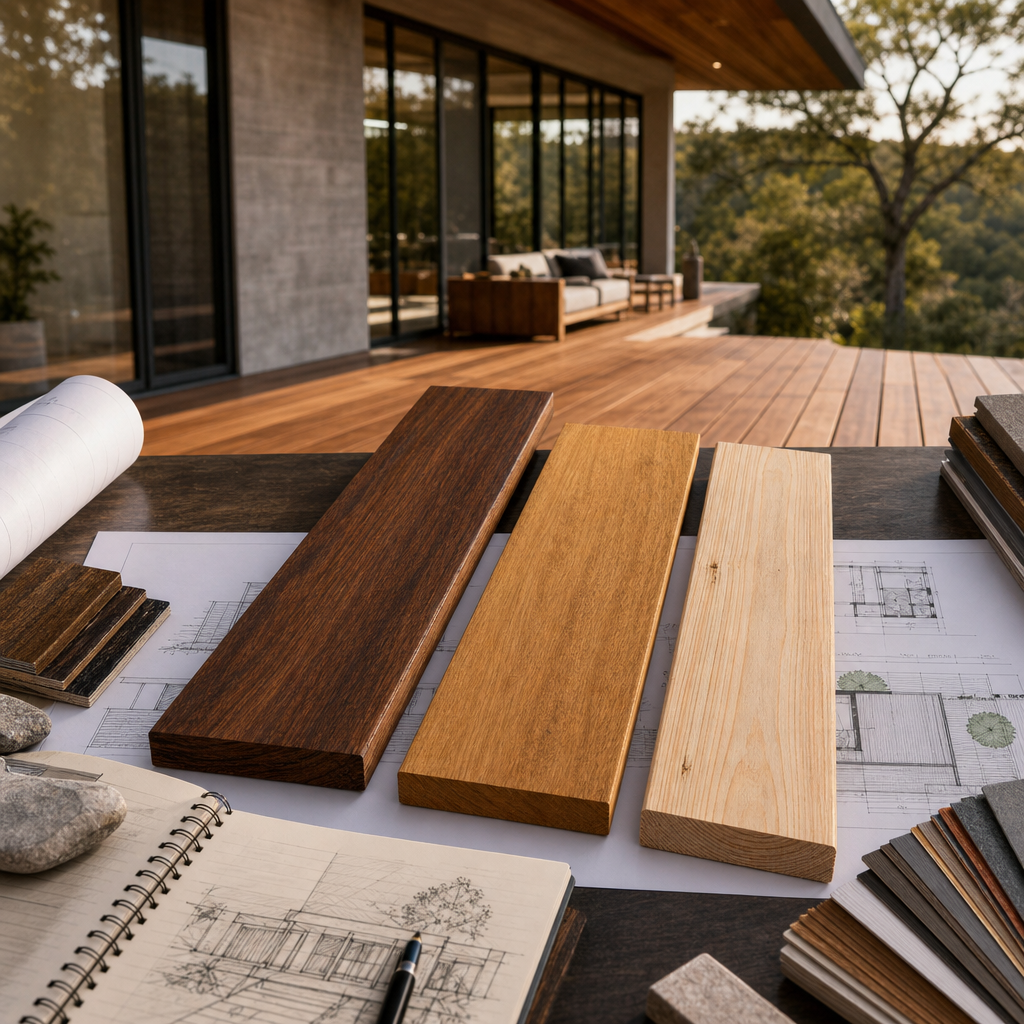
We don’t recommend Douglas Fir for architects unless clients genuinely commit to active maintenance or the project timeline is short enough that initial cost dominates lifecycle thinking. Specify it honestly: it’s beautiful, it’s legitimate, and it requires stewardship.
Selecting Your Material: The Decision Framework for Distinctive Homes
Start with the architecture. What visual statement does the deck need to make? Is it a grounding element that anchors contemporary glass and concrete, or is it a secondary surface that serves livability without claiming attention?
Next, assess the site. A Lake Travis home exposed to relentless sun and humidity benefits from IPE’s indifference to those conditions. An interior courtyard in Tarrytown with filtered light and protected exposure might support Douglas Fir with confidence.
Then, have the maintenance conversation with your client explicitly. Don’t assume they’ll accept responsibility. Some clients want their home to live without intervention. Others embrace seasonal care as part of ownership. The material choice should align with that reality.
Finally, consider the project’s timeline and future. Is this a forever home or a stepping stone? Do you anticipate major renovations within 15 years that would discard the decking anyway? That context shapes whether you invest in 25-year durability or choose material that serves 12 years beautifully.
We work with architects from design phase through specification and sourcing. We stock all three materials (along with Ipe, Cumaru, Massaranduba, and Tigerwood alternatives) and understand installation details that influence performance. Bring your specifications to us early. We’ll confirm material availability, discuss installation approaches that optimize each wood’s potential, and deliver products that arrive job-site ready.
The right decking material isn’t abstract. It’s the material your clients will touch daily, the surface where warm wood and bright Texas light create those moments that justify architecture’s ambition. Choose with intention, and IPE stands as the material that won’t disappoint you or them.
To place orders, order samples, or talk with a live person.
Frequently Asked Questions (FAQ)
What’s the real cost difference between IPE, Garapa, and Douglas Fir for a typical 500 sq ft deck?
We typically see IPE priced around $8-12 per linear foot installed, making it our premium option, while Garapa runs $6-9 per linear foot as a solid middle ground. Vertical grain Douglas Fir comes in at $4-7 per linear foot, though you’ll factor in more frequent maintenance costs over time compared to tropical hardwoods. The choice depends on whether your project prioritizes longevity and minimal upkeep or initial budget constraints.
How do we ensure the hardwoods we supply meet both fire ratings and sustainability standards?
We source FSC-certified tropical hardwoods and carry WUI Class A fire-rated products specifically engineered for high-risk Texas zones, so your designs comply with current code requirements without compromising material integrity. Our inventory includes documentation for every product line, and we work directly with architects to confirm specifications before projects move forward.
Does vertical grain Douglas Fir hold up well in Texas heat and humidity compared to tropical hardwoods?
Douglas Fir performs respectably in Texas climates, but tropical hardwoods like IPE and Garapa have inherent density that resists movement and decay far better in our humidity and temperature swings. We recommend Douglas Fir when budget drives the decision or when the aesthetic of a softer wood grain aligns with your design vision, understanding that maintenance cycles will be more frequent than with hardwood alternatives.


