

1. Understanding WUI Class A Fire Ratings and Why They Matter for Texas Projects
Fire safety in Texas wildland-urban interface (WUI) zones isn’t optional—it’s a regulatory requirement that shapes material selection from the foundation up. We work with architects across the state who understand that fire-rated wood products don’t mean compromising on the warm, natural aesthetics that define contemporary design. The challenge is finding materials that pass strict Class A fire ratings while delivering the visual warmth and craftsmanship that sets a project apart.
This guide walks through the seven best WUI Class A wood products we supply and recommend for Texas projects, breaking down performance characteristics, cost implications, and practical application scenarios.
Class A fire ratings measure how a material resists flame spread and smoke development under standardized ASTM E84 testing. A material earns Class A status by scoring 0-25 on the flame spread index and producing smoke development of 450 or less. For WUI zones in Texas—including areas around Austin, San Antonio, Dallas, and the Hill Country—Class A materials are often mandatory for exterior siding, decking, cladding, and roofing components.
Why this matters for your projects: Building codes in WUI zones have tightened significantly. Many jurisdictions now require Class A materials for any structure within designated fire hazard areas. Using non-compliant materials can trigger project delays, code violations, or even denial of permits. We see this regularly with architects who specify beautiful wood products only to discover mid-project that local authorities require fire-rated alternatives.
The good news is that Class A wood products have evolved. You’re no longer choosing between safety and design. Modern fire-rated options—whether naturally fire-resistant woods or thermally modified products—can deliver the expressive wood character that defines contemporary Texas architecture.
Your first action: Review your local jurisdiction’s specific WUI requirements. Austin, Dallas-Fort Worth, San Antonio, and Hill Country municipalities each have different mandates. We can help cross-reference your project location with applicable codes.
2. Clear Grain Western Red Cedar: The Premium Fire-Rated Solution We Recommend
Clear Grain Western Red Cedar stands as our top recommendation for architects who prioritize both fire performance and visual distinction. This material achieves Class A ratings through a proprietary fire-retardant treatment process that doesn’t compromise the warm honey and russet tones that make cedar so compelling in contemporary design.
What makes cedar our preferred choice: The grain pattern is crisp and expressive without competing with architectural lines. Unlike some treated products that develop a greenish cast or patina unpredictably, Clear Grain Cedar maintains color stability for years. The vertical grain orientation creates subtle texture that photographs beautifully and ages gracefully when exposed to Texas sun and weather.
We stock both siding and cladding profiles in Clear Grain Western Red Cedar, as well as decking and soffit materials. A residential project in the Hill Country we supplied last year used 8-inch vertical grain cedar siding with a natural clear finish—the result was a warm, modern envelope that satisfied both the architect’s aesthetic vision and the fire marshal’s requirements.
Performance reality: Clear Grain Cedar delivers solid durability, but it requires thoughtful maintenance. In high-UV zones like Austin and the Hill Country, plan for refinishing every 3-5 years if you want to maintain the original color. If a weathered, silver-gray patina appeals to your design, the material virtually maintains itself.
Pricing consideration: Premium quality comes with premium cost. Clear Grain Cedar typically runs 25-35% higher than commodity-grade treated wood. For projects where budget allows and the design emphasizes natural material expressiveness, this investment justifies itself through longevity and aesthetic performance.
Next step: Request samples of our Clear Grain Western Red Cedar siding and cladding. See how the grain and color respond to natural light in your site conditions.
3. Douglas Fir and Hemlock: Cost-Effective Class A Options That Don’t Compromise
Not every project has unlimited budget, and we don’t believe cost constraints should force you toward inferior materials. Douglas Fir and Hemlock—both available in vertical grain profiles—achieve Class A ratings through fire-retardant treatment and offer genuine performance and beauty at a fraction of premium cedar pricing.
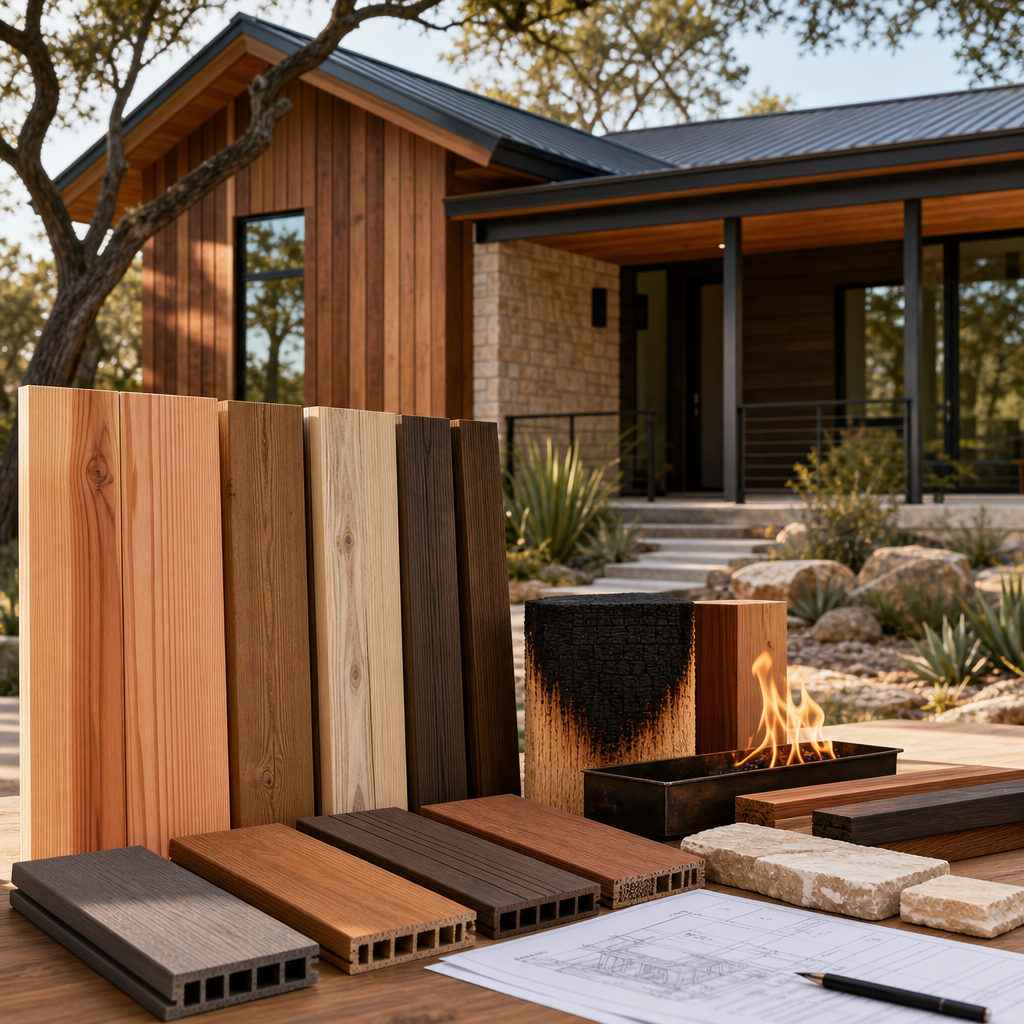
Douglas Fir delivers a tight, uniform grain that works exceptionally well in modern contemporary applications. The warm tan color reads as approachable rather than rustic, which aligns well with the light-filled, minimalist aesthetic favored by Lake|Flato-inspired architecture. Hemlock offers similar visual characteristics with slightly finer grain definition.
The practical advantage: These materials are available in longer lengths and broader widths than some premium options, which matters for siding and cladding applications where you want minimal joints. We regularly specify 10-inch and 12-inch vertical grain profiles that create clean, uninterrupted wall planes.
Real-world scenario: A commercial mixed-use project in downtown Austin used vertical grain Douglas Fir siding with a semi-transparent stain. The material achieved the required Class A rating, stayed within budget, and created warm wood character that complemented the building’s steel and glass components. Total cost savings versus Clear Grain Cedar exceeded $50,000 without visual compromise.
Durability profile: Both Douglas Fir and Hemlock are softer than cedar, making them more susceptible to mechanical damage in high-traffic areas like lower wall siding or ground-level decking. For upper-story cladding and protected applications, this limitation is irrelevant. For decking or areas exposed to physical wear, consider the tropical hardwood or composite alternatives discussed below.
One thing to know: Fire-retardant treatment does affect machining characteristics. Profiles are slightly rougher post-treatment. This isn’t a defect—it’s just the nature of the process. Many architects actually prefer the subtle texture for its visual interest.
Recommended action: Compare pricing on 8-inch and 10-inch vertical grain Douglas Fir and Hemlock for your project’s siding applications. The cost difference between these and Clear Grain Cedar often justifies the specification even when budget isn’t the primary constraint.
4. Thermally Modified Wood Products: Engineered Performance for Fire-Resistant Design
Thermally modified wood represents a different approach to fire resistance. Rather than applying chemical treatments, thermal modification uses controlled heat and steam to alter the wood’s cellular structure, improving fire resistance alongside dimensional stability and rot resistance.
We stock thermally modified Ash, Pine, Poplar, and Ayous, all of which achieve or exceed Class A ratings depending on application thickness and configuration. The distinction matters: thermally modified products don’t rely on surface treatments that can wear or diminish over time. The fire resistance is engineered into the material itself.
Why architects choose this approach: Thermal modification produces stable color, excellent dimensional stability (critical for decking applications where cupping and warping create safety hazards), and inherent durability without maintenance-intensive refinishing schedules. A Lake Travis waterfront project we supplied used thermally modified Ash decking—five years later, the material has aged to a sophisticated silver-gray without cupping, warping, or color inconsistency.
Thermally modified wood siding also delivers distinctive character. Thermally modified Poplar develops warm, uniform color that reads as contemporary rather than traditional. Thermally modified Ash offers tighter grain definition suitable for modern applications.
The practical consideration: Thermal modification costs more upfront than fire-retardant-treated softwoods but typically costs less than premium Clear Grain Cedar. When you factor in the 15-20 year lifespan without refinishing versus cedar’s 3-5 year refinishing cycle, the lifecycle cost becomes competitive or favorable.
Application strategy: We recommend thermally modified products most strongly for high-performance applications—decking, lower-wall siding in exposed locations, and applications where stability and low maintenance align with project priorities. For upper-wall cladding where visual expressiveness is the priority, traditional fire-rated softwoods often deliver better value.
What to do next: Request samples of thermally modified Ash and Poplar siding. Evaluate color stability and grain character against your design direction.
5. Ipe and Tropical Hardwoods: Combining Fire Resistance with Durability
Ipe, Cumaru, Garapa, Massaranduba, and Tigerwood occupy a specialized category: naturally fire-resistant tropical hardwoods that exceed Class A ratings without any chemical treatment. These materials are genuinely dense, genuinely durable, and genuinely beautiful—with costs and working characteristics to match.
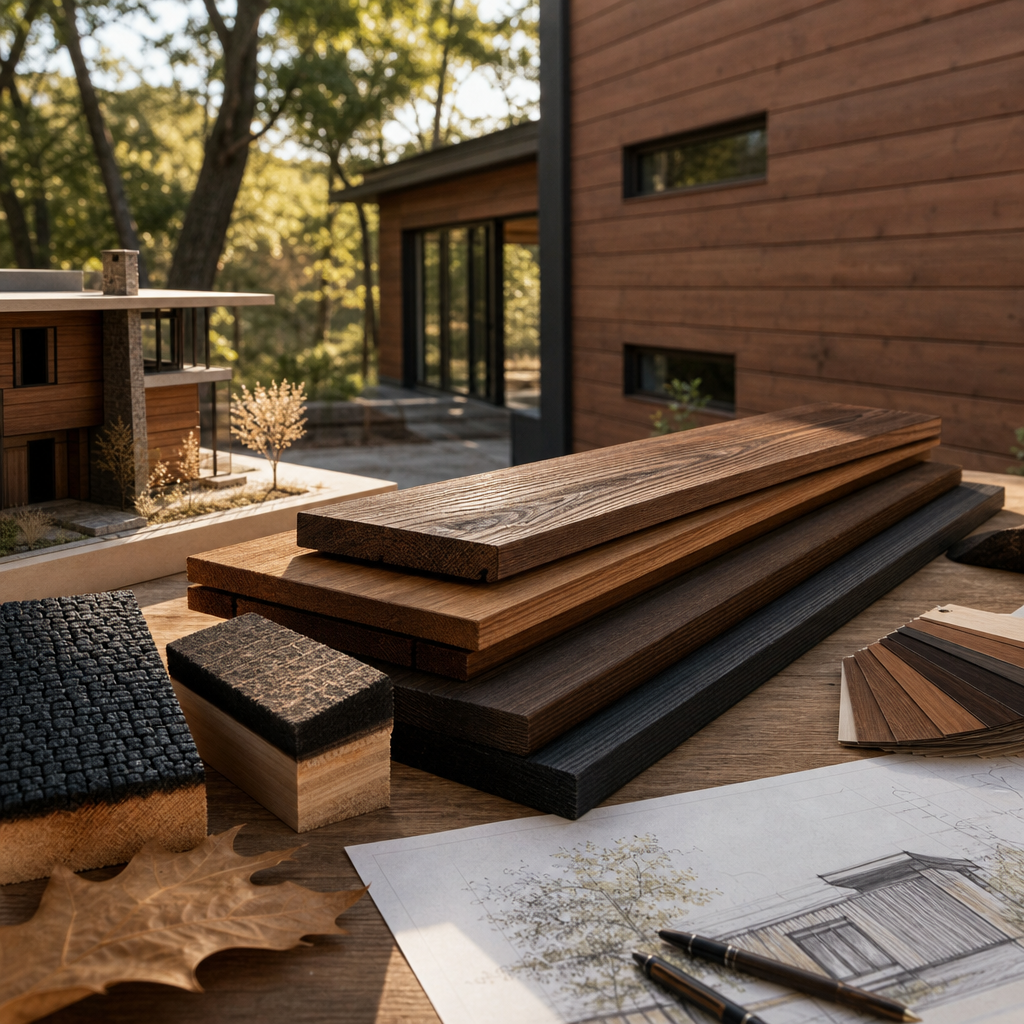
Why specify tropical hardwoods: They’re essentially immune to rot, decay, and insect damage. In wet environments like the Hill Country and around Lake Austin and Lake Travis, where humidity and moisture exposure challenge most wood products, tropical hardwoods simply don’t fail. A custom home deck built in 2012 with Ipe we supplied continues to perform flawlessly with zero maintenance beyond occasional cleaning.
Visual distinction: Ipe develops rich amber and chocolate tones with age. Cumaru and Garapa offer golden-orange character that intensifies with UV exposure. Tigerwood delivers bold striping that creates striking visual impact. For architects who want wood to be a visual anchor rather than a neutral backdrop, tropical hardwoods deliver presence.
The trade-offs: These materials are expensive—typically 2-3x the cost of treated softwoods. They’re also hard enough that standard fastening requires pre-drilling, adding labor cost. Ipe specifically is so dense that conventional saw blades dull quickly, requiring carbide tooling. On large projects, installation labor can rival material cost.
Real application: A luxury residential project in Rollingwood specified Ipe decking and Tigerwood cladding accents. The material costs were substantial, but the dramatic visual impact and zero-maintenance durability aligned with the homeowner’s priorities and the architect’s vision for a statement-making contemporary home.
Best practices: Reserve tropical hardwoods for high-visibility applications where durability and visual impact justify the investment. Use them selectively—as primary decking, accent cladding, or feature walls—rather than across entire exteriors.
Your next step: Assess where tropical hardwoods align with your design vision and budget parameters. We can help you specify them strategically across a project.
6. Composite Alternatives: When to Consider TimberTech and Trex for WUI Compliance
We’re lumber brokers and wood manufacturers, not composite promoters, but professional integrity requires honest assessment: composites like TimberTech and Trex offer genuine advantages in specific WUI scenarios, particularly for decking applications in high-moisture or high-maintenance-aversion contexts.
TimberTech and Trex both achieve Class A ratings and require zero refinishing. For homeowners in WUI zones who prioritize maintenance-free living over authentic wood character, composites deliver that promise reliably. The material won’t rot, won’t splinter, and won’t require restaining every 3-5 years.
Where composites make sense: Ground-level decking exposed to constant moisture, HOA-governed communities with strict maintenance restrictions, and projects where homeowner preference explicitly favors low maintenance over natural material aesthetic.
Where they don’t: Composites cannot match the warmth, grain character, and organic aging quality that defines contemporary architectural design. They photograph differently. They feel different underfoot. For architects and clients who specify wood because they want wood—not as a convenient substitute—composites underdeliver on the experience.
The honest assessment: If your design concept centers on expressive natural materials and the boundary-blurring between interior and exterior that warm wood provides, composites fundamentally compromise the vision. This is exactly why our tropical hardwoods and thermally modified products exist—to deliver authentic wood performance without the maintenance burden that sometimes drives clients toward composites.
Application guidance: Use composites for supplementary applications (fastening systems, drainage components, temporary site elements) where wood character is irrelevant. Specify authentic fire-rated wood products for elements that define the visual and experiential character of the project.
7. Navigating Texas Permitting Requirements for Class A Fire-Rated Wood Products
Permitting complexity varies significantly across Texas jurisdictions. Austin applies WUI standards that differ from San Antonio, which differ from Dallas-Fort Worth and the smaller Hill Country municipalities. We navigate these variations regularly, and we’ve learned that early coordination prevents costly mid-project surprises.
How to approach permitting: Start by identifying your jurisdiction’s specific WUI designation and requirements. Not all areas within fire-prone regions require Class A materials everywhere—designations often focus on zones within one or two miles of wildland areas. Your exact site location determines which materials qualify.
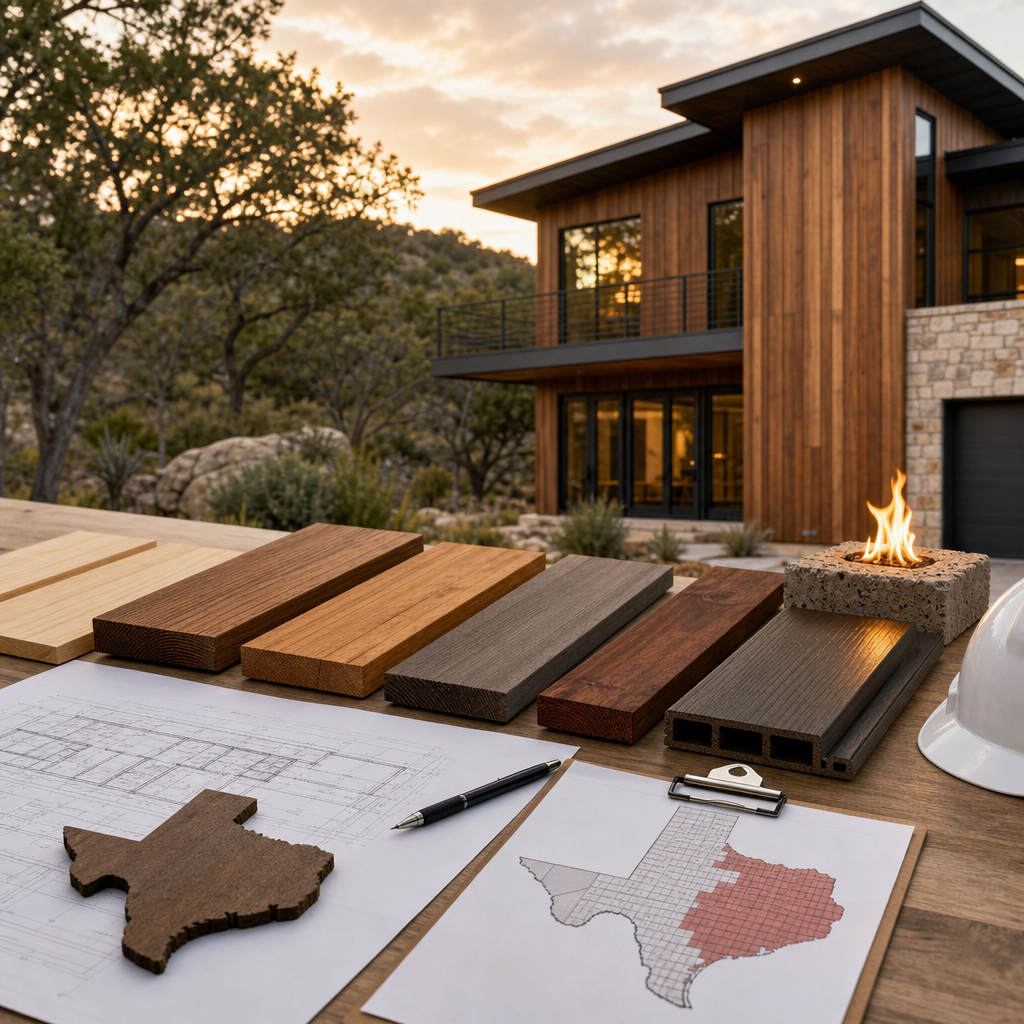
Documentation requirements: Most jurisdictions require third-party ASTM E84 test reports for all fire-rated wood products. We maintain complete test documentation for every product we supply, and we provide these reports with material specifications. When you submit permits, include these reports alongside material warranties and application details.
Common challenges: We’ve seen permit denials stem from mismatched product specifications, unclear application descriptions, or using generic “fire-treated wood” terminology without specifying the actual product and treatment system. The solution is straightforward: be specific. Name the product, provide the test report, clearly describe where it’s applied.
Coordination strategy: Before finalizing material specifications, schedule a brief consultation with your local building official. A 15-minute conversation often clarifies what documentation and performance levels they actually require. We frequently join these calls to provide technical details and historical precedent from previous approved projects.
Your action plan: Confirm your project’s WUI status with your local jurisdiction, document the specific requirements, and have us verify that your specified materials and application meet those requirements before permit submission. This front-end investment typically saves weeks in permitting timelines and eliminates revision cycles.
—
We’ve supplied WUI Class A materials for hundreds of projects across Texas, and we’ve learned that material selection is fundamentally about matching performance requirements with design vision and budget reality. Clear Grain Western Red Cedar delivers premium aesthetics and reliable performance when budget allows. Douglas Fir and Hemlock provide genuine beauty and durability at accessible pricing. Thermally modified products offer engineered stability and low maintenance. Tropical hardwoods combine fire resistance with unmatched durability and visual impact.
The key is starting with honest assessment of your priorities. What does the design require? What does the client value? What does the site demand? Once you’ve answered those questions, we can specify the exact product that delivers on all fronts.
Contact us to discuss your specific project requirements and fire-rated material options. We’ll help you navigate permitting, source materials efficiently, and ensure your design vision becomes reality—safely, beautifully, and with full regulatory compliance.
To place orders, order samples, or talk with a live person.
Frequently Asked Questions (FAQ)
What makes a wood product WUI Class A fire-rated, and why do Texas architects need to know this?
WUI stands for Wildland-Urban Interface, and Class A is the highest fire-rating classification for building materials. We work with products that meet these standards because they’re essential for properties in high-risk fire zones throughout Texas, from the Hill Country to areas around Austin and beyond. When you specify Class A materials with us, you’re ensuring your designs meet local fire codes and protect both the structure and its occupants from wildfire exposure.
Which wood products do we stock that are WUI Class A approved without sacrificing the aesthetic your designs demand?
We supply Clear and Vertical Grain Western Red Cedar, Douglas Fir, Hemlock, and Cypress in fire-rated grades that maintain the natural wood character architects like Lake|Flato prioritize. We also stock thermally modified wood options like Thermally Modified Ash and Pine, plus premium hardwoods like Ipe that deliver both fire resistance and exceptional durability. These materials let you achieve warm, expressive wood interiors and exteriors while meeting all WUI compliance requirements.
How do we help you navigate Texas permitting with Class A fire-rated materials?
We understand the documentation and approval requirements across Texas jurisdictions, and we provide the specifications and certifications your projects need for permit review. Our team works directly with architects and builders to ensure material selections align with local fire codes in specific areas like Austin, Dallas, Houston, and surrounding regions, eliminating delays and design conflicts during the permitting process.


