

The Cantilever Challenge in Modern Texas Architecture
The dramatic cantilever has become a signature element in contemporary Texas architecture. Firms like Lake|Flato and Page have mastered the art of extending living spaces far beyond the building envelope, creating those signature light-filled interior-outdoor transitions that define modern Hill Country and Hill Austin homes. But executing these design visions requires timber that delivers both structural performance and aesthetic presence.
A 15-foot cantilever deck hanging off the side of a limestone cliff. A 12-foot soffit projecting deep shadows across a glass-heavy facade. Interior timber beams spanning across open floor plans without intermediate support. These aren’t theoretical exercises. We see these specifications regularly on projects across Austin, Dallas, San Antonio, and beyond, and the timber you choose determines whether the design succeeds or gets compromised.
The challenge isn’t simply finding wood that won’t deflect under load. It’s finding timber that handles long-span demands while maintaining the warm, expressive wood character that draws architects to natural materials in the first place. The wrong timber choice leads to visible sag, movement, and a visual disappointment that no finishing detail can fix.
Why Standard Lumber Falls Short for Long-Span Applications
Standard dimensional lumber from commodity suppliers isn’t engineered for cantilever loads. A typical 2×12 or even a 2×14 beam will deflect visibly under extended cantilever conditions, and that movement compounds over seasonal cycles as moisture content fluctuates.
Here’s the real problem: cantilevers amplify stress. A 10-foot beam over a simple span bears load evenly. A 10-foot cantilever concentrates stress at the connection point, creating maximum bending moment at the critical junction where wood is already under the most mechanical strain. Undersized or lower-grade timber will move, crack at the connection, and settle in ways that become visible within the first year.
Many architects and builders default to engineered solutions like steel or laminated veneer lumber (LVL) because they assume solid wood can’t perform. That assumption costs design integrity. The moment you shift to steel or synthetic beams, you’ve abandoned the warm wood aesthetic that justified the cantilever in the first place.
We work with architects who refuse that compromise. They specify solid timber timbers in larger dimensions and premium grades that deliver structural performance without sacrificing material expression.
Our Premium Timber Options for Extended Cantilevers
We supply heavy timber in grades and dimensions specifically suited for cantilever applications. Our inventory includes dense softwoods and hardwoods with the strength-to-weight ratios and dimensional stability needed for long-span work.
Our approach focuses on three key characteristics:
- Modulus of Elasticity (stiffness): Controls deflection over span. Higher is better for cantilevers.
- Bending Strength (Fb): Determines maximum safe load. Premium grades carry higher ratings.
- Stability: Moisture movement in exposed cantilevers creates visible checking and cupping. We prioritize species and treatments that minimize this.
For most Texas projects, we recommend starting with Douglas Fir for strength, Western Red Cedar for combined performance and beauty, or tropical hardwoods when maximum durability matters. Thermally modified options add fire rating and enhanced stability when local codes or design intent requires it.
Douglas Fir Timbers: Strength and Span Capability
Douglas Fir is the workhorse for structural applications across the Pacific Northwest and beyond, and it performs exceptionally well in cantilever design. The wood carries a bending strength (Fb) rating of 1,350 PSI in Select Structural grade, with a modulus of elasticity (E) of 1.9 million PSI. For a 15-foot cantilever carrying distributed deck load, these numbers support beams in the 10×14 or 12×14 range depending on load specifics.
The wood’s tight grain structure resists deflection better than many softwoods. A 12×14 Douglas Fir timber will visibly outperform an equivalent-sized hemlock or yellow pine under identical loading conditions.
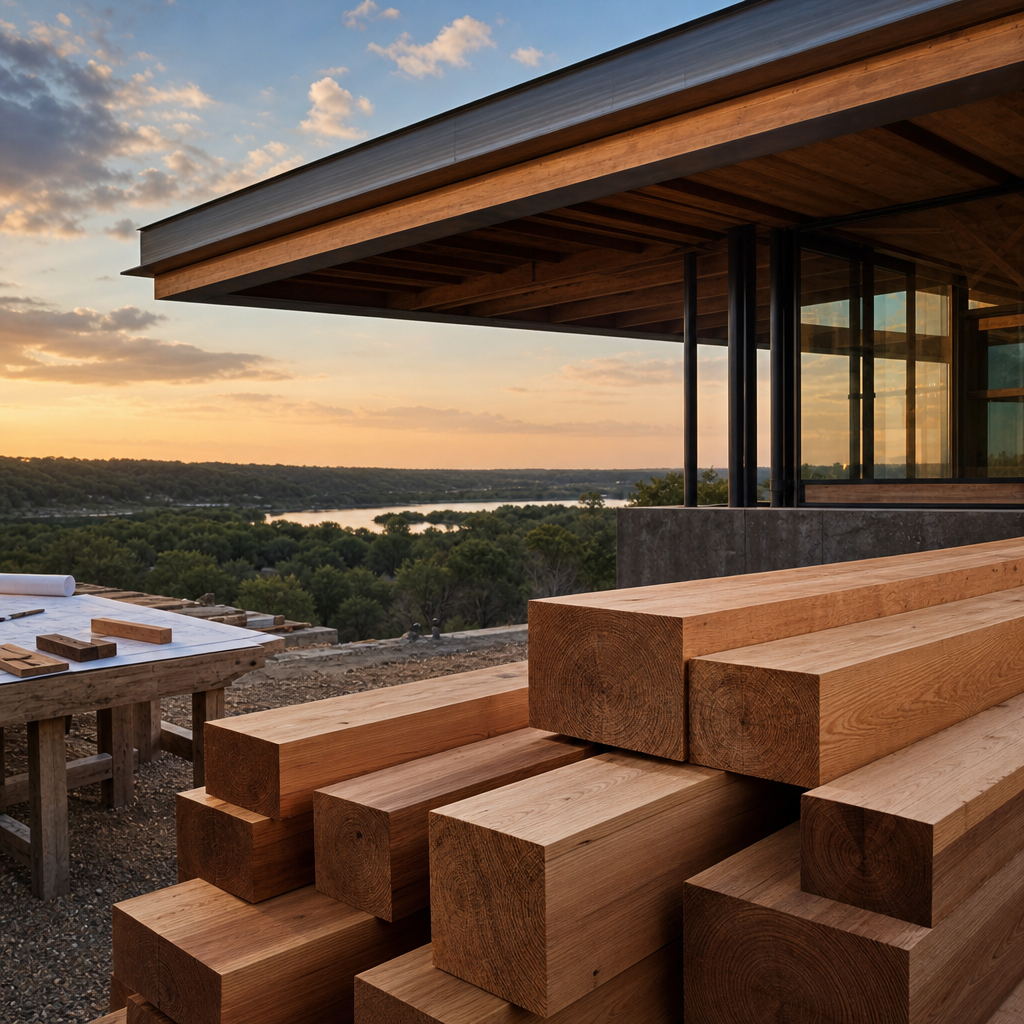
The trade-off is appearance. Douglas Fir shows significant grain variation and color range (cream to reddish-brown), which works beautifully in some architectural expressions but conflicts with designs calling for uniform, warm tonality.
Next step: Have your structural engineer run a load calculation specific to your cantilever span and load case. Bring those numbers to us with photos of the design intent, and we’ll specify the exact grade and dimension you need.
Western Red Cedar Timbers: Beauty Meets Structural Performance
Western Red Cedar delivers a compelling middle ground that explains why it dominates in high-end residential cantilever work across Texas. The wood carries an Fb rating of 1,000-1,100 PSI in higher grades (Select Structural or Premium), with an E rating around 1.6 million PSI.
Those numbers appear lower than Douglas Fir on paper, but Cedar’s advantage lies in dimensional stability and aesthetic consistency. The warm, uniform reddish-brown tone reads as intentional and premium. The wood moves less with seasonal moisture swings, reducing checking and cupping risk on exposed cantilevers. A 12×14 or 14×16 Clear Grain Western Red Cedar timber can reliably handle 12 to 18-foot cantilevers in typical residential applications.
Cedar also machines cleanly, allowing for custom detailing (tapered ends, subtle chamfers, custom profiles) that enhance visual presence without compromising structural performance.
We stock Vertical Grain Western Red Cedar in architectural grades specifically selected for cantilever work. The vertical grain orientation provides additional stiffness and reduces seasonal movement compared to flat-sawn material.
Hemlock and Yellow Pine: Cost-Effective Long-Span Solutions
When budget constraints are real but performance requirements remain demanding, Hemlock and Southern Yellow Pine offer legitimate structural capability at a significant cost advantage over Cedar or Douglas Fir.
Hemlock carries an Fb rating of 1,100-1,200 PSI in Select Structural grade, with dimensional stability characteristics better than many assume. The wood accepts stain and finish well, and when detailed cleanly, can read as premium despite the lower price point.
Southern Yellow Pine (SYP) is denser and stiffer than Hemlock, with Fb ratings reaching 1,400 PSI in dense Select grade. For pure structural performance per dollar, SYP is difficult to beat. The wood’s natural golden-amber tone weathers to an attractive silver-gray on exterior cantilevers, which aligns well with contemporary architectural aesthetics.
The trade-off: both species show more pronounced grain variation and color movement than Cedar, and both require more careful maintenance to prevent checking on fully exposed applications.
Use Hemlock when the cantilever is partially shaded or interior-facing. Use Southern Yellow Pine when design intent embraces the wood’s natural character evolution and when the cantilever will weather naturally as part of the aesthetic expression.
Tropical Hardwoods: Maximum Durability for Exposed Cantilevers
When your cantilever experiences full sun exposure on all sides with minimal shelter, tropical hardwoods become the right choice regardless of cost. We supply Ipe, Cumaru, Garapa, Massaranduba, and Tigerwood in dimensions suitable for cantilever beams.
Ipe is the gold standard. At 3,680 PSI bending strength, Ipe outperforms softwood species by a factor of 2.5 or more. The wood’s dimensional stability is exceptional, with moisture movement rates one-third that of softwoods. On a fully exposed 15-foot cantilever in full sun, Ipe will not check, cup, or move perceptibly over decades.
The downside is cost and workability. Ipe runs $8-12 per board foot (compared to $2-4 for Cedar), and it requires specialized tooling and patience to machine cleanly. But on signature projects where the cantilever becomes the visual anchor and long-term performance is non-negotiable, Ipe delivers results that softer species cannot match.
Cumaru and Garapa offer slightly lower density than Ipe with correspondingly lower cost and easier workability, while retaining excellent durability for exterior exposure.
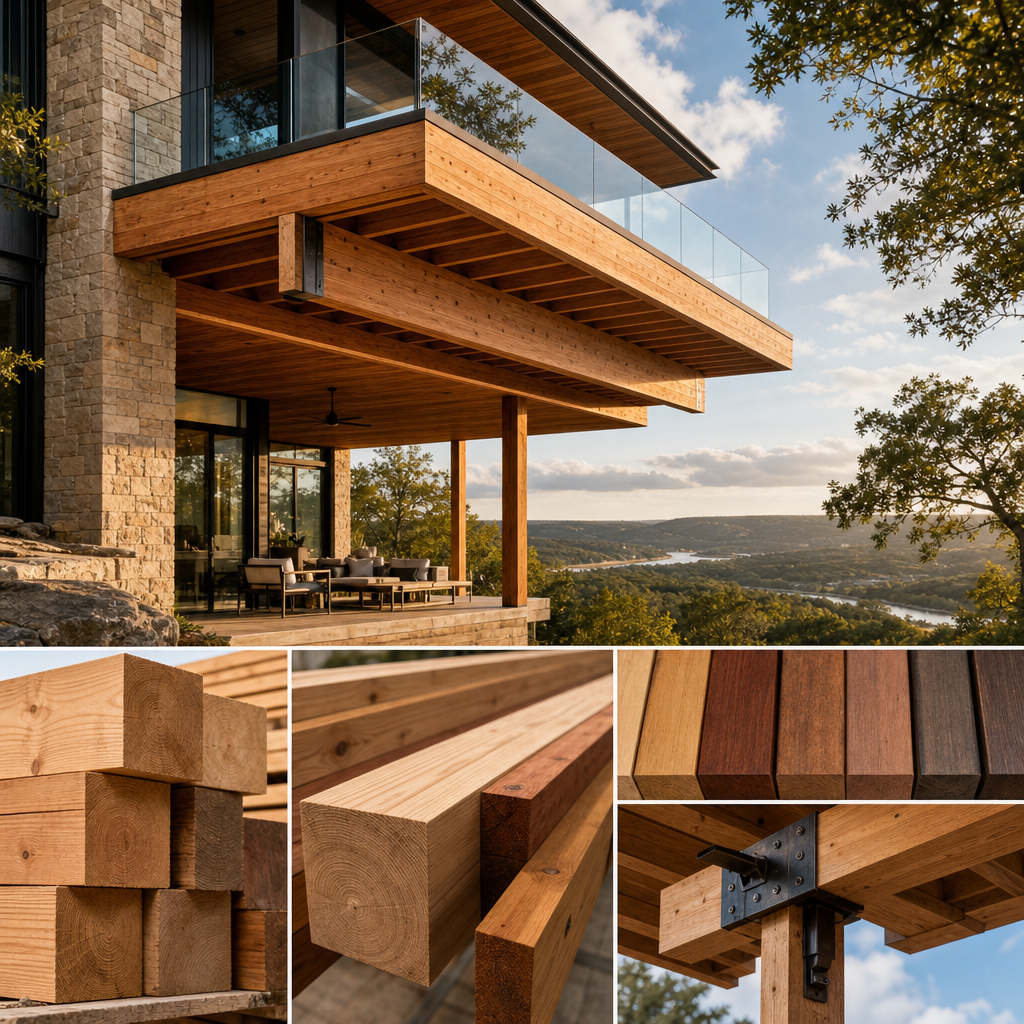
Thermally Modified Timbers: Enhanced Stability and Fire Rating
Thermally Modified Wood for Texas Architects adds another powerful option for cantilever applications, especially in wildland-urban interface (WUI) zones where Class A fire ratings are required or expected.
Thermal modification (heat treatment without chemicals) fundamentally improves dimensional stability while also boosting durability characteristics. Thermally modified Pine, Ash, and Poplar show moisture movement rates comparable to tropical hardwoods, eliminating the checking and cupping risk that can plague standard softwoods on exposed cantilevers.
We carry Tantimber Thermowood in larger dimensions suitable for cantilever work. The process darkens the wood to deep warm browns that read as premium, and the material naturally achieves Class A fire ratings without additional treatment, making it ideal for properties in the Hill Country, Dripping Springs, or other fire-prone Texas regions.
For cantilevers in WUI zones, thermally modified timber solves two problems simultaneously: it delivers the dimensional stability and fire rating that code and safety require, while maintaining the warm wood aesthetic that drives cantilever design in the first place.
Load Calculations and Deflection Management
We always recommend that your structural engineer run detailed load calculations before finalizing timber selection. The span length, cantilever depth, load type (point load at deck edge versus distributed deck load), and allowable deflection all influence the final recommendation.
Most building codes allow L/240 deflection for cantilevers (where L is the span length). A 15-foot cantilever would allow 0.75 inches of deflection under design load. That’s an aggressive limit that rules out undersized or lower-grade timber.
A proper load calculation specifies:
- Actual distributed load (psf) or point load (lbs)
- Live load duration (permanent loading gets different adjustment factors than seasonal loading)
- Load combination under design conditions
- Required modulus of elasticity (E) and bending strength (Fb) values
Once you have those numbers, timber selection becomes straightforward. We can cross-reference your requirements against our inventory and recommend the exact species, grade, and dimension that meets the calculation with optimal cost and appearance.
Specifying the Right Grade and Dimension for Your Project
Not all “Select Structural” timber is equivalent across species. Douglas Fir Select Structural carries tighter visual standards and higher strength values than Hemlock Select Structural. Cedar comes in multiple grades (Clear, Select, and Construction grades), each with different knot specifications and appearance standards.
For cantilever applications, we recommend specifying Grade and Species together:
- Douglas Fir Select Structural: Maximum structural performance, tightest visual standards, highest cost within the species.
- Western Red Cedar Vertical Grain, Select or Premium Grade: Balance of structural performance, dimensional stability, and appearance. Most common recommendation for architect-driven Texas projects.
- Southern Yellow Pine Dense Select: Maximum strength per dollar, suitable when design embraces the wood’s natural character.
- Ipe Select Structural: Maximum durability and minimal movement for exposed applications where long-term performance justifies cost.
Dimension matters equally. A 10×14 timber in one species may perform equivalently to a 12×16 in another, depending on E and Fb values. Our team calculates the right dimension for your load case and aesthetic intent.
Why US Lumber Brokers Is Your Texas Timber Partner
We’re not a commodity lumber yard. We stock heavy timber in architectural grades specifically because we work with architects and builders who refuse to compromise on either performance or appearance.
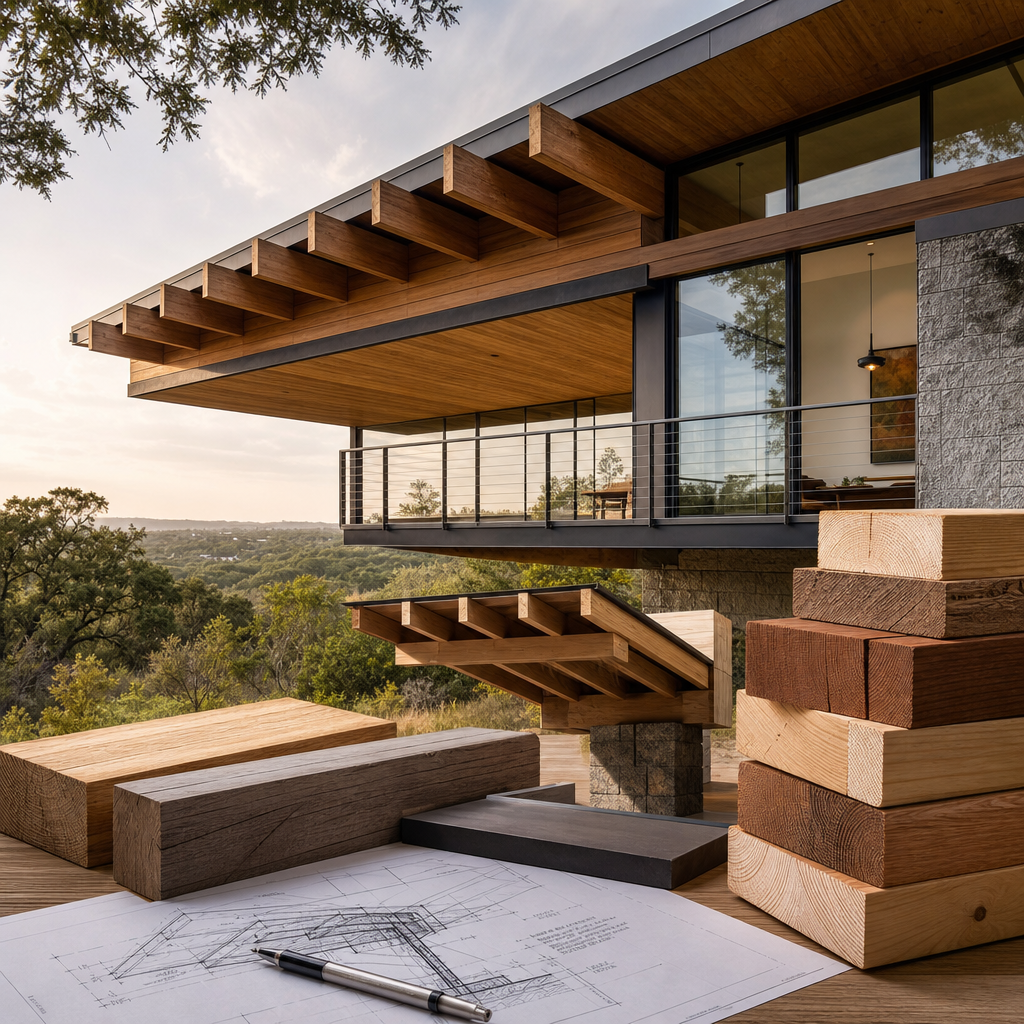
Our Texas inventory includes Clear and Vertical Grain Western Red Cedar, Douglas Fir, Hemlock, and Southern Yellow Pine in the larger dimensions (10x, 12x, 14x, and 16x) that cantilever work demands. We also maintain consistent stock of Ipe, Cumaru, and other tropical hardwoods for durability-critical applications.
We’ve built relationships with structural engineers throughout Texas and understand the specific load cases, code requirements, and design aesthetics that drive cantilever specifications. When you bring a load calculation and design intent to us, we don’t just pull inventory numbers. We consider how the timber will look in the specific architectural context and recommend species and grades that deliver both structural performance and visual integrity.
We’re also WUI Class A fire-rated wood suppliers, and we carry the thermally modified product lines that increasingly specify in fire-prone regions. That expertise matters on projects in the Hill Country, Spicewood, Driftwood, and other Texas locations where building code and fire safety intersect with design intent.
Selection Guide: Choosing Your Ideal Cantilever Timber
Start here: Does the cantilever require fire rating? If yes, specify thermally modified timber or dense tropical hardwoods. If no, proceed.
Will the cantilever be fully exposed to weather (sun, rain, seasonal swings)? Full exposure argues for Ipe or other tropical hardwoods if budget allows, or thermally modified timber if fire rating is also needed. Partial shade or interior-facing cantilevers can use softwoods.
What is your budget range per board foot? Southern Yellow Pine runs $2-3/bf. Hemlock runs $3-4/bf. Western Red Cedar runs $4-6/bf. Douglas Fir runs $3-5/bf. Tropical hardwoods run $8-15/bf. Thermally modified timber runs $5-8/bf. Budget often determines the feasible range.
What is the cantilever span? Longer spans (18+ feet) shift toward Douglas Fir, Ipe, or larger dimensions in lighter species. Moderate spans (12-15 feet) work across most premium softwood species. Short spans (under 12 feet) allow more design flexibility.
What does the architectural expression require? Warm, uniform tonality argues for Cedar or thermally modified timber. Grain character and variation is acceptable argues for Douglas Fir or Yellow Pine. Maximum visual impact argues for Ipe. Weathering character is intentional argues for SYP or Cedar in unstained applications.
We’ve guided architects and builders through this decision framework hundreds of times across Texas. Get your structural load calculation in hand, consider the aesthetic and environmental context of the cantilever, and reach out with those details. We’ll specify the timber that delivers structural integrity and architectural presence together.
To place orders, order samples, or talk with a live person.
Frequently Asked Questions (FAQ)
What timber species do we recommend for long-span cantilevers in Texas architecture?
We typically recommend Douglas Fir for maximum strength and span capability, Western Red Cedar when aesthetics and durability matter equally, and tropical hardwoods like Ipe or Cumaru for exposed applications requiring minimal maintenance. For fire-rated projects, we stock WUI Class A approved options that meet both structural and safety requirements without compromising on appearance.
How do we help architects specify the correct grade and dimension for cantilever beams?
We work directly with you to evaluate your load requirements, span distances, and deflection tolerances before recommending specific grades and dimensions. Our team can guide you through the technical specifications needed for your structural engineer’s calculations, ensuring the timber we supply will perform exactly as your design intends.
Can we source thermally modified timbers for cantilever applications that need enhanced stability?
Yes, we distribute thermally modified options including Thermally Modified Ash and Pine that offer improved dimensional stability and naturally higher fire ratings than standard lumber. These products are particularly valuable when you’re designing for long-term performance in Texas’s variable climate conditions while maintaining the warm, natural wood aesthetic your projects demand.


